Travel Guide to Northern Xinjiang
Discover the Preferences and Travel Tips from Ink Voyages
Table of Contents
In this guide, we will take you to explore the northern lands of Xinjiang. In the vast prairies where the ancient customs of nomadic populations are still preserved, it will be easy to rediscover a deep connection with nature and a lifestyle intimately tied to the rhythm of the seasons.
Visiting these places, you will also discover how diverse China can be and how far removed it is from the traditional images that probably come to mind first when thinking of this country.
Below, we will share with you what makes northern Xinjiang special for us at Ink Voyages, guiding you through the destinations that have impressed us the most.
If you’re interested, in the previous chapter of this guide, we talked about Yunnan—the most multicultural region in China. If you’d like, you can read the article here.
If you also want to discover our practical tips on how to travel in China, you can find our guide here, which will help you have a smooth experience and prepare your trip in the best way.
Introduction to Northern Xinjiang
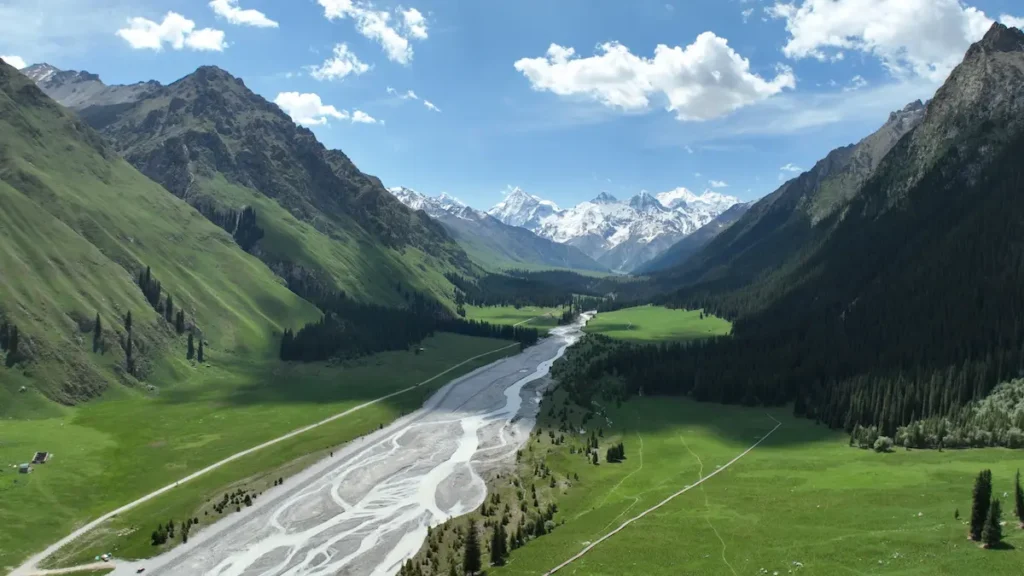
Xinjiang is a surprisingly contrasting and diverse land, both in terms of landscape and culture—and immensely vast. Consider that it alone accounts for 1/6 of the entire China!
While the south will enchant you with its rugged terrain and vast desert expanses, northern Xinjiang is a land where you can explore endless prairies, alpine valleys, and sapphire-colored lakes.
In the north, the predominant ethnic group is Han, especially concentrated in urban centers. However, as you venture deeper into the territory, you will frequently encounter faces and traditions of Kazakh and Mongolian origin, and notice the presence of a nomadic or semi-nomadic lifestyle, best represented by the white yurts that dot the valleys of these remote areas.
We recommend visiting in spring and summer for the blooms and lush nature, in autumn to admire the golden colors igniting the landscape with magical charm. If you’re not overly intimidated by mountain cold, you can also consider traveling in winter to enjoy the enchantment of snow and excellent ski facilities in the area.
A practical note for your trip: the distances in this region are very demanding, in line with the vastness of its territory, so moving from one place to another can require significant driving effort (up to 8 hours). The landscapes you’ll cross are stunning, and if you enjoy on-the-road vacations in areas still unknown to international tourism, Xinjiang could be the ideal destination.
If you want to watch our introductory documentary on Xinjiang, you can click here. For more on-the-road exploration ideas, you can also check out our catalog of trips in China.
Our Favorite Places in Northern Xinjiang
Tianchi Lake
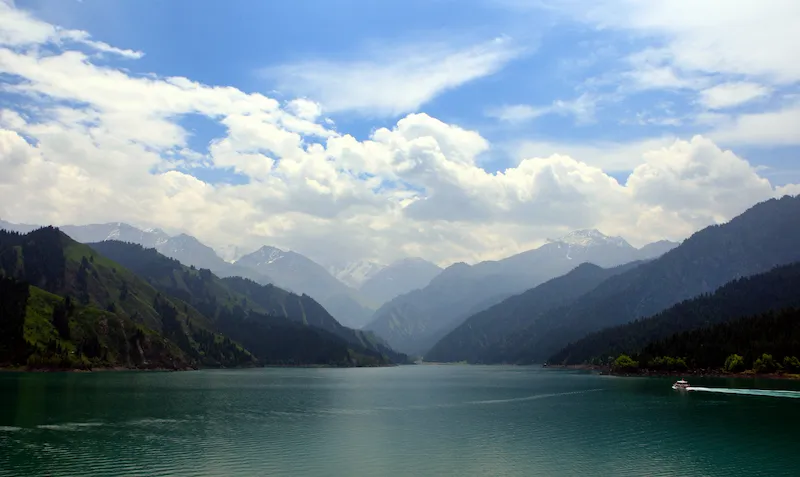
About two hours’ drive from Urumqi—which we’ll cover in the guide dedicated to southern Xinjiang, as the latter is essentially of Uyghur culture—lies Tianchi Lake, which we consider somewhat the gateway to northern Xinjiang, as it will introduce you to the typical alpine beauty of this part of the region.
A note of caution: the lake is beautiful, a sapphire set among the mountains. However, don’t imagine finding yourself in a wild natural setting. On the contrary, consider that the lake is within a protected area created to regulate tourist flows and avoid environmental impacts. When you arrive at the parking lot, you’ll need to leave your car and continue on an eco-friendly bus that will take you to the lake along a panoramic road.
In China, such an approach is truly necessary given the large volumes of people in the territory, which must be managed skillfully. Don’t be surprised if this pattern repeats in other places you visit, and consider that it is the only possible way to preserve the natural environment.
Kanas, Hemu, and Baihaba
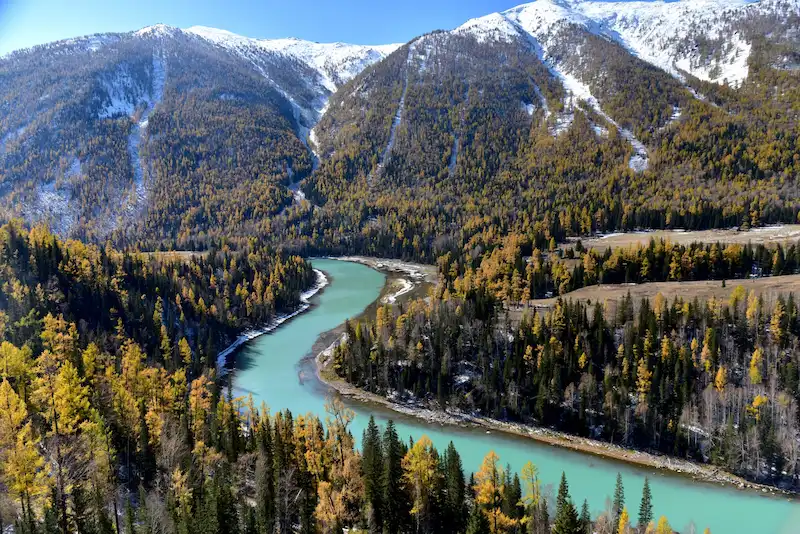
In the Altai Mountains area, reachable directly by flight from Urumqi (Burqin Kanas Airport (KJI))—or by car, passing through Fuyun and planning for two days of driving.
Kanas Lake is set in a stunning alpine natural context; it is one of the most spectacular places in northern Xinjiang and has earned the nickname “photographers’ paradise,” offering numerous panoramic viewpoints for taking spectacular photos.
For overnight stays, there are some accommodations directly within the scenic area, some with truly beautiful lake views, or you can stay in Jiadengyu, from where you can then take a convenient shuttle bus to Kanas.
Caution: this destination is literally stormed in certain periods of the year, including August. From direct experience, let us tell you that if you decide to visit during one of these periods, you need to prepare for an experience that is also anthropological in nature: you will discover what the Chinese mean by the expression rén shān rén hǎi (literally: people like mountains, people like the sea; “a sea of people”)—which must be taken literally when dealing with local tourist flows.
We also point out the opportunity to go rafting in the area, which will give you an adrenaline-filled half-hour on foaming waters. To be precise, the half-hour of rafting—as sold by the park provider—lasts 30 minutes only if you also count the time needed to prepare and return to the base camp with the dedicated shuttle. Let’s say the 30 minutes are a bit relative… It remains, however, a great adventure to include in your park exploration.
Hemu and Baihaba are two villages that are victims of their own fame, where traditions are now inseparably linked to the flourishing tourism developing in the area. After all, it’s understandable that the charm of these destinations attracts more and more domestic tourists, allowing residents of Tuwa ethnicity to integrate tourism revenue into their economy. It must be said that this also allows greater accessibility to village life for visitors, who can stay overnight directly in some local homes converted into guesthouses.
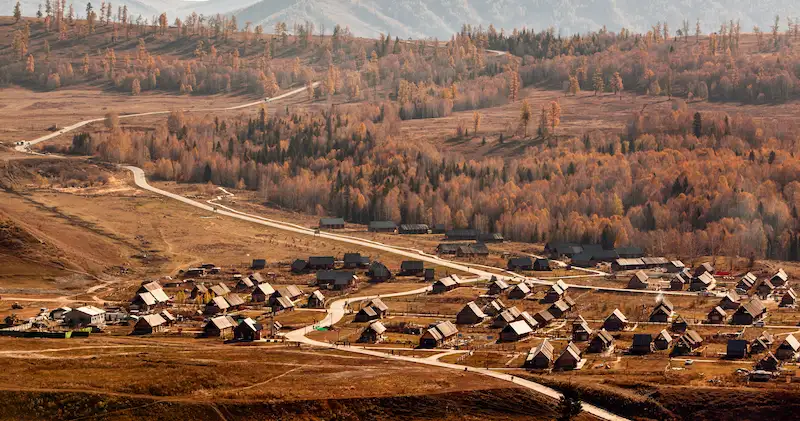
It’s interesting to know that the Tuwa people, part of the Mongolian minority but with their own roots, are legendarily direct descendants of Mongolian soldiers left by Genghis Khan to guard these places during his conquests.
Within these villages, you’ll find yourself surrounded by pointed-roof houses built with overlapping logs, perfectly matching the surrounding wooded landscape. If you’re lucky enough to visit when there aren’t too many tourists, you’ll pleasantly immerse yourself in a fairytale atmosphere, especially in autumn, when the trees around the villages spectacularly turn fiery colors.
One of the things we love most about this experience—and usually not mentioned—is that the road to Baihaba is in itself a scenic attraction. You’ll travel through an untouched landscape, sometimes encountering grazing animals crossing your path, and tiny settlements that—in a parallel universe—could themselves become new Hemu or Baihaba. By fate, however, they remain anonymous, preserving the charm of the remote intact.
Finally, remember that to enter Baihaba, you need a special permit (border defense permit). You can obtain it on site, or we can help you get it in Shanghai before your departure to Xinjiang. It’s amusing to note that, when we got our first permit a few years ago, the officer in Shanghai who issued it said: “This is the permit, but I can’t guarantee it will be accepted on site.” Fortunately, it worked well from the very first time! For curiosity, know that even Chinese citizens must request it to enter certain areas of Xinjiang, including Baihaba.
If you’re interested in discovering remote villages, you can check here our catalogue of private trips, offering the opportunity for an in-depth exploration of the most authentic China. And for an overview of other remote villages through China, we have prepared here a short video for you.
The Ghost City of Karamay (non-touristic part)
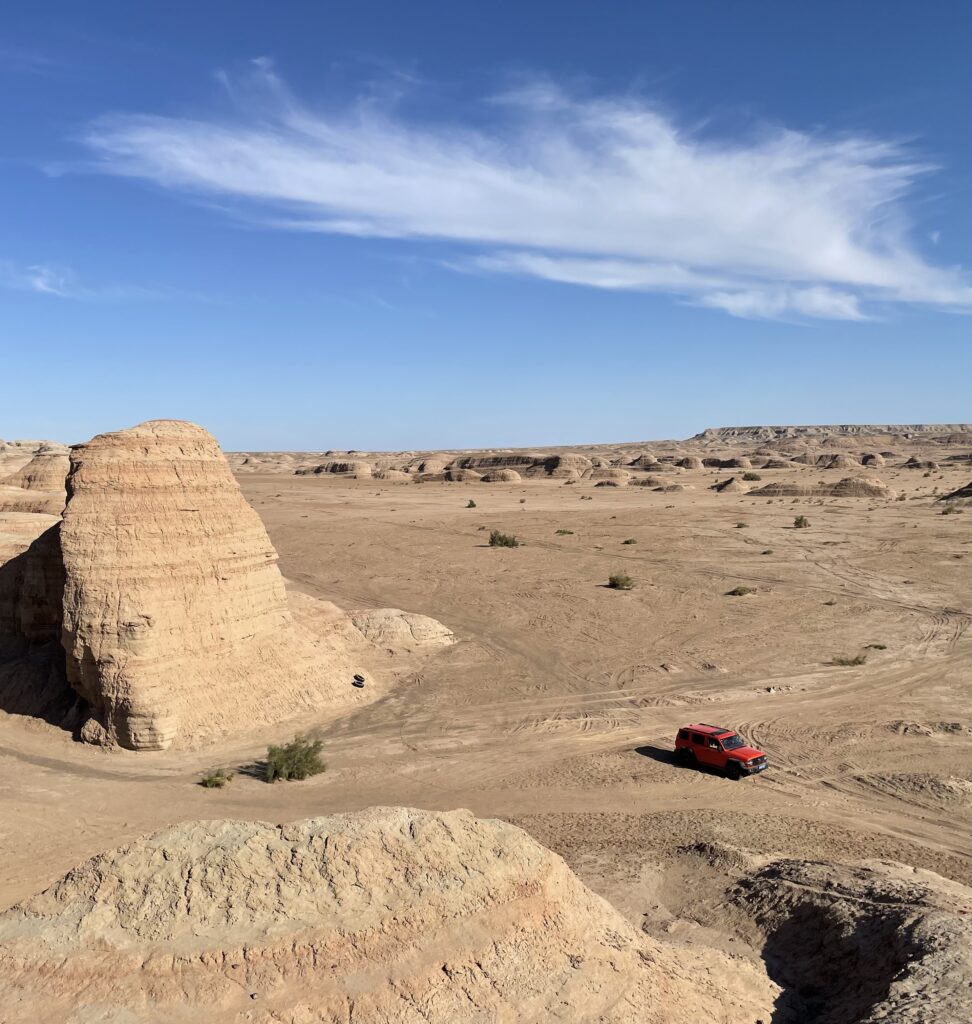
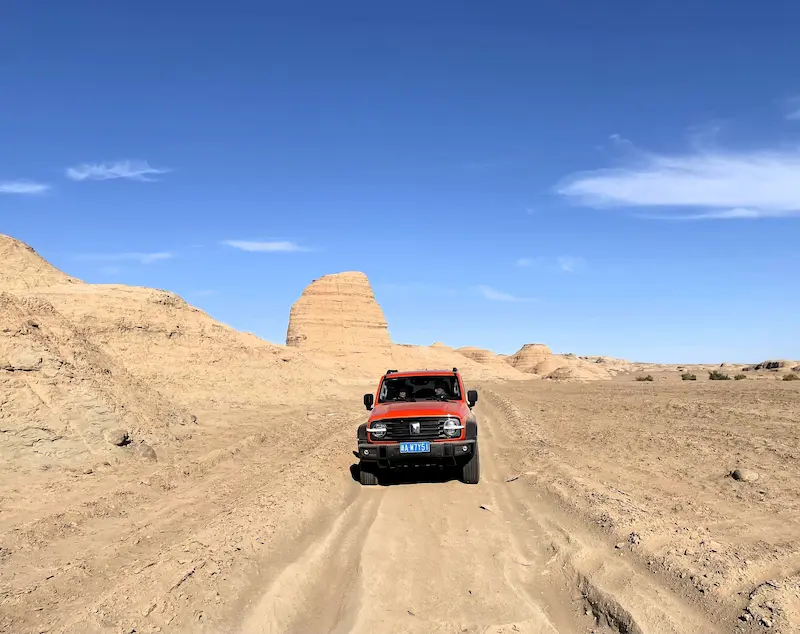
After visiting the alpine panoramas of the Altai Mountains, head south toward the oil city of Karamay. What we love to share about this place is its “ghost city“—an area a few kilometers from Karamay—and more precisely its non-touristic part, which you can still access without queues, for free, and find yourself face-to-face with the desert landscape of this desolate area. After all the green and blue of Altai County, you’ll find an unexpected contrast here.
It’s really fun to drive your 4×4 on the dirt terrain, kicking up clouds of dust from the crumbling ground, and weave between rock spurs that pop up like mushrooms, which you can climb to observe the landscape.
Enjoy the moment, but be careful not to stray too far, and especially avoid overly daring detours: this area is famous for trapping many bold drivers who got a bit too into the role of rally pilots.
Narati Prairies, Qiongkushutai, and Ili Lavender Fields
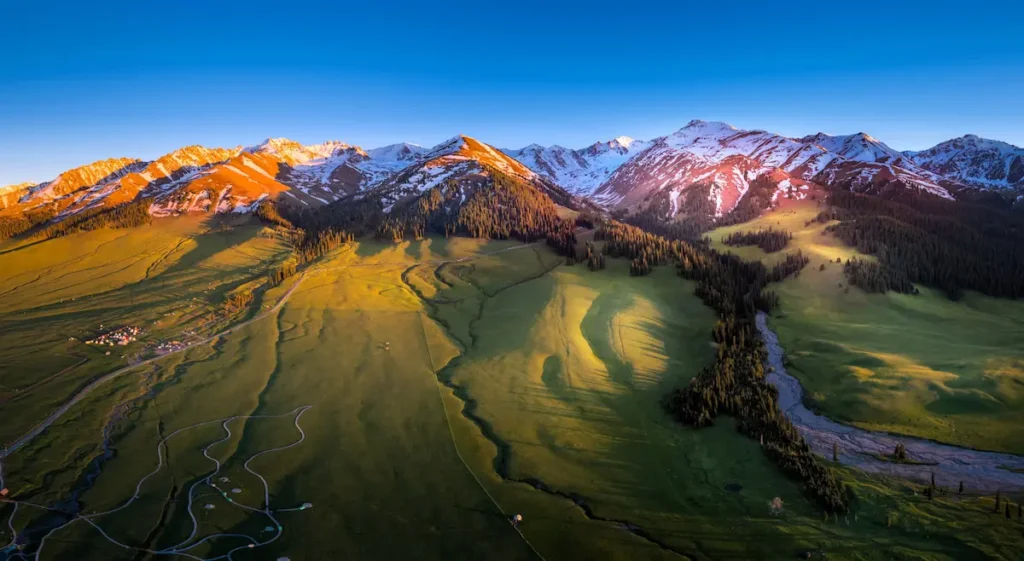
The Ili Valley is the green heart of northern Xinjiang, a place where prairies stretch as far as the eye can see, interrupted only by white yurts and grazing herds.
Narati Prairie is among the most beautiful in China, with vast green carpets, fir forests, and snow-capped peaks in the background. As with other scenic areas, you’ll need to take an internal eco-bus to reach the most panoramic points, but it’s absolutely worth it.
Like Kanas, the area attracts huge numbers of Chinese tourists. You need to plan ahead if you want to access the prairie in high season and prepare for some queues. In general, however, consider that Chinese organization is very efficient—especially considering the volumes of people to manage. With a bit of patience, you’ll be able to enjoy the prairie.
Also consider that tourism in Xinjiang has exploded only in recent years. In a sense, tourists have preceded the development of accommodations and services, many of which are now run by people who have converted from local herder lives.
Unfortunately, we’ve noticed that, especially in Narati and Kanas, hotel prices in peak months have reached truly excessive levels, without a corresponding improvement in service quality.
Without detracting from Narati’s beauty—which, despite some negative notes related to the tourist context, remains a truly enchanting place—when it comes to prairies, our preference goes to the Qiongkushutai area: a Kazakh village immersed in a fairytale alpine setting, with traditional wooden houses surrounded by prairies and streams.
This area is less touristy than others, located deeper in the heart of the Ili Valley in Tekes County, and offers an atmosphere of absolute peace, perfect for those seeking a more intimate contact with nature and local culture. The scenery to reach it is also as spectacular as the destination itself!
In short, if you have time, visit both places, which offer a natural spectacle capable of inspiring a strong sense of freedom, as if, for a few days at least, you too become a prairie nomad.
If, however, you prefer to choose due to time, budget, or both, we recommend the Qiongkushutai area, as it offers a more authentic and less touristy experience compared to Narati.
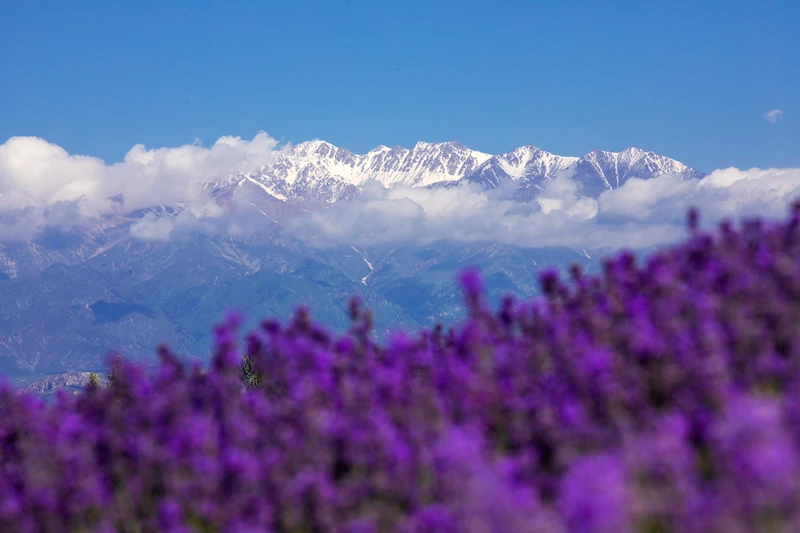
Finally, for a romantic touch, explore the Ili lavender fields (especially around Huocheng), which turn the valley into a purple sea from mid-June to July. The scent is intoxicating, and the fields stretch to the mountains, creating an incredible contrast. In this area, specialized in lavender production, there are real “lavender farms” allowing you to immerse yourself in the blooming fields, rent a small electric vehicle to explore, and buy fragrant local souvenirs. The focus on lavender has earned the area the nickname “Provence of Xinjiang“—and it’s truly well-deserved.
If you’re a bit late for the blooming season, consider that even in the second half of August, some farms delay harvesting certain areas to allow tourists a—albeit partial—experience of the flowering fields.
Sayram Lake
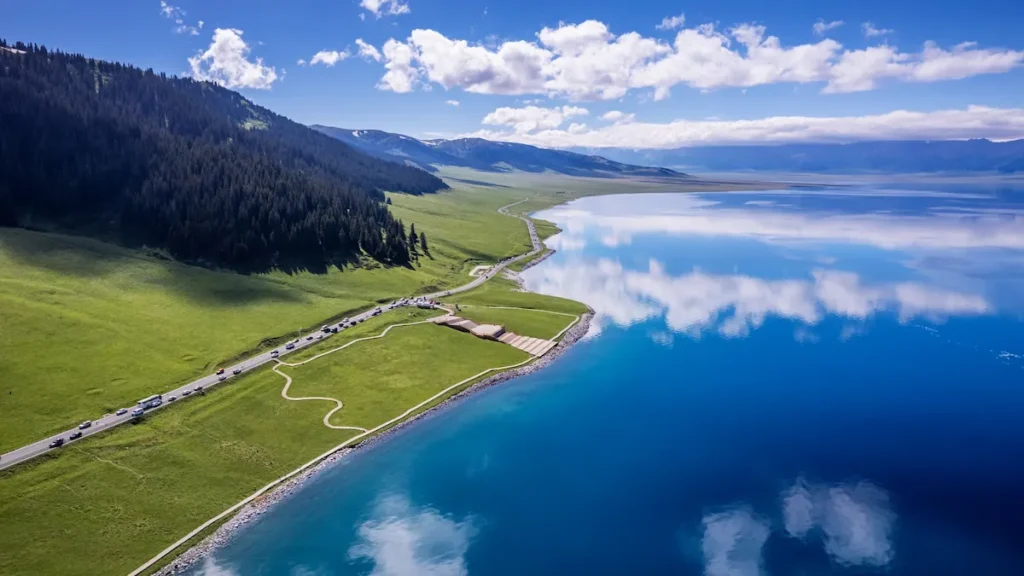
Known as “the last tear of the Atlantic” for its purest water, Sayram Lake is another alpine jewel of northern Xinjiang, nestled among the Tian Shan mountains at over 2000 meters altitude. Its waters change color from turquoise to deep blue depending on the light, and surrounding it are flowering prairies in spring and summer.
It’s a perfect place for a relaxing stop: you can stroll along the shore, take a boat ride, or simply admire the panorama with Kazakh yurts scattered around. In June-July, wildflowers create a colorful carpet that makes the lake even more magical.
Accommodations around the lake are plentiful, ranging from authentic yurts to traditional hotels, with intermediate options (yurt-shaped hotels) where the nomadic tent form is evoked or preserved but with greater tourist comfort.
However, if your budget allows, our advice is to visit the lake during the day and then retreat further inland, where an intact natural landscape awaits, with the chance to rest in accommodations away from the more touristy lake area, offering unexpected luxury among the mountains. You can find some photos of our favorite hotel here.
A point of caution: especially if heading inland, watch out for animals crossing the road, including possible sightings of wild camels. Also, on the road around the lake, especially if arriving in the evening, entire herds may cross, which are hard to spot in time in the dark.
Since you need to buy a ticket at the tourist center at the entrance to access the lake area, we recommend arriving in the early afternoon to have time for a calm check-in and avoid driving in the dark, as the road around the lake is poorly lit—or not lit at all in some sections.
Duku Highway (Northern part: Dushanzi – Narati)
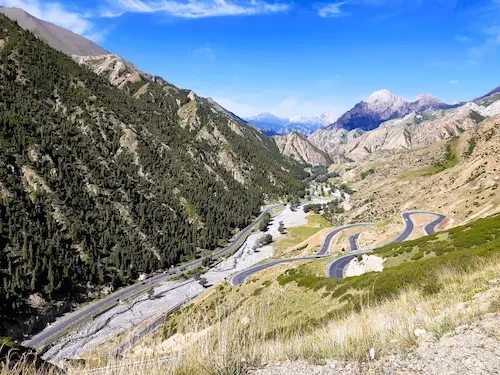
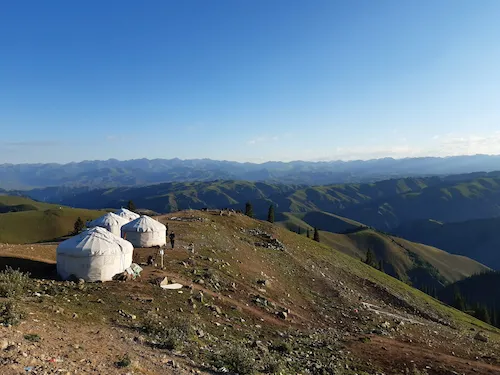
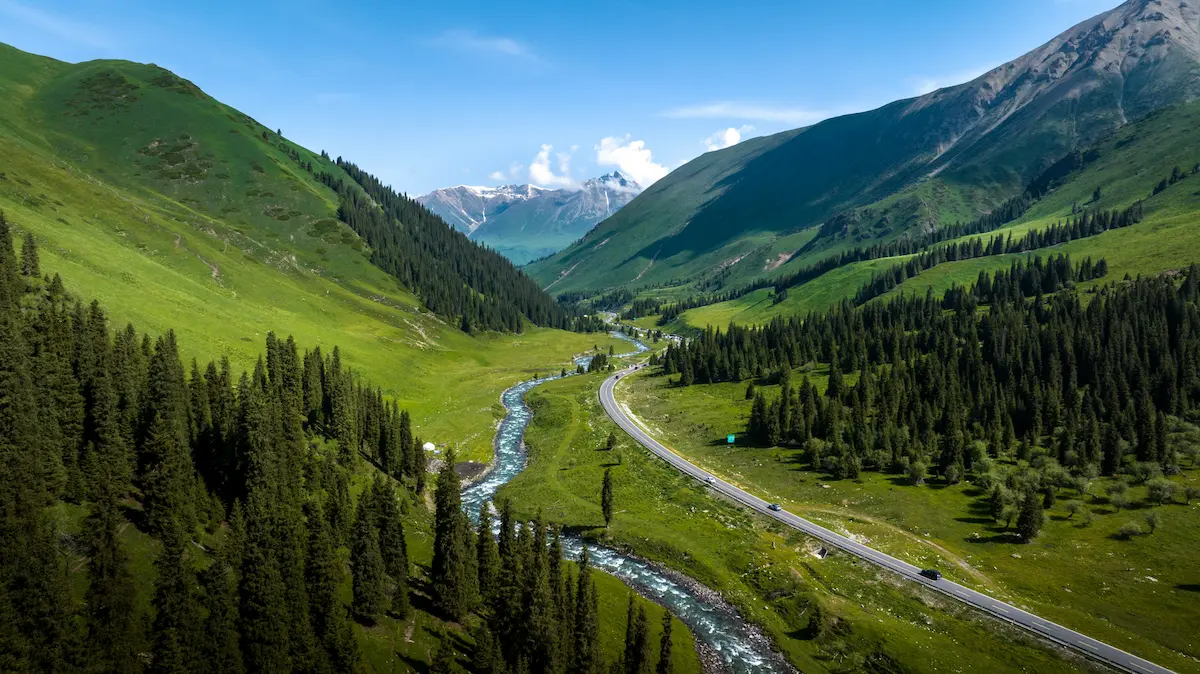
The Duku Highway is considered one of China’s most spectacular roads, and its northern section (from Dushanzi to Narati) is a true concentrate of natural wonders. In just a few hours of driving, you’ll pass through snow-capped mountain passes, dense forests, and lush green prairies.
If you love epic landscapes and the sense of freedom from driving in remote areas, we truly recommend driving it. You can also consult our catalogue of organized trips here for exclusive on-the-road experiences, including exploration of the Karakoram Highway in Xinjiang and the famous G318 and G317 in Sichuan.
As locals say, on the Duku Highway, you can experience all four seasons in a single day and enjoy breathtaking views at every turn. Caution, however: the road is open only from June to September/October due to snow and requires careful driving (better with an experienced driver if you’re not used to mountain roads).
The effort to build this road was enormous and lasted a decade. It is the only road connecting northern to southern Xinjiang (Dushanzi to Kuqa), crossing the harsh barrier of the Tian Shan mountains. The cost of 168 human lives for this extraordinary engineering feat, which still earns it the name “Heroes’ Road,” is respectfully commemorated with a memorial monument along the road at Qiaoerma.
Anjihai Grand Canyon
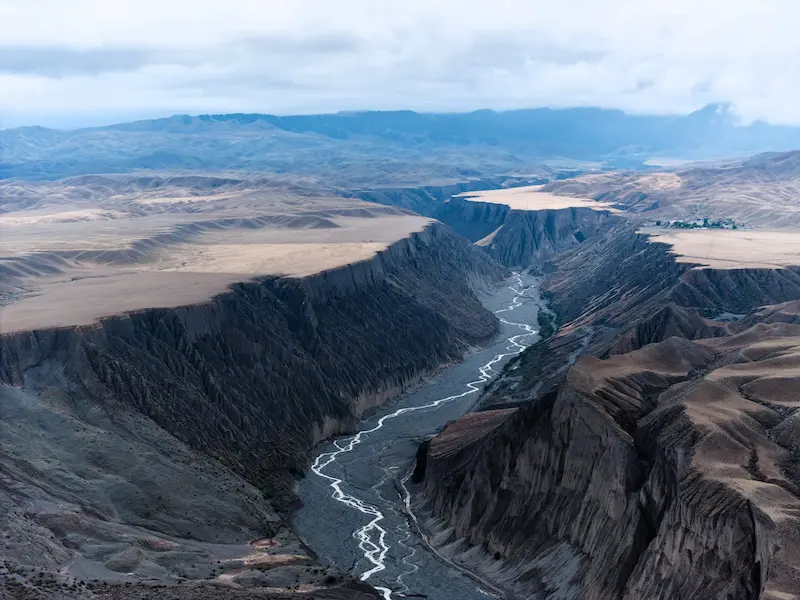
Remote, dramatic, spectacular! One of our absolute favorite places in China, this canyon offers a photogenic combination of depth and colors.
Only recently has the entrance been structured as a “tourist attraction,” while until a few years ago, it could be explored in complete freedom. During one of our explorations, the Ink Voyages team even met the young son of the landowner on whose property the government has now built the attraction entrance, as he raced back and forth on a motorcycle to block those trying to access unauthorized points.
He explained that, also due to overly reckless behavior by some tourists who drove right to the edge of the precipice for beautiful but dangerous photos, the area is now more controlled. It remains, however, largely wild, also considering the canyon’s vast extension. Don’t miss this natural jewel!
If you’re interested in learning more, you can watch a short video illustrating a route in northern Xinjiang, or read here all the details of one of our recommended itineraries.
Conclusion: The Call of the Prairies
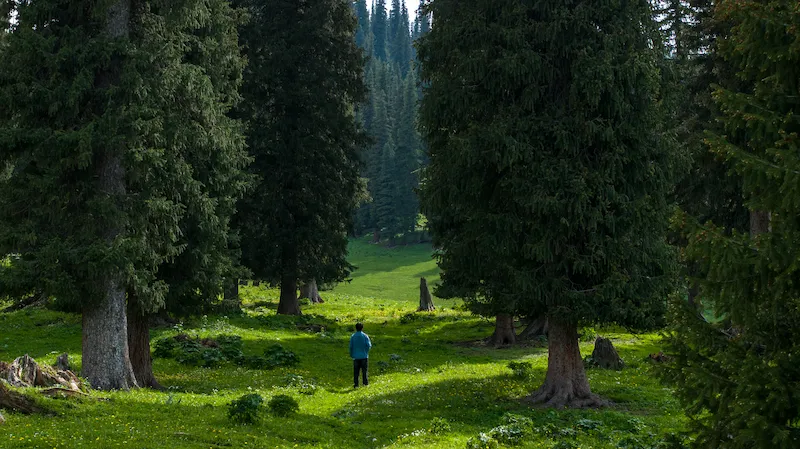
Northern Xinjiang is a land that invites exploration of landscapes and cultures deeply intertwined, evoking a sense of profound connection between man and nature. Seeing with your own eyes the yurts dotting the prairies, patiently waiting for cows to move off the road you’re driving, walking through village streets that seem straight out of a fairytale means bearing witness to an ancient and remote way of life that still resists modernity.
If you want to discover other itineraries aimed at in-depth and meaningful exploration of China, you can check our catalogue here—which we can use directly or as a base to create your dream itinerary together.
We hope the information in this guide will be useful for planning your trip. Whether you choose to travel with Ink Voyages or not, we strongly recommend dedicating a chapter of your world adventures to this extraordinary land. That said, all that’s left is to pack your bags and start the journey. Northern Xinjiang is already waiting for you!