

How to Travel in China
A Practical Guide to Preparing Your Trip to China
Table of Contents
With this guide, we at Ink Voyages want to share our travel and living experience in China, with the goal of putting you in the best position to travel in China with as few worries as possible.
We also want to help you become aware of some information—both cultural and practical—that will be useful during your journey through a territory that is still largely unknown to international tourists.
The growing interest from international tourism has been strongly felt for a few years now, with a steady increase in visitors from other countries—to the point that 2026 is already shaping up to be a triumphant year for tourism in China. If you want to learn more about the factors that, in our opinion, have sparked the transformation of China into a top-tier global destination, you can explore the topic in depth here.
Chinese Lifestyle and Culture

That said, as you prepare for your trip, we first want to try to share with you what it means to visit China, starting with the lifestyle and culture that are characteristic of this part of the world.
Culture of Hospitality
Let’s start with some good news: Chinese people are generally very welcoming and curious toward foreign tourists, as well as very willing to help if needed. While in major cities like Shanghai, Beijing, Guangzhou, etc., tourists are a relatively common sight—as soon as you venture a little off the beaten path, it’s easy to attract the curious and friendly gazes of locals. In some remote areas, you can even be sure that they’ll ask you to pose for a photo! If you’re interested in exploring where to travel in China, you can discover some in-depth itineraries here that delve deep into the various Chinese regions.
It’s interesting to note that this friendly interest toward foreigners (“laowai”) was, until about ten years ago, also associated with a feeling of admiration linked to locals’ aspirations to reach the levels of well-being seen in the Western world. Today, however—while the kind hospitality of the Chinese remains unchanged—that feeling has disappeared, replaced by an awareness of the achievements of “made in China” and the value that China represents in the contemporary world.
An Informal Style
Another trait we can share based on our experience living in China is the extreme behavioral informality that is widespread among people, making relationships and interactions truly very accessible and immediate. This casualness is evident in many aspects of daily life, from clothing styles that can be much more relaxed than what you’re used to, to flexibility regarding some Western etiquette rules during meals.
Now, beyond the occasional moment of disorientation that may arise from it, the overall effect this approach has on daily life is a pleasant sense of relaxation, coupled with the awareness of not being judged by others based on strict standards.
To be completely honest, while this casualness is almost always a benefit throughout the day, there are also contexts where a touch of formality might—in our humble opinion—be appreciated. That said, we are big supporters of informality, so we’re always ready to turn a blind eye if, during a taxi ride, the driver gets curious and asks how much we earn.
“Face,” or Reputation
Although it might seem contradictory to what we just said, there is also a central concept in Chinese culture that is useful to keep in mind: in China, it’s called “mian zi”—which literally translates to “face”—and refers to “reputation” and “social perception.” This is a deeply felt topic, so all the informality we’ve talked about above—which is indeed a pervasive element of Chinese lifestyle—coexists with the importance that the concept of “mian zi” holds for everyone.
For this reason, even in cases of misunderstandings or disagreements, remember to maintain a calm and respectful approach during discussions, especially if they take place in public. In any case, it must be said that China has a very low level of conflict—people tend to interact non-aggressively with others, especially when dealing with visitors from other countries.
A Very Safe Country
This generally peaceful and relaxed atmosphere is also linked to safety: China is truly an extremely safe country, where you can be almost certain of not being exposed to any kind of aggression or theft, no matter where you are. If you forget your phone on a table, you’ll find it exactly where you left it!
Until a few years ago, in the most touristy areas like the Bund in Shanghai, some scams targeting tourists still existed—but even those have been eradicated by the vigilant controls of law enforcement. Visiting China thus has the advantage of relieving visitors from concerns about personal safety, as the local authorities have already taken abundant care of that.
Practical Tips and Information for Your Trip to China
Entering China has become extremely simple thanks to recent facilitations, ranging from full visa exemptions for stays up to 30 days for 46 countries, to other exemptions for transit travelers (up to 240 hours!). You can explore these aspects in more detail by reading our article here.
However, while entering requires little more than booking a flight for visitors from many countries, it’s equally true that China has some peculiarities that should not be underestimated: keep in mind that this country has developed its own standalone technological ecosystem, which can create a real barrier to accessing services—starting with the most basic ones—if you’re not properly prepared.
The Great Firewall
For starters, as soon as you enter China, connectivity issues begin. The Great Firewall—as the digital barrier regulating the internet in China is known—blocks many platforms you’re used to (Facebook, WhatsApp, etc.), as well as everything related to Google!
To avoid being stuck, there are several solutions, all revolving around using a VPN (Virtual Private Network): you can subscribe to a VPN for the duration of your stay (note: not all VPNs work in China), or you can purchase a SIM/e-SIM card that automatically includes VPN services. These can be bought through dedicated websites or directly at airports. You can read our practical guide here with tips on the topic.
Payment Methods
Another major source of disorientation? Payment methods! Expect that your credit card will be accepted almost only in international hotels, and very few other places. China has evolved into a cashless society that relies on digital systems for every type of payment through two main apps: WeChat and Alipay.
Payments are made by scanning QR codes, which—after an initial moment of embarrassment—is an extremely convenient method for transactions. Trust us: it’s addictive! The good news is that recently both WeChat and Alipay have introduced features to allow linking foreign credit cards: this way, you can deposit credit from your card into the “wallet” of your WeChat or Alipay app and use it directly during your trip in China. For more information, we’ve written an in-depth article here on digital payments.
One point of attention: both for the VPN and for downloading and setting up WeChat and Alipay, remember to complete everything before arriving in China. For the VPN, if you decide to buy a SIM at the airport—there wouldn’t be any issues. However, if you want to download and install a VPN on your phone after arrival, remember that VPN download sites are blocked in China, so you need to organize this beforehand.
For WeChat and Alipay, we similarly recommend completing the setup before arriving in China—since small complications can sometimes arise—to avoid hiccups during your trip. For safety, we suggest downloading and setting up both apps on your phone.
The Main Chinese Apps
In addition to WeChat and Alipay, which are the two primary reference apps, numerous applications are used in China that dictate the rhythm of daily life and are deeply integrated into locals’ habits—from the youngest to the oldest; no one is excluded.
From food delivery apps (and more) [Meituan, Eleme], to those dedicated to shopping in virtually any category [Taobao, JD.com, Pinduoduo], to lifestyle and experience-sharing apps [Xiaohongshu], to navigation and urban transport apps [Baidu Maps, Gaode Map, Didi], to apps that serve as service platforms and help you find restaurants, cinemas, theaters, hospitals, etc. [Dazhong Dianping]—it’s good to know what might be useful to download to navigate a world that is deeply rooted in the digital.
If you want to learn more, you can find our guide to the main Chinese apps here. So, once you have WeChat and Alipay set up correctly, you’ll discover the full convenience of not having to carry cash, since in China everything is done with your phone. And even if you find yourself in remote areas, you can be sure that a QR code to scan will always appear at the right moment to let you buy what you need.
The Language Barrier
Despite all the preparation, expect to encounter difficulties when putting theory into practice. In fact, you’ll discover that English is less widespread than one might think, even in international major cities like Shanghai, and finding places with names written in Chinese characters is far from easy… But that’s part of the experience and the adventure! With a bit of patience and a translator, miracles can happen! Note that WeChat has an extremely useful built-in translation feature that can even translate text in an image! Take a photo and… translate it!
To help you break the ice with Chinese, we’ve prepared some basic phrases for situations you might encounter. At the very least, they’ll earn you smiles and respect from locals, who appreciate foreigners’ efforts to speak their language—even if it’s just to say “Ni Hao”!
Transportation in China and the Temporary Driver’s License for Foreigners
At this point, we’ve gathered some information that will surely allow you to approach your trip to China more comfortably. You’re ready to explore this wonderful country. All you’re missing is… the car keys!
Public Transportation
Consider that transportation in China is very well developed: from high-speed trains to numerous domestic flights, to the extensive network of roads and highways that crisscross the territory, moving around this vast country is not difficult. For purchasing train and plane tickets, the simplest solution for foreign tourists is to use Trip.com, which also lists hotels you might want to select during your trip. In fact, when traveling in China, we recommend downloading the Trip.com app, as it offers more localized services compared to Booking.com, which you might usually use.
The Temporary Driver’s License
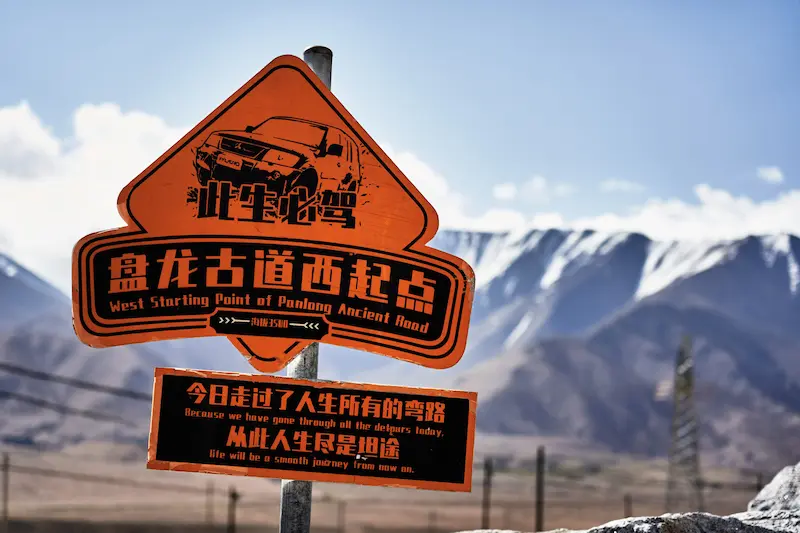
Of course, if you’re planning a deeper exploration of China, relying solely on public transportation could be extremely difficult—sometimes entirely unfeasible—especially when venturing into remote areas where the more traditional Chinese lifestyle still thrives.
Keep in mind that the international driver’s license is not valid in China, but there is a way to obtain a local one in record time (a few hours) after your arrival. This way, you can drive a rental car within hours of entering China!
At Ink Voyages, we can help you obtain a temporary local license, which will allow you to move around with full autonomy and freedom throughout your stay in China.
The required documents are as follows:
- Your original driver’s license
- An official translation of your driver’s license
- Your passport
- The foreigner registration form issued by the hotel where you are staying
- And… a bit of patience to complete the procedures at the relevant offices
Also note that the procedures for obtaining your temporary license may vary slightly depending on the city where the request is made.
For those who want to travel in China independently and at their own pace, this option is highly recommended!
Your Chinese Name
You will finally need to choose your Chinese name to register on the temporary driver’s license that will be issued to you: start thinking of one! And if you’re curious to know what your Chinese name would be by phonetically translating your name, you can try our name generator below:
Remember that the temporary driver’s license you can obtain this way as a tourist can only be used for rental vehicles, and you must always keep it together with your original license and its translation. The procedures for obtaining a permanent license, on the other hand, involve passing a dedicated test and are generally not recommended for those staying in China for a short period.
Special Permits for Tourists
Once you have your license, you’re ready to explore! Although most of China can be visited independently without needing special permits, there are exceptions! Below is a list of areas that require particular attention:
Tibet
The Tibet Autonomous Region (TAR), also known as Xizang, is by far the most complicated region when it comes to permits. First, foreign tourists are not allowed to visit it independently and must obligatorily join an authorized agency during their stay in the region. In addition, depending on the areas in your itinerary, other permits may be required, such as the Alien’s Travel Permit (ATP) and the Military Permit (or Border/Military Area Permit).
Xinjiang
The Xinjiang Uyghur Autonomous Region is nothing short of wonderful and is mostly freely visitable. However, there are some zones that require a permit, for foreigners and others alike. For example, to reach the villages of Baihaba and Hemu, both foreign and Chinese tourists must have the same type of permit. For safety—especially since Xinjiang can be visited independently—it’s possible to ask the officer processing your permit to include all the stops in your itinerary, to avoid surprises.
A special note of caution goes to refueling in Xinjiang: this information isn’t widely known, but it’s very important! To enter gas stations, you need to scan a Chinese ID card… If you’re not accompanied by someone who has one, there’s a high chance you’ll run out of fuel!
Some Border Areas
There are some border areas considered sensitive, for which access requires special authorizations that may (or may not) be issued by local Public Security Bureau (PSB) offices. In any case, these areas are usually not included in tourist itineraries and represent a truly marginal issue—unless you intend to cross the border into another country like Myanmar, India, Bhutan, Nepal, Afghanistan, or North Korea.
Some Tibetan Autonomous Prefectures Outside Tibet
Temporary closures may occur in some areas bordering Tibet in the provinces of Sichuan, Qinghai, and Gansu, which are considered “Tibetan Autonomous Prefectures” even though they are outside Tibet’s borders. Usually, these zones are open and visitable by foreign visitors without needing special permits.
Restricted Areas for Military Reasons
If you plan a hike on the wild section of the Great Wall between Gubeikou and Jinshanling, for example, you’ll discover that at a certain point you’ll have to detour onto a wooded path and then rejoin the Wall after a few kilometers: this is due to the presence of a military zone that you’re asked to bypass during your hike. In China, there are well-known and some lesser-known areas restricted for military reasons. If you accidentally enter one, you would simply be escorted out without any problems. In any case, these are mostly limited and remote portions of China that certainly won’t disrupt your travel plans.
Hong Kong and Macao
Finally, remember that to enter Hong Kong and Macao from mainland China, you’ll go through passport verification procedures—but for many foreigners, visa-free entry is allowed for up to 30 days. Which, to be precise, has now become the standard for travelers from 46 countries.
Hotels That Do Not Accept Foreigners
A final note on hotels: it should be clarified that there is no longer any law limiting foreign tourists’ access to any accommodation facility. However, in some remote areas, you might still be turned away in the name of this old rule. From experience, we can tell you that hotel staff act in good faith: either because they believe the law is still in force, or because they have no idea how to register your passport in the designated systems. Sometimes, you might have to go to the nearest police station with the hotel owner to complete the registration “manually.” If you want to avoid issues, especially if venturing into remote areas, it’s best to check in advance whether hotels are willing to accept foreigners—to avoid long and difficult discussions.
Check for Updates
Before departure, for safety, always remember to check the official website for any communications regarding China’s entry policies, which may change over time, and to get adequate health insurance suited to your travel experience. You can find our article on this topic here.
The Treasures of China: An Unforgettable Travel Experience

The vast territory of China is capable of offering surprises and wonders both culturally and scenically, leaving you undoubtedly satisfied. You’ll return home with a baggage of emotions and stories that you’ll be eager to share! If you wish to organize a trip to China, you can start by browsing our catalog of private tours. Each itinerary is fully customizable based on your preferences and provides the foundation on which we can begin planning your adventure together, fully respecting your travel style and budget.
At Ink Voyages, we celebrate the traveler, the explorer, the adventurer, the curious mind seeking the horizons of the world. Our mission is to create every travel experience with care and creativity, to ignite your curiosity and sense of wonder. After reading this guide, we hope you feel more prepared and ready to go. Whether you choose to travel with us or not, we wholeheartedly recommend that you write a chapter of your adventure in China!