Baishuitai: The Enchanted Terraces of Yunnan
Table of Content
Where to Start Your Visit to Baishuitai
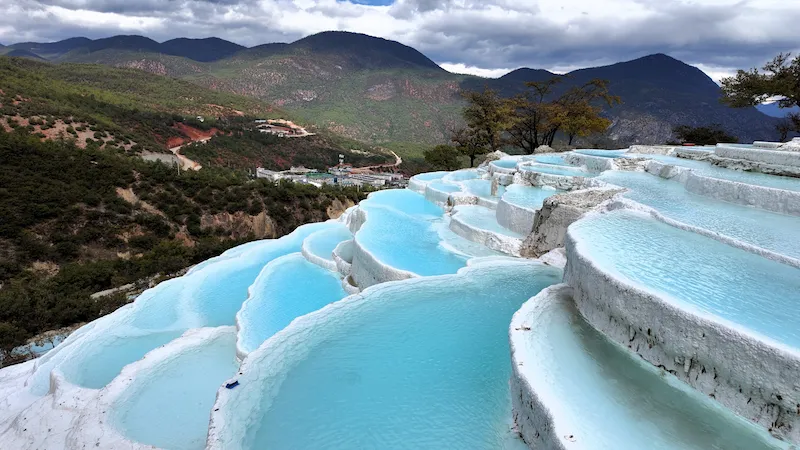
Baishuitai is one of those places that looks like it has come straight out of a fairy tale — and we do not say this lightly. Located between Shangri-La and Tiger Leaping Gorge — approximately 100 km from the former and 45 km from the latter — it is a stop that we at Ink Voyages highly recommend if you are visiting northern Yunnan.
Upon arrival, leave your car in the parking area and purchase the entrance ticket, which costs 30 RMB, approximately 3.50 euros. As you exit the tourist centre, head to the right and continue for about fifty metres: there you will find the beginning of the path climbing up the mountain, from where you can enjoy a panoramic view of the terraces.
A couple of practical notes: at the beginning of the trail, some local people may offer — quite insistently — to take you up on the back of a mule. The cost is 10 RMB, around 1.20 euros, should you wish to avoid the 15-minute walk. In any case, keep in mind that the path leading to the terraces has been equipped for visitors, so despite the incline, it remains broadly accessible.
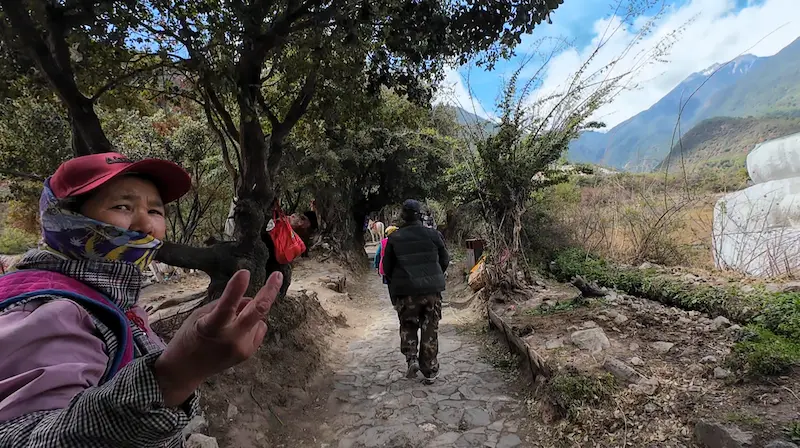
Another point we would like to share concerns the first terraces you will see, both from the parking area and from the beginning of the trail. They are neither particularly beautiful nor are they the real terraces. On the contrary, they were artificially built as an introduction to the spectacle waiting for you at the top.
A Geological Wonder
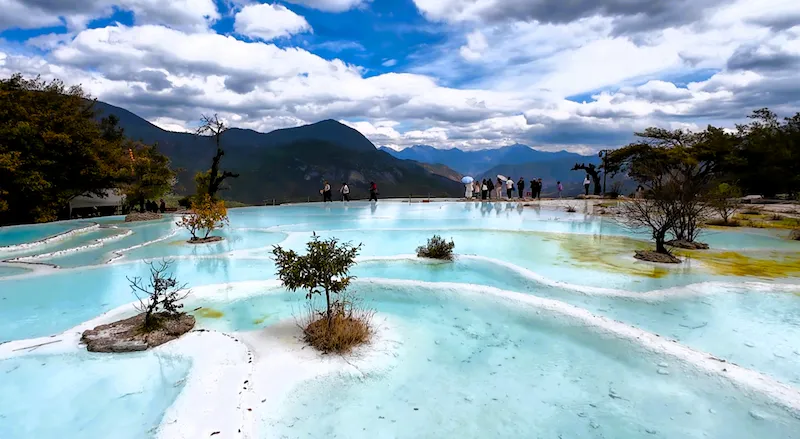
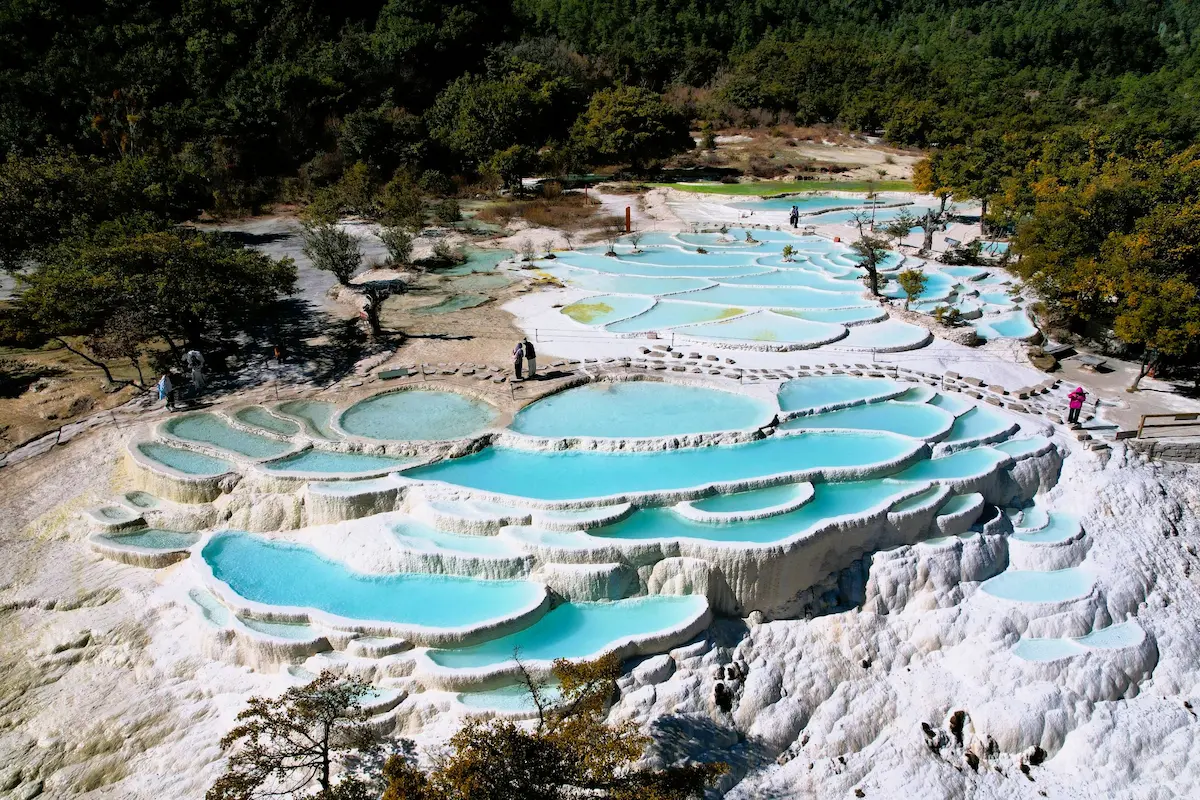
From a geological point of view, Baishuitai — which in Chinese means “terraces of white water” — is a complex of travertine terraces made of calcium carbonate. They formed over thousands of years through the sedimentation of this mineral, carried by the spring water that flows through the area.
Visually, it truly feels like stepping into the middle of a fairy tale: Baishuitai is an almost utopian place, where it is easy to linger, walking back and forth along the white corridors that allow visitors to observe the terraces.
The water contained in these natural pools, especially if you are lucky enough to visit on a sunny day, takes on an almost surreal shade of blue. Set against the white of the terraces, it creates an idyllic landscape that you will find hard to leave behind. Along the corridors — and sometimes even inside the pools — there are beautiful dwarf trees and aquatic shrubs, such as wild azaleas, pines, willows, and others, which somehow further perfect the aesthetic beauty of this little corner of paradise.
The only downside? You cannot dive in!
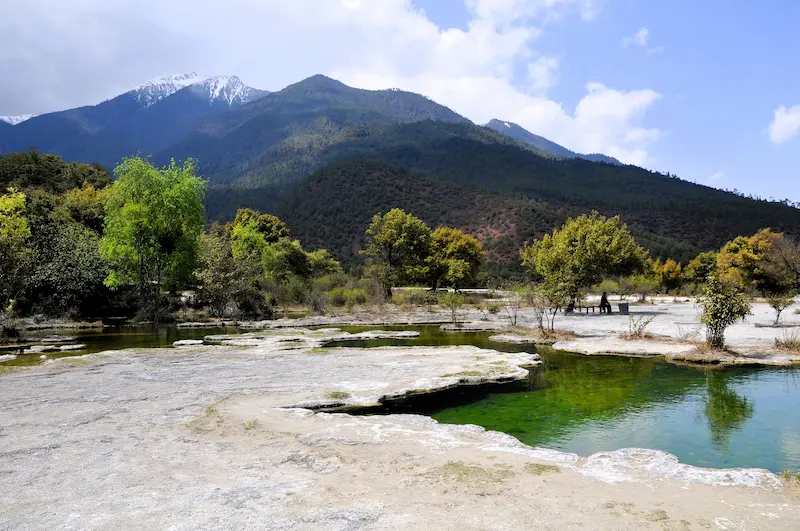
If you want to fully appreciate the area, we also recommend taking some drone footage: the aerial view of the terraces makes this place even more special. On our YouTube channel, you can get a sense of what these terraces look like. You can watch our YouTube short here, which also includes aerial footage of the area.
To discover other fascinating corners of China, you can also explore our catalogue of customisable private journeys.
The Spiritual Heart of the Naxi People
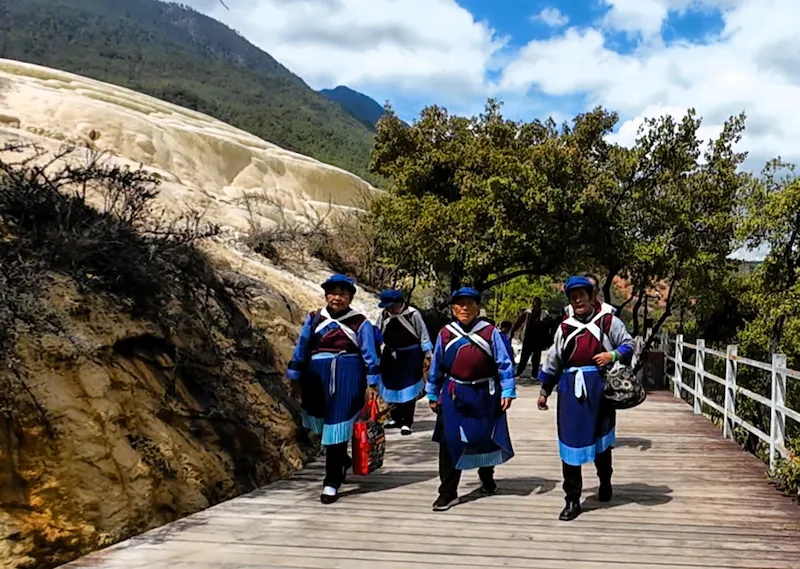
After exploring the geological and aesthetic aspects of this hidden gem in the heart of Yunnan, let us now turn to its cultural and spiritual dimension. Yes, because Baishuitai is also an essential place for the Naxi people and for Dongba culture.
Visiting Baishuitai means immersing yourself — metaphorically, of course! — in the place of origin of the Dongba religion. To understand what this means, we must first begin with the Naxi people, also known as Nashi, one of the many ethnic minorities found in Yunnan. If you would like to learn more, here is the link to our travel guide to this beautiful region.
The Naxi are concentrated in north-western Yunnan and are distinguished by Dongba culture, a term with multiple meanings. The word Dongba can refer to:
- the Naxi priest-shamans;
- the traditional religious system of the Naxi people;
- the set of rituals and practices that form the cultural foundation of the Naxi people. This also includes the Dongba writing system — one of the last pictographic writing systems still in use in the world.
To understand the type of spirituality that characterises Dongba religion and, more broadly, Dongba culture, it is useful to refer to Tibet’s original religion, Bön, which preceded Tibetan Buddhism. To learn more, you can read our article on the Bön tradition and its relationship with Tibetan Buddhism, starting from the history of Dongzhulin Monastery.
In short, like Bön, the Dongba religion also has an animist character, placing the elements and forces of nature at its centre. Traditionally, Dongba priests are also shamans, able to connect with natural spirits in search of protection during sacred rituals. In villages such as Baisha and Shuhe, near Lijiang, traditional shamanic practices — including healing practices — are still preserved by a small number of Dongba priests.
It is interesting to know that there are still a few individuals capable of reading and reciting the sacred Dongba texts, which are written using pictograms. This type of writing is not intended for everyday use, but has a specifically sacred and ritual function. That said, in some everyday contexts, as part of a cultural revival, you may notice pictograms — for example, on the back of some buses in Lijiang — although this usage goes beyond the original purpose of the script.
Baishuitai is important to the Naxi because Dongba Shilo, the founding figure of the Dongba religion, is said to have received here the revelation that later allowed this spiritual tradition to develop and take shape.
Visiting Baishuitai therefore means standing before at least two kinds of wonder: first, the natural one, represented by the astonishing formation of the travertine terraces; and second, the cultural and spiritual one, as you enter the most sacred place of an ancestral religion. The sacred value of this place is still reflected today in the presence of rituals and celebrations during Er Yue Ba, a festival held on the eighth day of the second lunar month, when community events, pilgrimages, and dances in traditional clothing take place.
During our visit in April, although it was not the period of Er Yue Ba, we were still able to witness one of these dances in traditional clothing, accompanied by the sound of Naxi music.
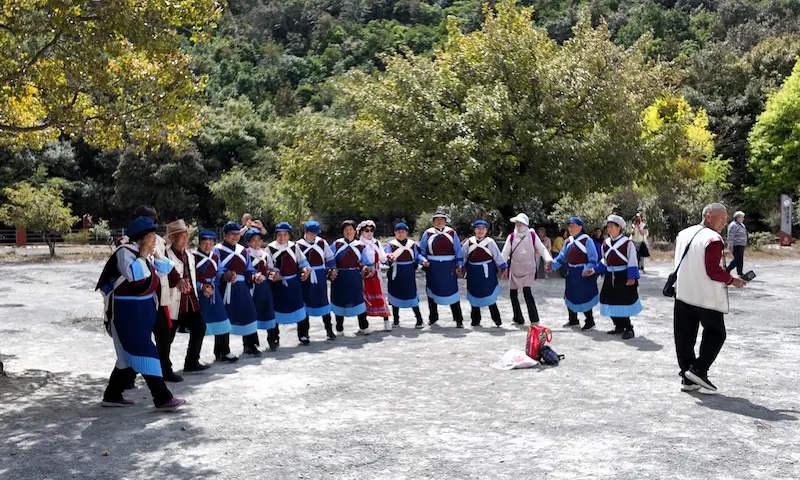
There is, finally, one more possible interpretation of the enchanted terraces of Baishuitai: the agricultural one. According to legend, the morphology of the water terraces inspired people to create agricultural terraces, whose shape imitated that of Baishuitai and contributed to the agricultural development of the area.
Baishuitai as a geological wonder, the spiritual heart of the Naxi people, and an agricultural archetype: this is a place rich in meaning, which can be visited in around two hours and represents the best possible way to break up the journey between Shangri-La and Tiger Leaping Gorge.
If you enjoy places like this, we also recommend the Huanglong terraces in Sichuan, a site with a comparable geological and aesthetic formation. Also, near Lijiang, you may come across something similar at the “Blue Moon Lagoon”. Keep in mind, however, that this is an artificial and very tourist-oriented site. We mention it here for the sake of completeness, but we do not personally recommend it.
With this article, the Ink Voyages team hopes to have helped you discover one of the most enchanting places in Yunnan, suspended between natural beauty and ancient traditions. To visit China in an authentic way, beyond the most beaten paths, you can find inspiration by browsing our catalogue of tailor-made journeys, which will give you special access to its vast territory.
Happy exploring!