Gadan Dongzhulin: The Converted Monastery in the Mountains of Yunnan
Table of Contents
A Monastery Far from Mass Tourism
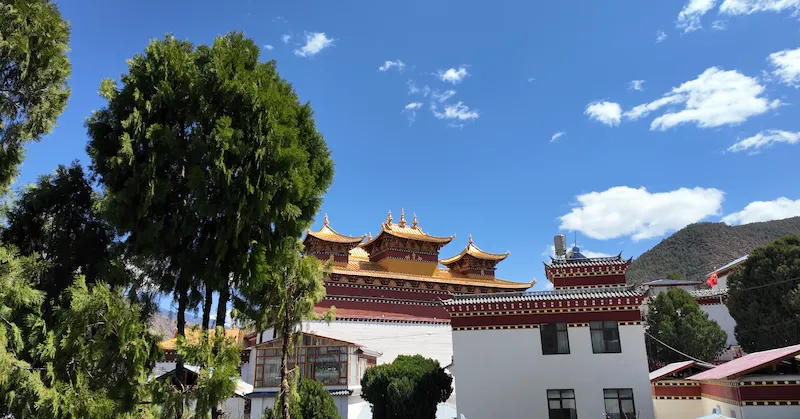
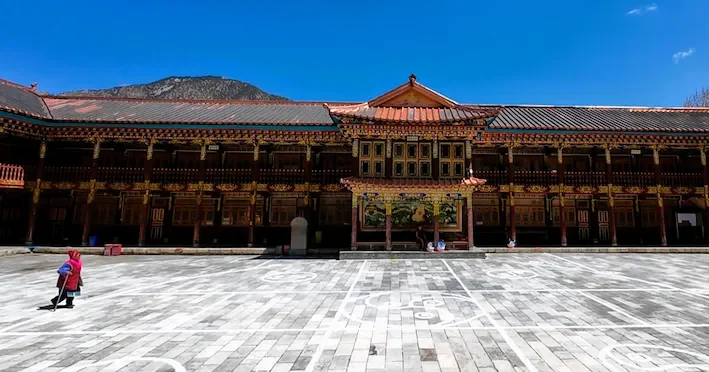
The Gadan Dongzhulin Monastery is suspended at 3,000 meters among the silent peaks of northern Yunnan, which still protect its deep, intact spiritual atmosphere. What makes this place special for us at Ink Voyages is, first and foremost, this distinctive aura that sets it completely apart from mainstream tourism destinations.
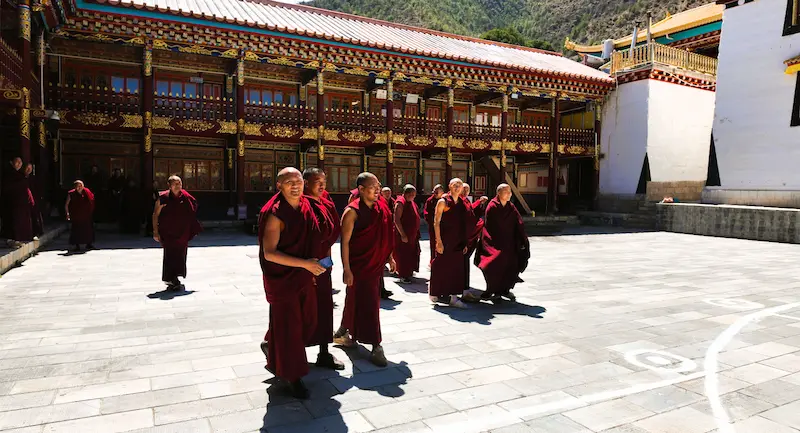
As happens all too often, even temples and monasteries—when heavily strained by tourism—transform into “attractions,” losing their original charm. At Gadan Dongzhulin, however, you can immerse yourself in a still-authentic haven of Tibetan Buddhist culture. Here, you can observe the daily lives of the monks who bring the monastery to life with their prayers, their walks under the porticoes, their curious glances, and their timid smiles directed at the few tourists who have ventured this far.
If you want to travel to China authentically, you can explore our catalog of customizable private trips here.
The experience begins even before stepping through the monastery gates, well before finding yourself in front of the large rectangular courtyard that you must cross to enter the heart of Gadan Dongzhulin. If you are arriving from the north, you will encounter the monastery before reaching Benzilan (23 km), along the road (G214) heading in the direction of Shangri-La.
Pay close attention while driving, because at a certain point, you will notice a gateway on your left, on the other side of the road: right there, this is the spot that marks the beginning of your spiritual adventure. Make a sort of U-turn, keeping an eye out for oncoming cars, and take the downhill road that passes under the gateway, where you will see the name of the monastery appear for the first time.
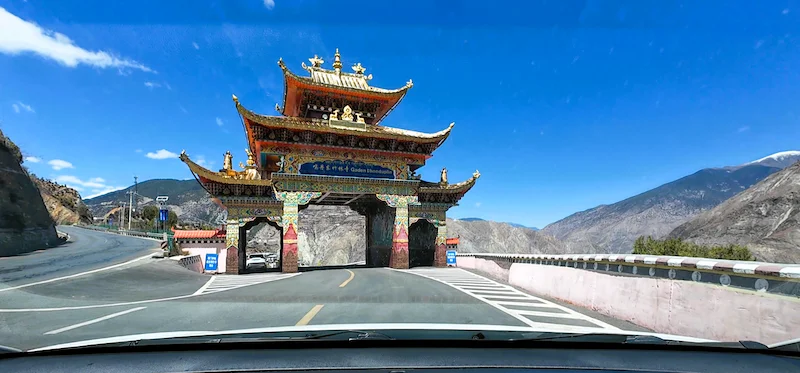
The descent toward the parking lot right in front of its walls is spectacular in its own right: you will find yourself crossing a true Tibetan village, with houses that seem to have come straight out of the historic center of Lhasa. You will also begin to notice the presence of numerous monks, wrapped in their scarlet robes, who seem to be the primary inhabitants of this small village, all gathered around its spiritual heart.
The Story of a Conversion
What might surprise you is that behind this pervasive feeling of peace, this monastery actually hides a history of turbulent conversion. And this is the other reason that makes this place so fascinating. To understand the vicissitudes of Gadan Dongzhulin, we must first take a leap into the heart of Tibetan Buddhism, which is not a spiritual monolith but is composed of various sects, each with its own specific characteristics.
Tibetan Buddhism and the Bön Religion
Tibetan Buddhism is fundamentally an emanation of one of the three great “Vehicles” of Buddhism: Theravada, Mahayana, and Vajrayana. Tibetan Buddhism derives from the latter, which has its spiritual pivot in “tantric” practices—that is, mystical techniques and rituals to achieve enlightenment. This is an important point, as it will be decisive in the conversion history of Gadan Dongzhulin.
Tibetan Buddhism descends from this branch, also known as “The Diamond Vehicle,” and has its origins in the ancient Nyingma school, founded in the 8th century by Padmasambhava. According to tradition, this guru crossed the Himalayas with the mission of defeating the demons that prevented Buddhism from spreading in Tibet.
Legend has it that another monk had summoned him after his attempts to build the first Buddhist monastery in Tibet were systematically thwarted by the overwhelming power of demonic forces. Padmasambhava’s task was therefore to subjugate them.
It is interesting to pause and understand the more rational meaning buried behind this narrative. First, it is important to know that before the advent of Buddhism, Tibet possessed an indigenous spirituality—an animistic religion called “Bön“—which clashed with the initial attempts to introduce Indian Buddhism into the territory.
The Bön cult, which still survives residually in Tibet and represents its original cultural substrate, is oriented toward the devotion to the forces of nature. The sacred is the environment itself, where these forces manifest in their unpredictability and hyper-power.
The strategic move of Buddhism was as follows: to favor the spread of Buddhism, Padmasambhava did not directly oppose the Bön deities, nor did he aim to destroy them. On the contrary, he approached them with a clever ascetic intention: he first acknowledged their overwhelming power and then convinced them to become guardians of Buddhism itself, elevating them to a nobler purpose.
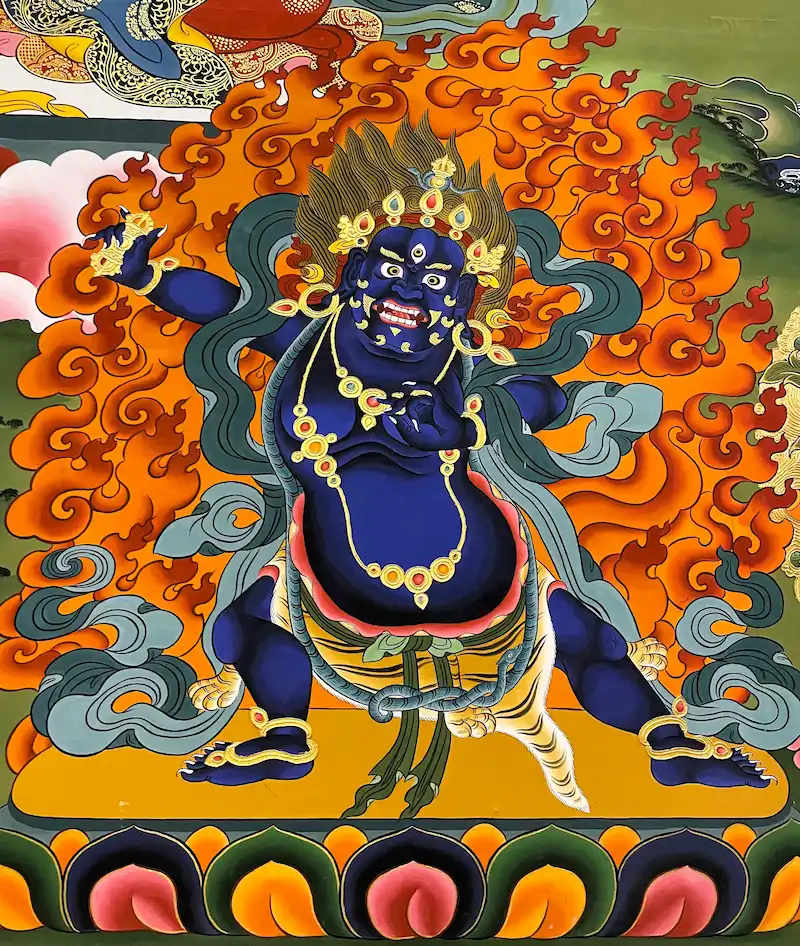
The storytelling easily reveals the intuition of the early Buddhist missionaries: instead of forcing their cult against the pre-existing one, they integrated it within the Buddhist framework, functionally yet subordinately. This also explains the presence of monstrous figures on the walls of Tibetan Buddhist temples: they represent the forces of nature, transformed into guardians and protectors of Buddhism.
The integration between Buddhism and the Bön religion is also visible in the adoption of Bön practices within the Nyingma school, the original school of Tibetan Buddhism. Perhaps the most evocative of these is the tradition of “Terma,” or secret treasures (fragments of texts and sacred objects) that were hidden in natural locations to be rediscovered in the future, at a designated time, by a chosen one (“Tertön”).
Contact with the Terma should ideally be enough to re-trigger memories and teachings belonging to past lives within the Tertön, allowing the recovery of the entire truth, of which the Terma is only a fragment. According to tradition, the Tertöns are nothing less than the reincarnations of Padmasambhava’s disciples, who, upon contact with the sacred fragments, can reactivate—intact and unaltered by time—the truth transmitted by their master.
The Mysticism of the Kagyu School
This point is important because it connects us explicitly to the mystical essence of original Tibetan Buddhism. This practice, along with others, the emphasis on the master-disciple relationship, the search for remote natural locations, and the focus on direct experience obtained through meditation, are key components of the Nyingma school, from which the Kagyu school (founded in the 11th century) inherited its mystical and esoteric character.
Having introduced the Kagyu school, we can now return to the history of our monastery: the Gadan Dongzhulin Monastery, founded around the year 1574, was indeed born as a place of worship for the Kagyu school, aligning with the type of spirituality described in the paragraphs above. However, things changed in 1674 when, by order of the Fifth Dalai Lama, it was forcibly converted to the Gelugpa sect (the “Yellow Hats”), in opposition to the Kagyu resistance and revolt in that area.
It must be kept in mind that Tibet extended its influence beyond its current borders, reaching into what is now northern Yunnan, western Sichuan, and parts of Gansu, which belonged to the Tibetan kingdom of Kham.
If you are interested in exploring further, you can also read our Yunnan travel guide and our Tibet travel guide here. For a general overview, you will find the link with useful information to organize your trip to China here.
The Rationality of the Gelugpa School
At that time, the Fifth Dalai Lama forged a military alliance with the Mongols, who acted as the armed branch of the conversion. Simultaneously, he obtained authorization from the Kangxi Emperor (Qing Dynasty) to proceed militarily. The latter viewed the establishment of an official power in the area favorably, as it would facilitate political relations within a still-untamed territory.
As is recurrent throughout history, it is good to bear in mind that spiritual differences are never the sole drivers of conversion efforts like the one just described. In fact, control of this area was particularly relevant because it was a transit point for the Ancient Tea Horse Road, which wound from southern Yunnan all the way to Lhasa, carrying precious tea and other valuable commodities like the salt of Nuodeng.
That said, it must also be noted that the Gelugpa sect, founded in 1409, was born specifically with the intention of reforming Tibetan Buddhism according to the principles of logic and rationality, in contrast to the original mysticism. The latter was not completely removed, but was rather introduced into the “curriculum” only at the very end, as the epilogue of a path dedicated to the study of logic, thought, and ethics.
The Gelugpa sect historically ended up imposing itself and downscaling the esoterism of the origins, placing Buddhism within a rational framework—a path transmissible through explanation and methodical study, as opposed to subjective meditation practices passed down from master to disciple outside of any structured academic context.
The Spiritual Paradigm Shift
It remains true, therefore, that the conversion of the Gadan Dongzhulin Monastery to the Buddhism of the Gelugpa sect implies a radical shift in how spirituality is approached. It moves toward a controlled and rigorous approach, transforming the guru and yogi of the past into a schoolmaster, where enlightenment becomes the ultimate result of a progressive and methodical path rather than a mystical flash resulting from esoteric practices.
However counterintuitive it may seem, even the three-dimensional Mandalas preserved in the Gadan Dongzhulin Monastery are actually the result of this effort to institutionalize and rationalize original Buddhist spirituality. Despite their “psychedelic” appearance, a mandala is actually a meticulous representation of a structured meditation path, mapping out in its components the detailed instructions that a monk must follow during his spiritual exercises.
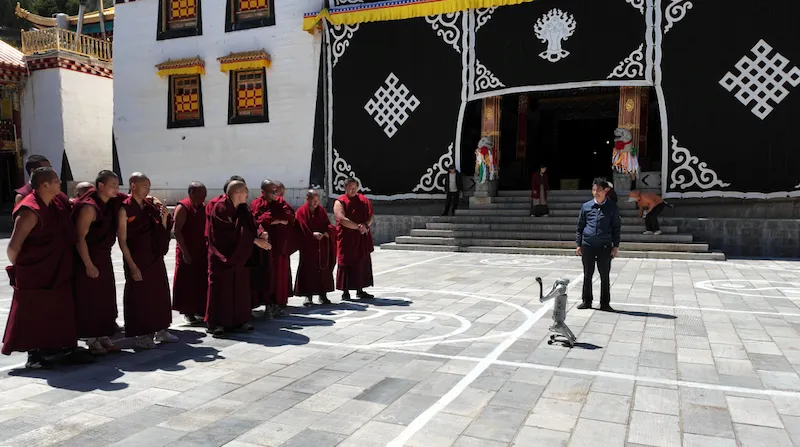
That said, rigorous study still leaves room for a healthy laugh, as we observed during our last visit to the monastery. A robot dog brought by a visitor literally sparked the amused curiosity of the monks, giving rise to a truly unusual scene: an unexpected contrast between tradition and futuristic technology!
Visiting the Gadan Dongzhulin Monastery is ultimately an experience that goes beyond a simple tourist visit. It opens the door to exploring an authentic place untouched by mass tourism, while allowing you to immerse yourself in the complex history of the Buddhist tradition and the territory of Yunnan.
At Ink Voyages, we can only highly recommend visiting this jewel nestled in the mountains of Yunnan, and we invite you to explore our catalog of private trips for your next adventures! Safe travels!