The Meili Snow Mountains: In Search of the Golden Moment
Table of Contents:
Stories of Love and Death from Mount Kawagebo
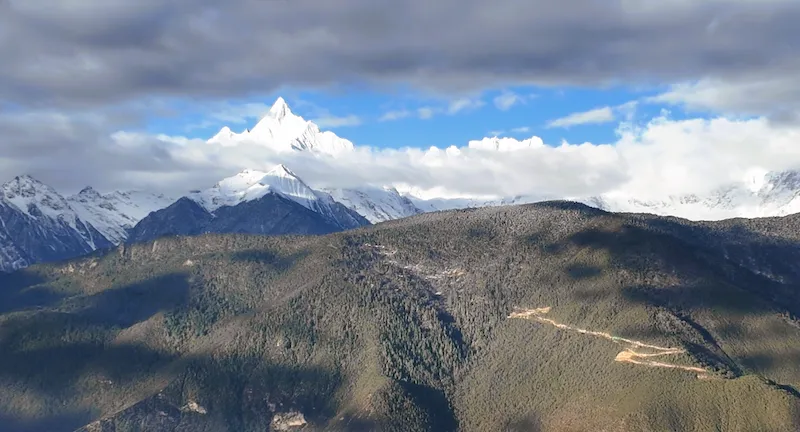
The Meili Snow Mountain range is located in the Diqing Tibetan Autonomous Prefecture, at the northwestern edge of Yunnan on the border with Tibet. It is composed of thirteen main peaks, with Mount Kawagebo standing as the undisputed king at 6,740 meters.
Not far from it rises Mount Miancimu (6,054 meters), his wife, draped in clouds as if wearing a bridal gown. We will return to the subject of these clouds later, as the weather factor is undoubtedly the most critical element to consider if you decide to venture into these parts…
If you would like more information on when and how to visit Yunnan, you can also read our travel guide to the region here.
Mount Kawagebo holds stories of love and death within its heart of stone and ice—stories that the Ink Voyages team heard once again during our latest journey to the area. The first is legendary and religious in nature; the second is daring and earthly.
Let us begin with the love story, which is rooted in the Tibetan mythology and spirituality that forms the cultural bedrock of the region. Kawagebo was not always the silent guardian we admire today. Tibetan myth tells us he was originally a fierce warrior deity with nine heads and eighteen arms, until the great master Padmasambhava converted him to Buddhism. Since then, Kawagebo became a divine general serving the legendary King Gesar, sworn to protect these snowy lands.
His love story with Miancimu (the “Goddess of the Sea”) was born, paradoxically, from a trick. During an expedition against an enemy kingdom, his adversaries offered the beautiful Miancimu to Kawagebo in marriage, hoping her beauty would distract him from the battle. However, the plan failed for an unexpected reason: the two fell deeply in love at first sight, turning a political plot into an eternal union.
To this day, the peak of Miancimu stands right beside her husband, gazing at him with affection and often hiding behind a thick veil of clouds, like a shy bride reluctant to reveal too much to travelers. It is said that the tears shed by the goddess during her husband’s absences at war gave rise to the Ice Lake near the village of Yubeng—a basin of crystal-clear water that reflects, like a mirror, the longing and devotion of a love that defies the millennia.
The history of the attempts to scale its summit tells a very different kind of story; the peak has never been reached by any expedition. Many times, Kawagebo has claimed the lives of those who dared to challenge him.
The Sino-Japanese expedition of 1991 was particularly tragic. It stopped just 270 meters below the summit when an avalanche buried the base camp during the night, claiming 17 lives.
Finally, in 2001, the mountain was declared a protected area for religious reasons, and it is no longer legal to attempt a climb. This was perhaps a way to officially and irrefutably decree the victory of the deity over man.
Hiking and Spirituality among the Meili Snow Mountains
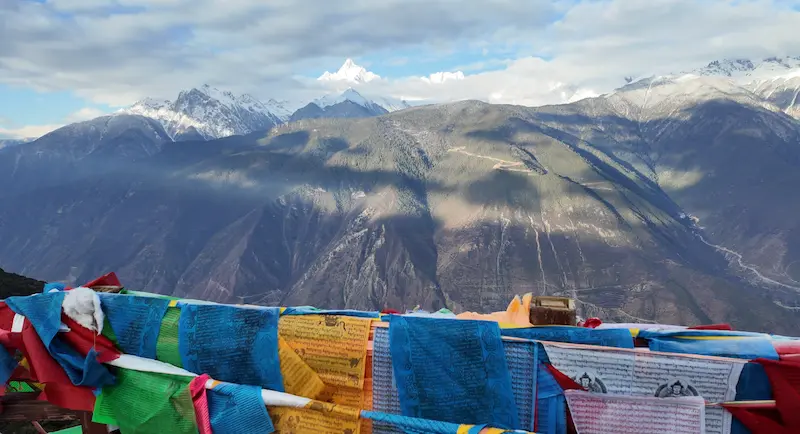
Today, only the ritual pilgrimage—the kora—is permitted around the mountain, for the purpose of purification, accumulating spiritual merit, and honoring the guardian deities of the range.
There are fundamentally two ways to perform the circumambulation:
The Inner Ring (Inner Kora)
This is the most famous route, lasting about 3–5 days (~30 km), and requires significant physical effort. The pilgrimage officially begins by descending the 3,777 stone steps connecting Feilai Temple to Qudeng Temple. From there, the trail continues clockwise toward the village of Ninong before climbing back up to the remote Yubeng Valley. The spiritual heart of this ring is the Sacred Waterfall (Shenpu): to correctly complete the kora, pilgrims must pass three times under the waterfall’s flow, as the “divine water” is believed to wash away sins and purify one’s karma.
The Outer Ring (Outer Kora)
This is the ultimate test of devotion—an epic undertaking of approximately 200 km that requires 8 to 12 days of trekking in total isolation. This route circles the entire Meili massif, crossing high-altitude passes that approach 5,000 meters (such as the Dokela Pass) and crossing into the Tibet Autonomous Region. It is an itinerary that tests physical endurance due to extreme altitudes and sudden weather shifts, but it rewards the traveler with a primal connection to nature and authentic Tibetan culture, far from any trace of mass tourism.
These are two physical trials that serve as spiritual exercises. Regardless of one’s religious beliefs, both paths offer a true experience of “meditation in motion,” allowing one to delve as much into the landscape as into oneself.
If you are interested in exploring hiking opportunities where history and legend intertwine, you can also read our article on the Ancient Tea Horse Road here.
If you do not have the time for these demanding excursions, rest assured that the Meili Snow Mountain range offers itself to the eyes of travelers even without the need for hiking.
Feilai Temple, the Sunrise, and the “Bride’s Veil”
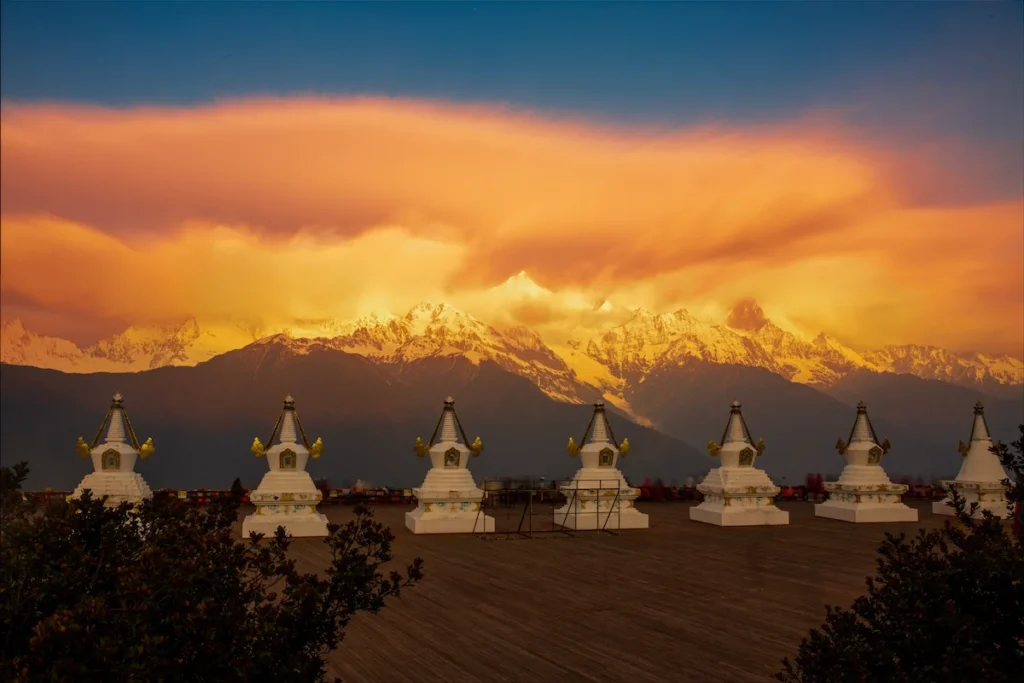
The quintessential observation point is Feilai Temple (literally “Flying Temple”), located about 10 km from the town of Deqin (Deqen) at an altitude of 3,400 meters. Built in 1614 during the Ming Dynasty, its name comes from a charming legend: it is said that a statue of Shakyamuni flew here directly from Tibet to indicate where the temple should be built.
On its viewing platform, eight white stupas have been constructed, their pointed silhouettes mirroring the divine peaks across from them on a human scale.
A tip: The main viewing platform tends to be quite crowded, even outside of peak tourist season. For a more intimate experience, head to the far left of the parking lot. You will notice a road that turns right and continues onward. You cannot drive it, but you can walk it.
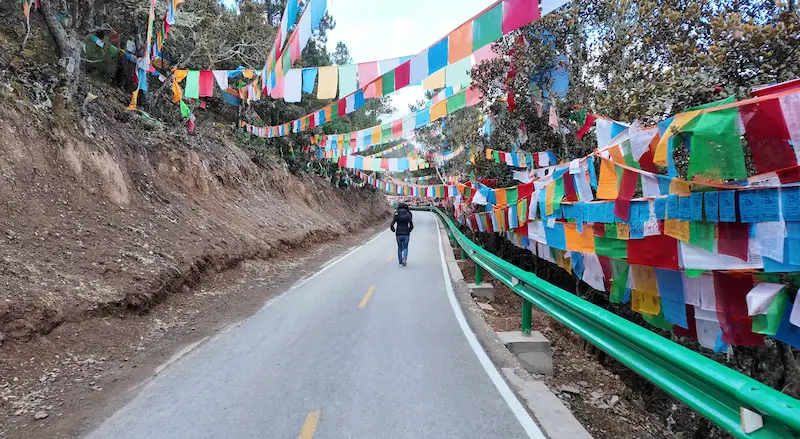
After about a fifteen-minute walk on a paved road, you will arrive at Viewing Point No. 3—decidedly more peaceful and capable of giving you a contemplative moment away from smartphones and the hum of drones (at least in low season; otherwise, prepare to share the experience with many others).
As we mentioned at the start of the article, let’s talk about the clouds. Kawagebo’s “bride’s veil” tends to be very extensive, often covering the surrounding mountains until they are barely visible.
If you have come this far expecting a postcard-perfect view of the Meili range, you must accept that it is possible… but only with luck. It is not just a matter of seasonality—the dry season is obviously recommended (avoid summer in Yunnan as it coincides with the rainy season)—but also specific daily weather conditions.
Even when planning a visit outside the rainy months—during which there is virtually no hope of seeing the peaks—one must consider that there are, on average, only fifty days a year when the view is completely clear of clouds.
This makes the experience quite unpredictable. And, in the event of failure, rather painful, given that the best time to enjoy the splendor of Mount Kawagebo and its surrounding peaks is at sunrise—which means you will have to wake up very early to try your luck.
This is a sign you might find in one of the local hotels, giving you an idea of how the sunrise is truly the pivot of the visual experience here:
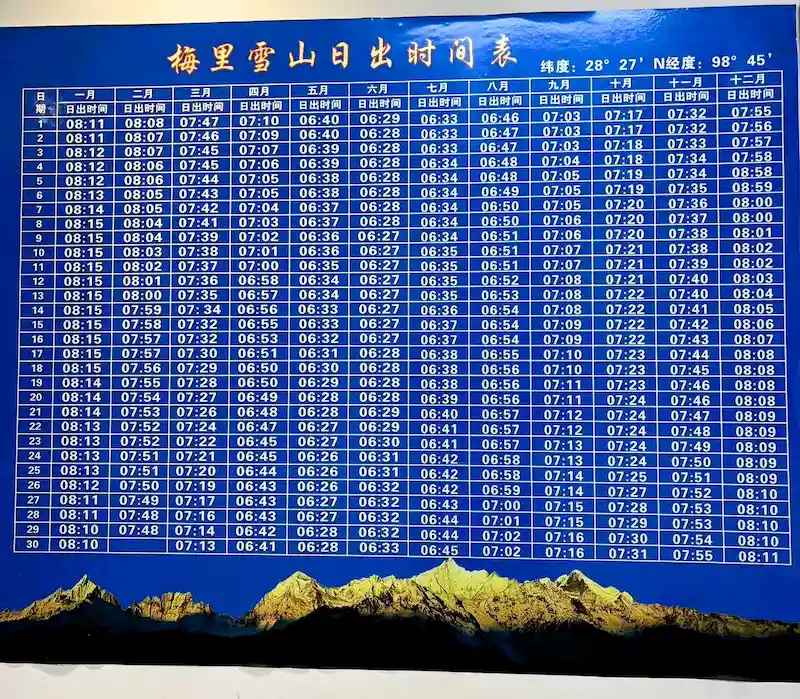
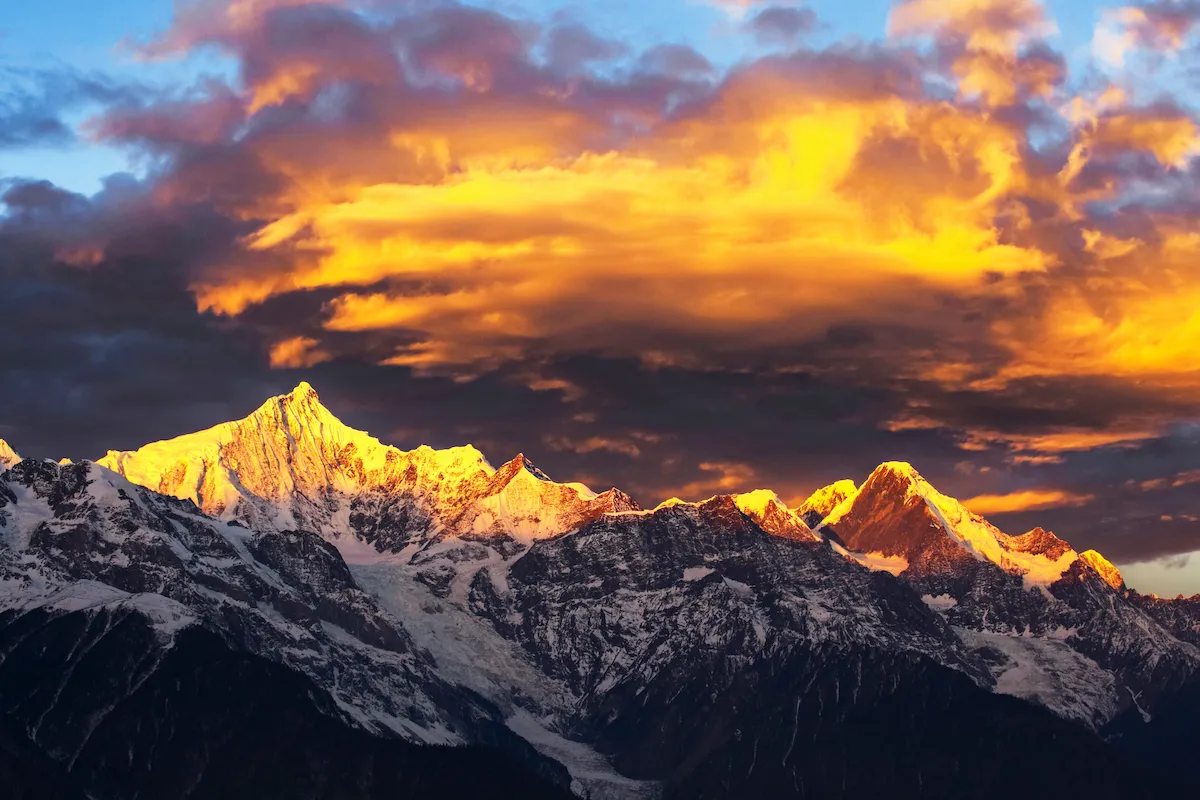
There is a magical moment when the peaks turn gold, perfectly kissed by the rising sun. This is the special “Golden Moment” captured in all the best photos of the Meili range—a sight and a photograph that every traveler aspires to, but which is granted to only a few.
Qudeng Temple and the Keys to Mount Kawagebo
Should you decide to perform the circumambulation of Mount Kawagebo, the first stop of your pilgrimage will not be Feilai Temple, but a temple located about 2.7 km further down the valley. This sacred site is dedicated to Padmasambhava (the Lotus-Born Master) and represents the true starting point for every pilgrim.
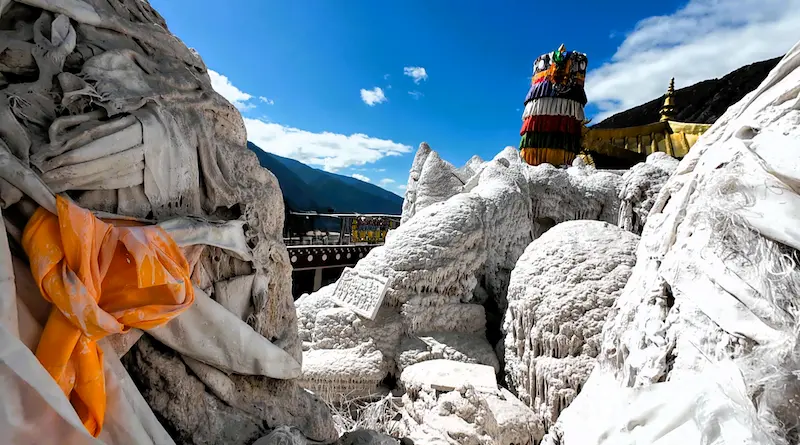
Even if you do not attempt the hike, we recommend visiting this place for its atmosphere and spiritual significance. It is a touching experience that leads you to a less touristy, truly local corner.
We are talking about Qudeng Temple, where pilgrims go to receive the spiritual “keys” before proceeding with the kora. To obtain the keys and be authorized to continue, one must perform three clockwise circumambulations of the white stupa and light butter lamps for protection and guidance.
There is another thing that makes this temple special: you will notice its appearance resembles the interior of a cave rather than a simple building. As an act of devotion, pilgrims have for centuries coated the temple walls with white lime and yak milk. This promotes a process of crystallization that literally makes the walls “grow,” transforming them into elements of the earth—much like minerals or stalactites—reinforcing the perception of a living, transformative spirituality.
Regardless of whether you are blessed with the weather to see the Meili range, this place opens the door to an authentic exploration. At Ink Voyages, we recommend it both to those who love challenging hiking adventures and to those who want to observe the rhythms of local spirituality up close in one of Yunnan’s most authentic corners.
If you are interested in discovering other destinations in China, you can browse our catalog of customizable private trips here.
Whether in Yunnan or elsewhere, we wish you the very best on your next adventure!