Along the Paths of Zhiziluo: the Ghost City in the Nujiang Gorge
Table of Contents
The Charm of a Ghost City
Are there perhaps places that best reveal their charm when it rains and the sky is overcast? Aren’t there places where—when you visit them—you almost hope the sun won’t come out? At Ink Voyages, we believe the answer is yes!
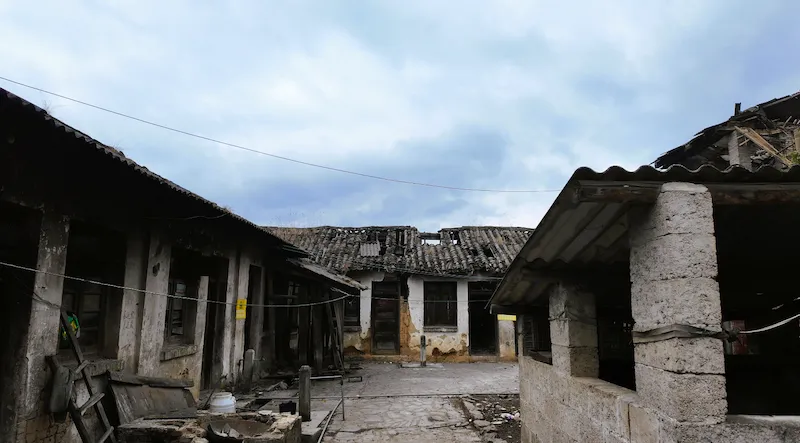
The “ghost city” of Zhiziluo is exactly one of these places, at its best when a gloomy atmosphere settles over its crumbling buildings, stirring a subtle unease in the pit of visitors’ stomachs as they wander through its streets…
To explore this settlement—one of the most surreal in China—you must venture into the Nu River gorge. Starting from Fugong, you should expect a drive of about 35 km northeast along numerous hairpin bends. The effort of the journey is more than rewarded by the charm of this truly unique destination.
If you are interested in learning more about this Chinese province, you can also read our travel guide to Yunnan.
Upon entering Zhiziluo, you immediately notice the abandoned feel of its main street, where a few shops appear almost by mistake among closed doors. The few remaining residents are not surprised to see you arrive by car, as throughout the year a handful of tourists make their way here, intrigued by the fame of the Ghost City. Yet you will be the one surprised to see them—unexpected apparitions in a place that strongly radiates the twilight charm of something that no longer belongs to the present, nor to the future.
A Ghostly Exploration
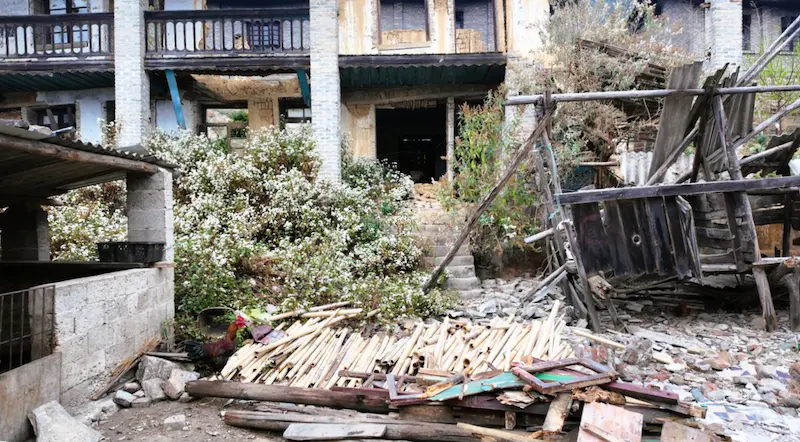
After parking your car by the roadside (don’t worry—there are no ghost traffic wardens ready to fine you), you can begin your exploration. As you walk through the streets, you will notice that the sense of abandonment that struck you at first only grows stronger with every step.
You may even feel a slight sense of unease as you pass courtyards watched over by roosters and hens, enclosures where large black pigs rest and grunt, crumbling buildings and ruins… all without encountering another human being.
And yet, turning down a street, you suddenly see someone who actually lives in Zhiziluo. An elderly woman carrying a basket full of vegetables on her back smiles at you and walks on… leaving you with an unavoidable question lingering in your mind: have you just met a ghost?
In reality, after walking around Zhiziluo for a while, you will realize that there are indeed residents here. Not many, of course: roughly three hundred people can be considered permanent inhabitants of this ghost city. In fact, you will notice that there are far more animal residents than human ones within the town’s boundaries.
Peeking through slightly open doors, you may also catch a glimpse of how harsh living conditions are inside the homes: always being careful to remain discreet, you might see a fire burning in a brazier on the floor, with a few people gathered around it.
A scene that, in itself, already reveals much about the strength and resilience of Zhiziluo’s inhabitants.
And if you are interested in exploring other remote areas in China, beyond the usual tourist routes, you can browse our catalog of customizable private trips.
The Rise and Fall of Zhiziluo
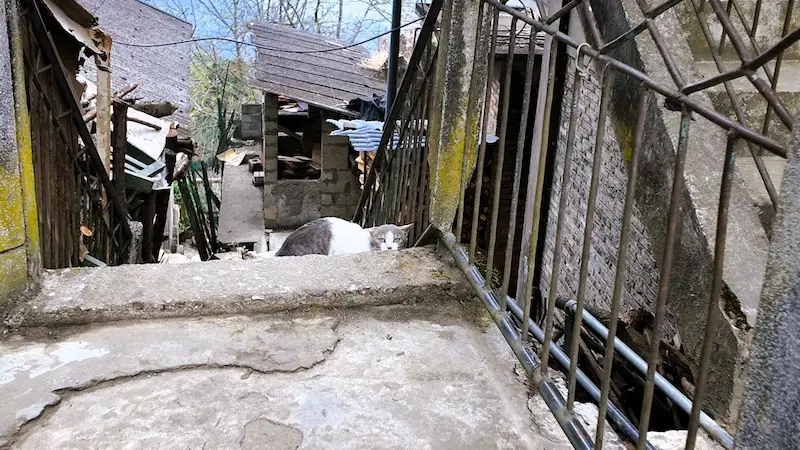
The history of this town is one of rise and decline: it began under the best auspices—starting with its very name, which according to some interpretations means “a good place” in the Lisu language. Zhiziluo was once an important hub along the Ancient Tea Horse Road, serving as a key trading post.
From the 1950s onward, Zhiziluo became the administrative center of the Nujiang Lisu Autonomous Prefecture, hosting government offices and functioning as a small regional capital. It was during these years that the Soviet-style buildings were constructed, which you can still visit today, and which retain—perhaps even intensified by the passage of time—their austere appearance.
The triggering event that led Zhiziluo to also be known today as the “Memory City” or “Ghost City” was a violent flood in 1979, which caused landslides and deaths. Following this tragic event, a commission sent from Beijing conducted a geological risk assessment of the area.
The results of that study led to the abolition of the county and the evacuation of Zhiziluo’s inhabitants in 1986, as it was deemed too exposed to geological hazards.
The Buildings of the City of Memories
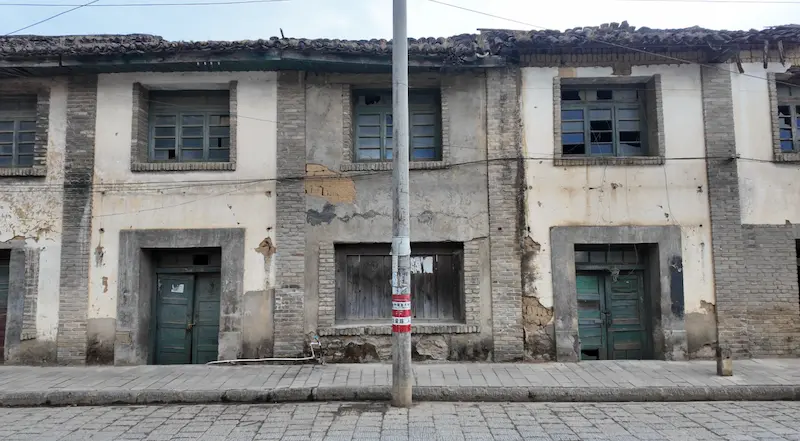
Over the years, some residents have returned to the City of Memories, which nevertheless has never ceased to belong to the past. Among the abandoned buildings, some are particularly symbolic and interesting (in some cases, they were even completed just before the evacuation order):
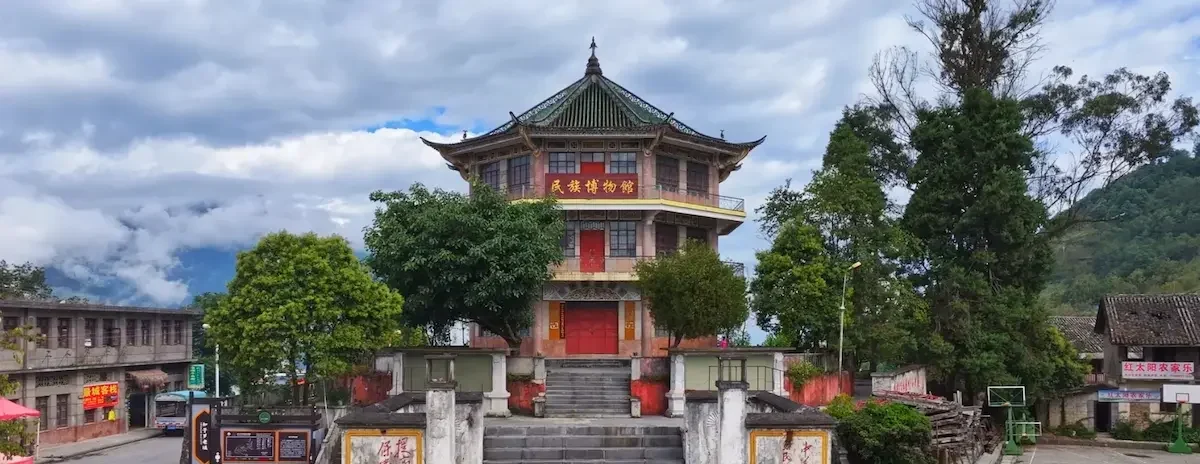
- Octagonal Pavilion: the most iconic building in the village. Built in the 1980s as a library and reading room, it was never actually used. Its octagonal shape and multi-tiered roof stand out among the surrounding rectangular blocks.
- Former county government headquarters: a large complex of Maoist-style administrative buildings, with inner courtyards and façades that still preserve traces of red slogans.
- Former cinema and recreation hall: once the center of social life, now silent and partially overtaken by vegetation.
- Former barracks, post office, bank: austere structures typical of the era, some now used as storage spaces or makeshift homes.
- Residential buildings from the 1970s–1980s: rows of two-story houses with simple balconies, many partially ruined or repurposed for livestock farming.
A Church in Zhiziluo?!
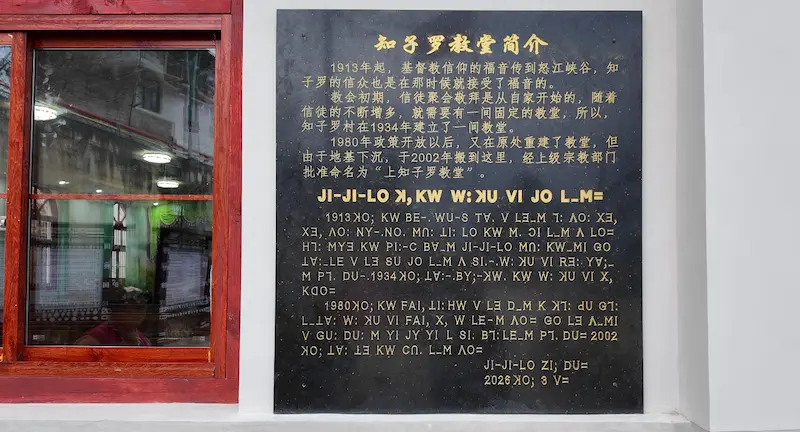
In this context of abandonment, it is also surprising to discover that there is one building still regularly used in Zhiziluo. Even more surprising is the fact that it is a Christian church!
This area is inhabited by the Nu and Lisu minorities, who have practiced Christianity since the 20th century, when British and French missionaries ventured into the Nujiang valley.
In particular, James Outram Fraser created an alphabet for the Lisu people, which later made it possible to translate the Bible into their local language, playing a decisive role in the spread of Christianity in the region. Today, around 70–80% of the Nu and Lisu population is Christian, as shown by Sunday services held in their villages, which survived the anti-religious Maoist reforms.
Finally, keep in mind that—unless you happen to be there on a Sunday—many of the churches in the surrounding villages remain closed and therefore cannot be visited.
The church in Zhiziluo has a simple, functional style both inside and out. Yet the very fact that it stands there, on the edge of a ghost settlement in the heart of the Nu River valley in Yunnan, is in itself astonishing and rich in history.
As this article comes to an end, the Ink Voyages team hopes it will be useful for exploring a place that—while it can hardly be defined as “beautiful” in the classical sense—certainly carries a truly unique and powerful charm.
If you find yourself in Yunnan and are looking for a special kind of exploration, we truly recommend passing through Zhiziluo. And if you are looking for further inspiration, you can also browse our catalog of private trips in China.
Safe travels!