Fenghuang Travel Guide: The City of the Phoenix
Table of Contents
Introduction to the City of the Phoenix
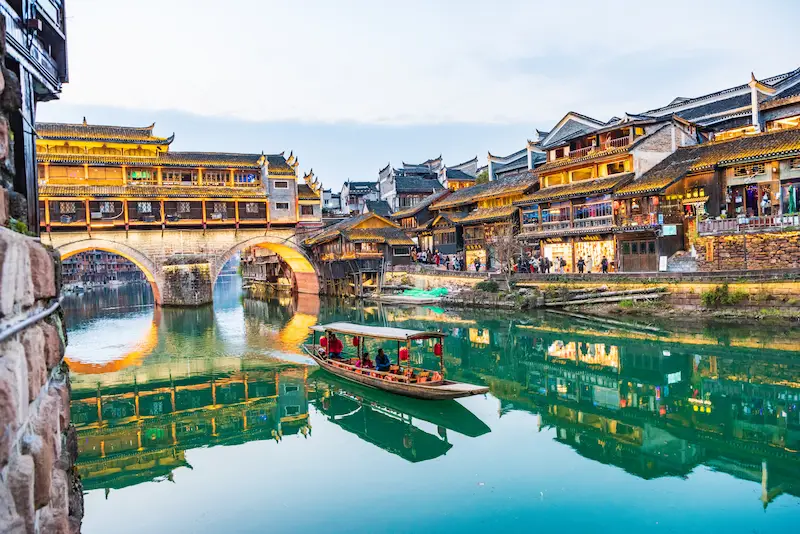
Fenghuang takes its name from Mount Fenghuang, located southwest of this ancient settlement in Hunan, which belongs to the Xiangxi Tujia and Miao Autonomous Prefecture.
According to legend, the shape of the mountain resembles that of a great phoenix spreading its wings over the Tuojiang River, ready to protect the valley and its inhabitants.
Fenghuang is located approximately 210 km south of Zhangjiajie and about 120 km south of Furong, making it easy to travel between these three destinations by high-speed train. Together, they form a perfect trio for a journey through this part of China.
Fenghuang between History and Scenic Tourism
As we wrote in our article on Furong, we at Ink Voyages consider Fenghuang a scenic town: in other words, a place that combines its genuinely historical character with extensive reconstruction and refurbishment for tourism, which has transformed it considerably from a scenic and visual standpoint.
If you would like to explore this subject further and better understand what to expect when visiting this type of town, you can read our article on Furong, where we look more closely at this key aspect of tourism in China.
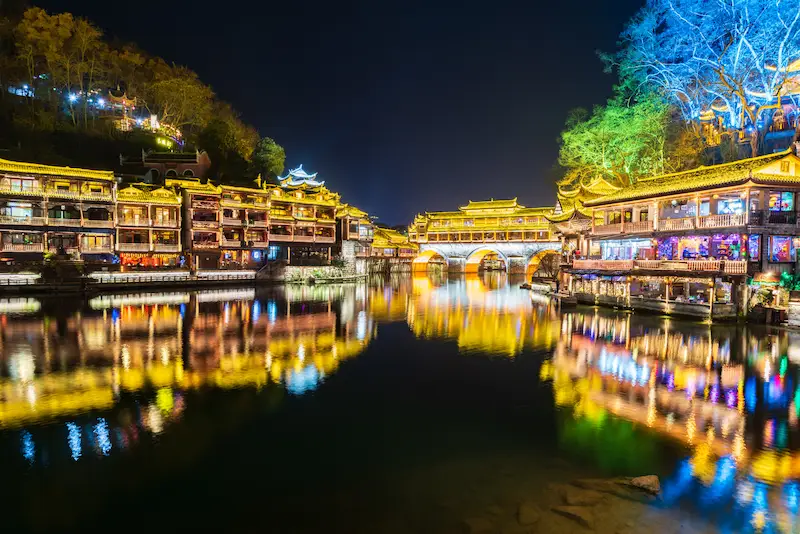
In our view, Fenghuang nevertheless retains a stronger historical character than Furong. Moreover, like Furong, it is in the evening that the City of the Phoenix truly comes alive, revealing its most beautiful and evocative side — something we genuinely recommend experiencing for yourself.
If you enjoy this kind of evening atmosphere, characterised by lights and lanterns, you might also consider visiting another scenic destination: Shangrao and Wangxian Valley, located about three hours by train from Shanghai. Alternatively, explore our catalogue of customisable private journeys to broaden your horizons across the vastness of China.
What to See in Fenghuang: The Highlights
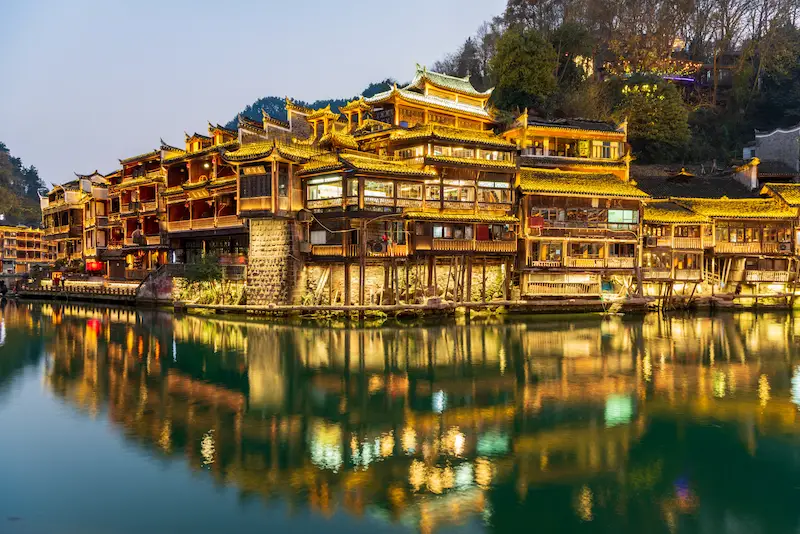
Visiting Fenghuang is quite straightforward: the historic centre is relatively compact, and the best way to discover it is on foot along the Tuojiang River — along which Fenghuang developed, with its characteristic Diaojiaolou architecture, also found at Hongya Cave in Chongqing — crossing its bridges and getting lost among its narrow lanes. Within a few hours, you will find yourself familiar with this town, whose highlights we summarise below:
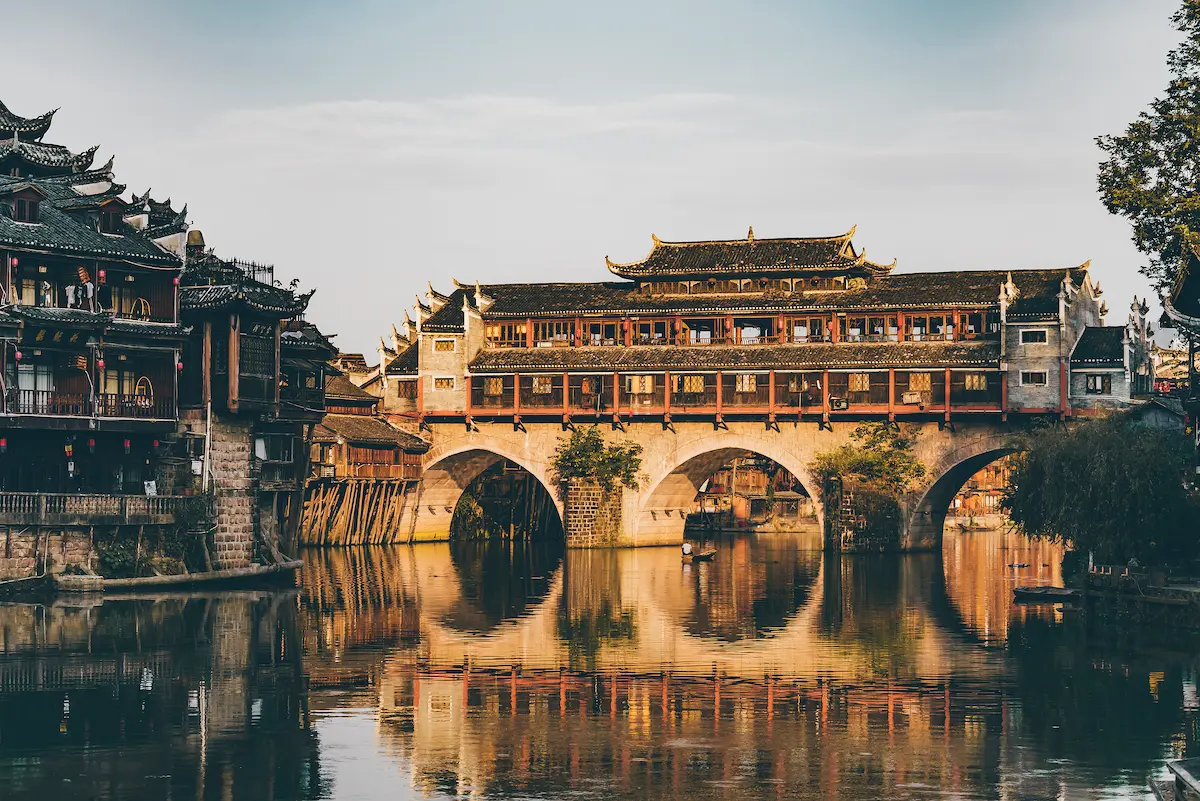
- Hongqiao Bridge: Fenghuang’s iconic two-storey covered bridge, built in 1670 during the Qing dynasty. From here, you can enjoy one of the finest panoramic views over the Tuojiang River and its historic stilt houses.
- Tiaoyan Stone Bridge: the famous crossing made of individual stone blocks spanning the river, historically used as a ford before the construction of modern bridges and today one of the town’s most photographed spots.
- Former Residence of Shen Congwen: a historic traditional courtyard residence in the style of the Qing period and the birthplace of the famous writer who immortalised the atmosphere of Fenghuang in Chinese literature: Shen Congwen.
- East Gate and Ancient City Walls: an imposing defensive bastion built of red sandstone, with origins dating back to the Ming dynasty, offering a direct testimony to Fenghuang’s military past as a frontier outpost.
- Wanshou Palace: a historic complex built by a guild of merchants from Jiangxi, now a museum with collections dedicated to traditional Miao art and culture.
The Origins of Fenghuang: An Imperial Frontier Outpost
In our view, to fully appreciate a visit to Fenghuang, it is interesting to understand the fascinating history of this settlement, whose origins as a military and commercial outpost date back to the Ming dynasty: in 1556, its pre-existing fortifications were rebuilt in brick, while the settlement continued to develop in the following decades, culminating in the important administrative and military reorganisation of 1704 under the Qing.
The emergence of Fenghuang was first and foremost driven by a political need on the part of the Han, who developed it as a true military outpost to control the Miao populations of the area, particularly those Miao who sought refuge in the mountains, or the “raw” Miao, as they were described by the Han in contrast to the “cooked” Miao, meaning those who had accepted imperial authority.
Indeed, Fenghuang became a key part of a system of fortifications known as the Southern Great Wall, or Miaojiang Great Wall (not to be confused with its much bigger brother in Beijing), developed during the Ming dynasty and extending for more than 190 km across western Hunan. Its purpose was to separate and protect the shu Miao (the integrated Miao, literally “cooked”) from the sheng Miao, the “raw”, non-assimilated groups who not only resisted imperial control but also carried out raids against Han outposts in the region.
The Organisation of the Miao and the Gaitu Guiliu Process
Unlike the Tujia — the ethnic group that made Furong the centre of its power and developed a highly centralised system — the Miao were not characterised by the same degree of political cohesion and were divided into numerous clans, some of which were led by families recognised by the imperial authorities through the Tusi system.
It should nevertheless be noted that the Miao did not form and consolidate true kingdoms, as was the case with the neighbouring Tujia Tusi, of which Furong represented the capital.
Despite the geographical proximity of the Miao and Tujia ethnic groups, their internal organisation and their interactions with the Han were therefore very different. While Furong represented the heart of a territory largely governed by an ethnic minority, Fenghuang was already an imperial outpost, established by the Han precisely with the aim of pacifying the tribal clans of Hunan and administered directly by imperial officials.
Over the centuries, the presence of imperial officials governing the frontier regions gradually extended beyond them, and local Tusi — direct representatives of the various ethnic groups — were progressively replaced by Han officials selected and appointed by the imperial court.
This tendency, already present in Fenghuang from the beginning because the city itself was a direct expression of Han imperial power, became institutionalised under the name of Gaitu Guiliu during the 18th century. Especially under the Yongzheng reign (1722–1735), the Gaitu Guiliu policy led to the gradual replacement of hereditary local rulers with officials appointed by the imperial court, reinforcing over time the integration between the Han and other ethnic groups across China’s vast territories.
This process was not without conflict, and the most evident scar left by this history dates back to 1795–1806, the years of the great Miao rebellion during the Qing dynasty. Led by Miao clan leaders Shi Sanbao and Wu Tianban, the uprising began in the mountains around Fenghuang in opposition to the expansion of Han settlers and imperial control. Fenghuang became one of the strategic centres of the Qing suppression, from which generals Fuk’anggan and Helun conducted military operations at the cost of numerous lives.
Travelling to Fenghuang with Ink Voyages
Are you finally ready to set off? From the Ink Voyages team, all that remains is to wish you a wonderful journey — with one final historical guidebook to pack in your luggage.
Especially in towns like Fenghuang, where tourism is advancing rapidly and, inevitably, in some ways alters the places that also benefit from the wealth and prosperity it brings, we believe it is even more important to visit with an awareness of the past.
If you are interested in exploring China in depth, you can also browse our recommended itineraries to discover China.