

What is Authentic in China? A Guide for Discerning Travelers
Table of Contents
When traveling in China, one of the most important and often overlooked aspects to consider when creating your itinerary is the tourist experience itself.
This means that when putting together an itinerary for China, it is not enough to ask: what am I going to see? You should also ask: what kind of tourist experience is associated with visiting that particular place?
This distinction is far from abstract, and overlooking it can have a negative impact on your trip. Speaking to someone who had recently taken an independent trip to China with his wife and two young children, he told us the following about Zhangjiajie:
“The mountains are beautiful, very beautiful. But it’s not for me… it didn’t even feel like I was in the mountains, with stairs, walkways, shuttle buses and elevators everywhere.”
To explore other useful aspects of planning a trip to China, we also recommend reading our articles on “How to Travel in China” and “10 Tips for Planning Your Trip to China”.
How You Visit Matters as Much as What You Visit
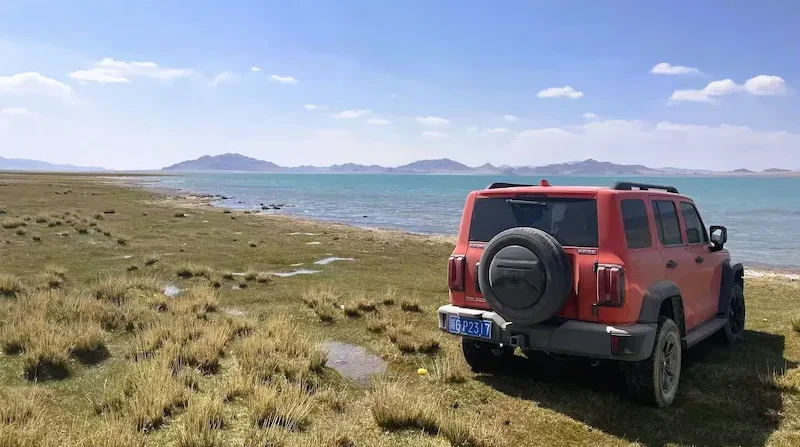
The question of what kind of tourist experience accompanies a particular destination therefore becomes essential when making travel choices. You could argue that how you visit a place is just as important as what you visit.
Encountering the reality of China’s major tourist destinations can create a mismatch with the expectations of an unprepared traveler, who may ultimately leave disappointed, even though neither side is really at fault. The problem is not Zhangjiajie’s walkways, nor is there anything wrong with preferring mountain trails to them.
An elevator such as the Bailong, which races from the foot of the mountains to the summit in just 66 seconds, covering a vertical rise of 326 meters, can be a spectacular experience for someone who enjoys being amazed by China’s engineering feats. At the same time, it can shatter the magic for someone who expected to encounter the untouched world of Pandora.
The solution, therefore, is to make your travel choices according to your own preferences: something that sounds obvious and simple in theory, but can prove surprisingly difficult in practice.
Before visiting a place, you do not have a first-hand experience of what it actually feels like to be there; you may be surrounded by conflicting feedback from acquaintances, whether direct or indirect; and, on top of that, you are exposed to a constant stream of social media content that tries, at all costs, to make even ordinary things appear “sensational”.
What Does “Authentic China” Really Mean?

So how should you go about creating your itinerary in China?
Someone who gets on a plane to travel halfway around the world wants to return home with the satisfaction of having seen the “real China”, the “authentic China”, as many of the guests who travel with Ink Voyages tell us.
Our view of this kind of request has become less categorical over time.
China is an immense country made up of many different worlds, marked by extraordinary diversity. It offers visitors an exceptionally broad range of experiences and can reveal its authenticity in ways that are very different from one another, and sometimes even seemingly opposite.
In this sense, it is worth understanding that traveling into the mountains by elevator is, in itself, “authentically” Chinese. It is one of the ways in which China expresses one of its proudest characteristics: the ability to build the impossible, to accomplish what once seemed unrealizable, and to make places that would otherwise be inaccessible available to everyone.
This is part of the “real China”, which, when faced with the Avatar Mountains, shows its hospitality by reducing physical effort as much as possible when visiting them. You may like it, or you may not. What matters is knowing what to expect.
Likewise, finding yourself in the middle of a grassland and sleeping in a yurt belonging to Mongolian nomads, surrounded by nothing but the darkness of the night and their livestock, or trekking along a forgotten ancient section of the Ancient Tea Horse Road in Yunnan, perched above the jade-colored waters of the Jinsha River, is also an authentically Chinese experience.
Furong and Wangxian: The Authenticity of Xianxia
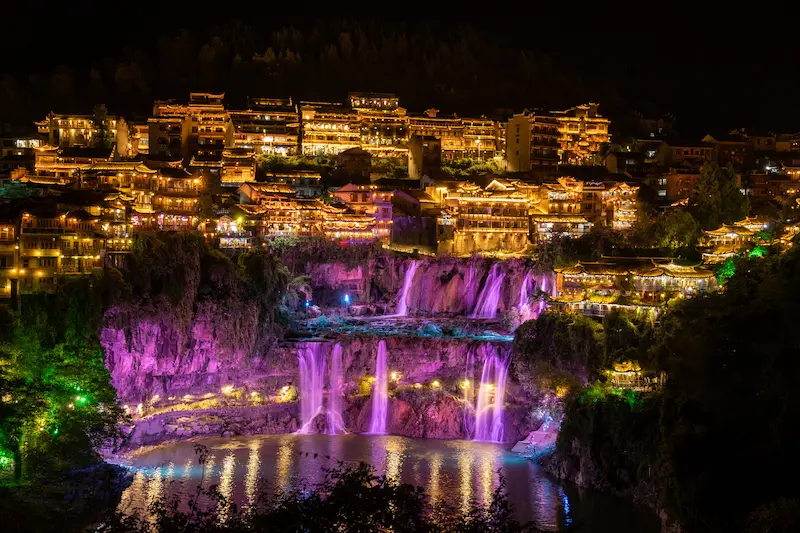
This perspective on the many faces authenticity can take can also be applied to towns and villages. The concept of the “Ancient Town”, widely used in China, is a perfect illustration of the different meanings the word “authentic” can take on.
Take Furong Ancient Town, for example. A visitor arriving in Furong expecting to find a perfectly preserved historic settlement would be disappointed. The historic part of Furong has in fact been extensively transformed for tourism and visual impact, to the point that walking through the town can feel like entering a theme park.
This is even more evident in Wangxian Valley, whose current old-fashioned appearance was largely built from 2012 onward as part of a redevelopment project that turned Wangxian into a genuine tourist village. There is literally staff inside.
And yet, in our view, these spectacular and highly staged reinterpretations of the past are, in themselves, authentically Chinese and represent one of the faces of the “real China”.
They reflect an aesthetic approach that is central to the modern Chinese way of engaging with cultural heritage: this spectacularization of the past draws on an imaginary that is deeply present in modern Chinese culture — xianxia (仙侠) — a fantasy genre associated with immortals, martial arts, magic and traditional cosmologies.
Isn’t this also an authentic trait of local culture?
At Ink Voyages, we prefer to describe this type of town as “scenic”, which in our view represents them better than the term “ancient”.
You can easily understand why this term fits by visiting these places, especially in the evening, when the lights come on and the colorful lanterns transport visitors into a fairytale-like, otherworldly world.
Whether you find yourself in front of the illuminated waterfall in Furong or beneath the light of Wangxian’s artificial moon (yes, they actually built a fake moon in Wangxian), you will find it hard not to be captivated by the spectacle.
The Authenticity of the Ancient and of Tradition

Alternatively, if you are more interested in another side of Chinese authenticity and exploratory travel, where the word “ancient” can be applied more strictly, you can visit villages such as Baoshan Stone Village, made up of stone houses emerging from a mushroom-shaped rock; Nuodeng, a thousand-year-old settlement of the Bai ethnic minority that flourished thanks to the salt trade; Zhiziluo, the ghost town (or City of Memories) in the Nujiang Gorge, a semi-abandoned city of socialist-era buildings dating from the 1970s and 1980s; or Wuli, near Bingzhongluo, also known as the Village of Mist, with its still-traditional wooden houses.
During our most recent visit to Wuli, we noticed that preparations were underway to build several guesthouses. Even so, these places remain remarkably well preserved and can still convey a genuine sense of “antiquity”.
Here, then, you can come into contact with another side of the “real China”: that of ethnic minorities and their traditions, of remote borderlands, of ancient trade routes, and of centuries-old rice terraces.
Keep in mind that China is home to 56 ethnic groups, including the Han, each with its own traditions and cultures, coexisting beneath the vast sky of the Middle Kingdom (Zhong Guo, 中国), as the Chinese call their country.
One China, Many Forms of Authenticity
We have therefore come to realize that the question of what is authentic in China can itself be misleading and restrictive. China is, in fact, a kaleidoscope in which authenticity takes many different forms.
Ultimately, behind the search for the “real China” there is often a desire for an itinerary that is authentically aligned with the tastes of the person traveling.
And this is therefore one of the most important things to consider when planning: understanding not only where you want to go, but also what kind of tourist experience is associated with that destination. How you visit, not just what you visit.
China’s vastness undoubtedly makes it possible to satisfy every kind of traveler, provided you know how to interpret it.
One important note before we leave you and wish you a good journey: the fact that there are many possible interpretations of the “real China” does not mean that everything that is, in its own way, authentic is also necessarily worth visiting.
It is worth emphasizing that not every Chinese natural park equipped with elevators, stairs and walkways is as spectacular as Zhangjiajie; not every scenic town in China is as breathtaking as Furong or Fenghuang; and not every ancient village retains the charm of Baoshan Stone Village or Nuodeng.
With this final clarification, we have reached the end of the article. We hope this guide will help you plan your next trip to China thoughtfully. And, if you are looking for inspiration for your journey, you can also explore our catalogue of recommended itineraries.



Leave a Reply