Wangxian Valley and the Awaiting of the Immortal
Table of Contents
Have you ever noticed the atmosphere of Chinese fantasy, with temples suspended among the clouds, mystical mist drifting through the landscape, and rows of red and golden lanterns enveloping everything they touch in an elegant sense of unreality?
Welcome to Wangxian Valley! A real-life embodiment of the fantasies and atmospheres of Xianxia, the world of Chinese fantasy.
How to Get to Wangxian Valley
Before telling you more about Wangxian Valley, let’s first explain where it is and how to get there, as reaching it requires a little logistical effort.
Wangxian Valley is located in Jiangxi Province, about 50 kilometres from the city of Shangrao. To get there, you first need to reach Shangrao Railway Station, which is well connected to Shanghai by high-speed train, taking around three hours. Once you arrive at the station, allow for another hour or so by car to reach the entrance to the scenic area.
Especially during the high season, keep an eye on late-afternoon traffic, as the final stretch leading to the entrance of the scenic area can easily become congested. In general, since one night in Wangxian Valley is normally enough, we recommend arriving by early afternoon at the latest, or in the late morning, so that you have enough time to enjoy the place at your own pace, including the rafting experience, which is great fun and quite an adrenaline rush.
The Rafting Experience at Wangxian Valley
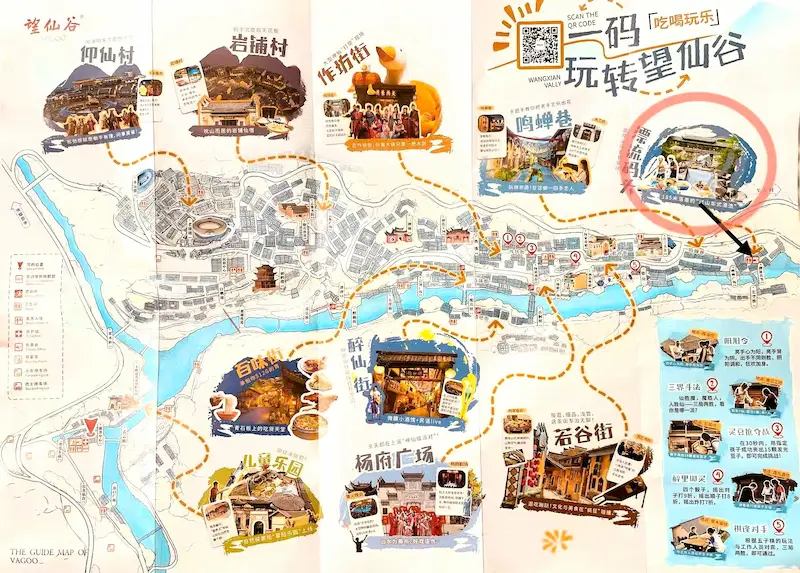
We at Ink Voyages really like it! The course is 2.8 kilometres long, with an elevation difference of 185 metres. Keep the helmet provided firmly fastened, hold on tight, and get ready to be soaked from head to toe!
The time spent on the water is approximately 40 minutes to one and a half hours, depending in part on how long you stop to play in the sections where the current slows down. The rafting starting point is located in the deepest part of the scenic area and requires around 30 minutes of uphill walking from the main entrance.
Suggested Schedule
- 13:30 — Arrival at Wangxian Valley and hotel check-in
- 14:00 — Start walking towards the rafting starting point
- 14:30–15:00 — Start of the rafting descent
- 16:00 — End of the activity, shower and change of clothes
If you enjoy rafting, you can also consider an equally adrenaline-filled experience at Gulongxia, about two hours north of Guangzhou.
The Evening Magic and the Right Perspective for Visiting
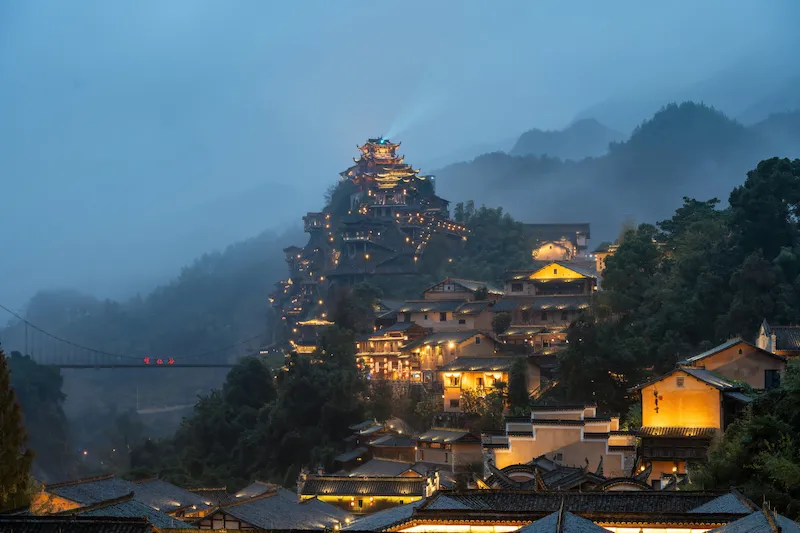
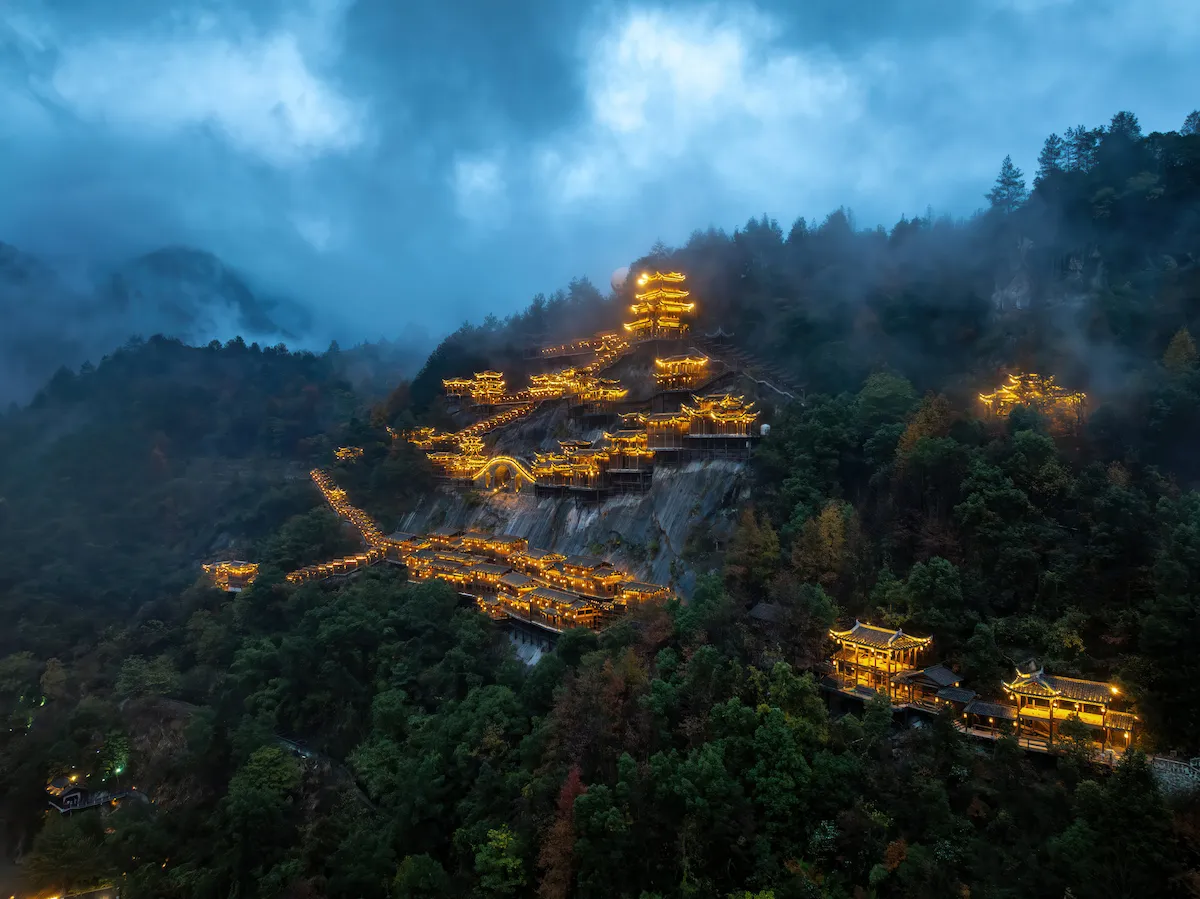
After the rafting experience, you are finally ready to enjoy one of the most beautiful Xianxia-style visual spectacles China has to offer. Wangxian Valley truly comes to life once the lights are switched on, suddenly immersing you in a fairytale-like and surreal world.
The best way to visit is simply to wander along the little streets, getting lost among them and taking in the magical atmosphere of the place. As we wrote about Furong Ancient Town and, to a lesser extent, Fenghuang, when visiting Wangxian you should not expect an ancient village in the strict sense of the term.
We tell you this because, in our view, having the right perspective is really important to appreciating the experience. If you come all the way here — and getting here is not particularly easy — expecting a settlement from another era, you will inevitably end up disappointed.
If you are planning a trip to China and want to play it safe, you can discover our recommended itineraries here for a perfectly organised private journey. If you prefer independent exploration, you can always rely on our experience for seamless planning.
The entire area was actually built recently, following a major process of land redevelopment in an area that had been heavily affected by mining activity between the 20th century and the beginning of the 21st century. Wangxian Valley was in fact an industrial site for the extraction and processing of granite. Mining had left behind a deeply degraded landscape, with polluted waterways, slopes stripped of vegetation, and villages that had gradually lost much of their population.
The rebirth of Wangxian Valley was made possible by a major environmental rehabilitation project. Specifically, the tourist area you visit today was built starting in 2011, using historical restoration techniques and local materials, with the intention of presenting visitors with an image of an untouched past. In some respects, this process of territorial redevelopment may remind you of the history of Datong, in northern Shanxi.
Today, the traditional earthen and wooden dwellings built along the vertical cliffs represent a remarkable example of highly successful scenic restoration: the houses, streets, bridges and architectural structures that make up the most spectacular part of the valley are part of a contemporary tourism development inspired by the region’s traditional architecture and imagery.
So keep this aspect firmly in mind: do not think of Wangxian Valley as a purely historical place, but rather as a vast landscape setting built around a natural gorge, its recent history, and an imaginary world deeply connected to the culture of the Immortals and Xianxia — complete with special effects and performances.
If, on the other hand, you are interested in visiting villages with an intact historical character, you can read our articles on Nuodeng, the thousand-year-old Bai village, and Baoshan Stone Village, a Naxi settlement seemingly untouched by time, in Yunnan.
What to See and Do: Highlights
Here are the main sights and experiences within the scenic area:
Iconic and Panoramic Sights
- Lanyue Bridge (揽月桥 — Moon Bridge): The famous stone arch bridge, the visual symbol of the valley and a perfect spot for panoramic photographs once the evening illumination begins.
- Chaohe Tower (朝鹤楼): The highest observation point, perched on top of the hill overlooking the entire canyon from above.
- Cliffside Walkways (悬崖栈道): Walkways built into the vertical granite cliff, connecting the overhanging dwellings.
Cultural Heritage and Performances
- Yang Residence (杨府): An imposing traditional residence that provides the setting for the immersive travelling performance The Mysteries of the Yang Residence (杨府奇谭).
- Ancient Weilou of Yangxian (仰仙村老围楼): The large circular fortified building where you can watch traditional Nuo Dance (傩舞) performances featuring ritual masks.
- Hu Family Ancestral Hall (胡氏宗祠): The folkloric heart of the valley, located near Zongci Square, where traditional parades, a re-enactment of an ancient Gan wedding and evening fire performances take place.
The Myth of the Immortals and the Legend of Hu Zhao
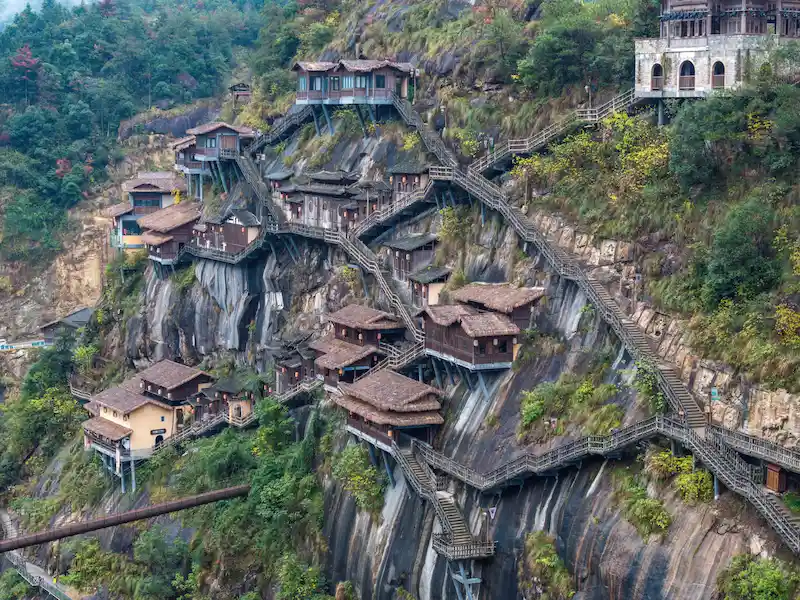
As you walk around, you will notice that there are also temples — recently built ones — and that, more than the individual highlights, what makes Wangxian fascinating is its overall atmosphere, which for one night transports you into the realm of the Immortals (Xian — 仙). This concept is central to understanding Wangxian Valley on a deeper level, and many of the performances you will see are inspired by it.
In Chinese culture, the term “Immortals” refers to those who have reached a state of transcendence through meditation, spiritual discipline and alchemy, transforming their body and soul, overcoming the limits of mortality and entering into perfect harmony with the forces of nature and the universe.
The story of Wangxian Valley revolves around the legendary figure of Hu Zhao (locally revered with the honorific title Hu Zhaogong), a character who was both historical and mythical and who lived during the late Eastern Han dynasty, around the 2nd century AD.
Hu Zhao was a high-ranking court official who gradually developed a deep detachment from politics and imperial life, which at the time was in a period of decline. Seeking to escape from a world in which he no longer felt at home, he decided to search for another one. During his journey in search of an inaccessible place where he could withdraw and protect his family, he eventually ventured into the wild mountains of Shangrao.
When he reached Wangxian Valley, protected by imposing granite cliffs and crossed by crystal-clear streams, he realised that he had found the right place. After settling there, Hu Zhao devoted himself entirely to the Taoist path, studying natural medicine and the alchemical arts. He spent the years of his life in the valley preparing medicinal remedies for local farmers and meditating, deepening his knowledge of Qi — the vital energy that flows through and connects all things — while searching for the secret of preparing the elixir of longevity.
According to legend, after reaching a venerable age without showing the signs of ageing, Hu Zhao one day ascended to the heavens, becoming an Immortal in the truest sense. After his disappearance, grateful farmers would often climb towards the peaks where he used to meditate and look up, hoping to catch another glimpse of him.
And it is precisely from this gesture that the valley takes its name: Wangxian (望仙) literally means “to look towards the Immortal” or “awaiting the Immortal”.
Who knows — as you wander through the enchanted Wangxian Valley, perhaps beneath the light of the great artificial moon positioned just behind the suspended structures at the highest part of the cliff — you might even catch, if only for an instant, a glimpse of the fluid and benevolent figure of Hu Zhaogong.
At Ink Voyages, we wish you the very best on your explorations of China. If you are looking for inspiration, you are welcome to discover our catalogue of customisable private journeys, designed to allow you to experience China in an authentic way.