
What to Eat in China: A Journey Through Its Regional Cuisines
Table of Contents
China’s Great Regional Cuisines
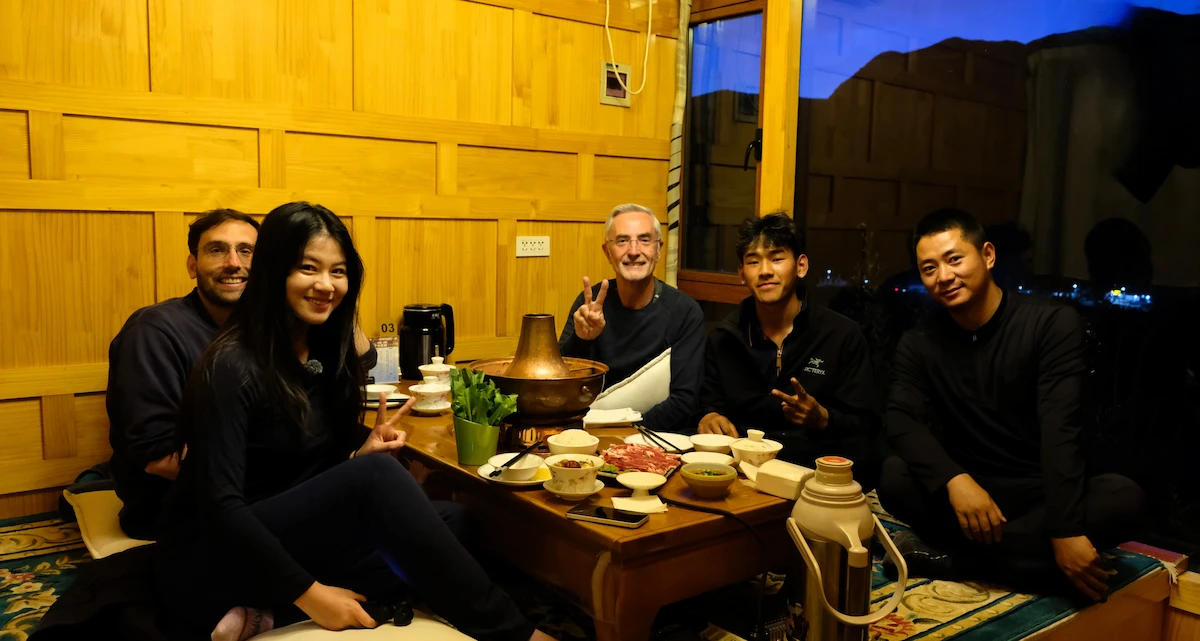
In this article, we want to introduce you to the richness of Chinese cuisine while also leaving room for our personal preferences and culinary tastes. We have also selected a number of restaurants that, based on our own experience, represent the flavours of their respective regions and are well worth trying.
We do not claim to have identified the very best restaurants in China, nor do we pretend to be entirely impartial. These are simply places that have left us with special memories and, in one way or another, offered us particularly rewarding culinary experiences. For convenience, we will provide each restaurant’s name in both Chinese and pinyin, together with its address in Chinese. This will make it much easier to find the places or ask a local for directions.
China’s vast territory has given rise to extraordinarily diverse culinary traditions. A traditional classification identifies eight major regional cuisines, known in Chinese as 八大菜系 (bā dà càixì), each with its own identity, ingredients, cooking techniques and distinctive flavours.
They are the cuisines of Shandong (鲁菜), Sichuan (川菜), Guangdong, also known as Cantonese cuisine (粤菜), Fujian (闽菜), Jiangsu (苏菜), Zhejiang (浙菜), Hunan (湘菜) and Anhui (徽菜).
However, this classification by no means encompasses the full diversity of Chinese gastronomy. Many other regions and ethnic communities have developed culinary traditions that are just as fascinating and deserve to be discovered.
Below, we introduce some of the regional culinary traditions that, in our opinion, are particularly interesting to learn about – or, better still, to taste!
And if you would like some practical advice on enjoying the food scene in China, ordering at restaurants, scanning QR codes and translating digital menus, you can also read our guide on how to eat in China.
The Kingdom of Spice: Sichuan, Hunan and Chongqing
When it comes to spicy food in China, Sichuan is probably the first region that comes to mind.
Its cuisine is famous for its generous use of chilli peppers and, above all, Sichuan pepper (huājiāo). The latter is not actually a pepper, but a spice that produces a distinctive tingling and mildly numbing sensation on the tongue. The combination of heat and this tingling sensation gives rise to the concept of 麻辣 (málà), one of the defining characteristics of Sichuan cuisine.
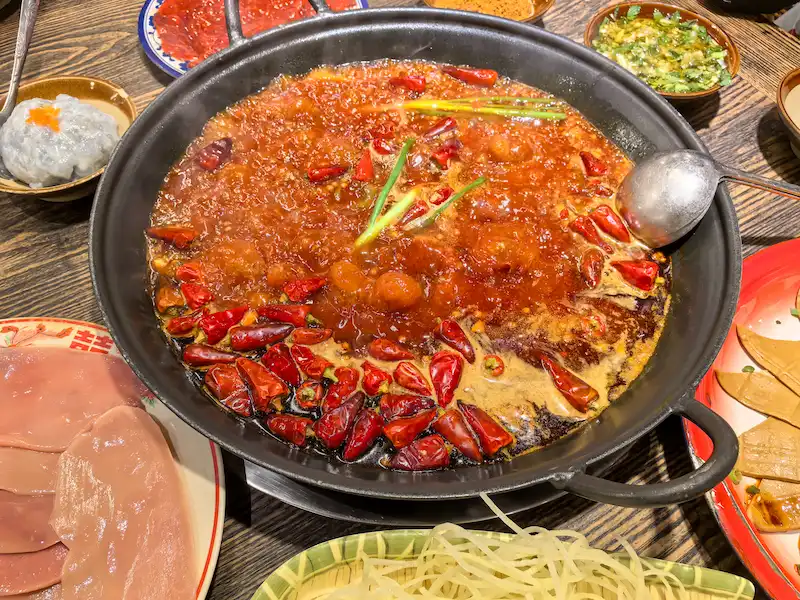
Among the best-known dishes are mapo tofu, twice-cooked pork and, of course, Sichuan hot pot, in which meat, vegetables, mushrooms and other ingredients are cooked directly at the table in a richly spiced broth.
However, not every dish from the region is necessarily spicy: Sichuan cuisine also offers plenty of preparations with sweet, aromatic and sweet-and-sour flavours.
Another region famous for its spicy cuisine is Hunan, where both fresh and dried chilli peppers play a particularly important role. Compared with Sichuan, the heat tends to be more direct, without the characteristic numbing sensation produced by Sichuan pepper.
Chongqing deserves a special mention. Although it is now a municipality directly administered by China’s central government, separate from Sichuan Province, it remains deeply connected to the region’s culinary traditions. It is here that one of China’s most famous versions of hot pot developed, becoming a true symbol of the city.
Compared with other varieties, Chongqing hot pot is distinguished by its particularly rich and intense broth, traditionally prepared with generous amounts of chilli, Sichuan pepper and beef tallow. Some of the most characteristic ingredients cooked in the broth include tripe, duck intestines and various kinds of meat and vegetables.
Eating hot pot in Chongqing is an experience that goes well beyond the food itself. Specialised restaurants are often lively and bustling, and sharing a hot pot, particularly among friends and family, is one of the most characteristic aspects of local food culture.
There are two interesting stories behind this preference for spicy food: one related to the region’s climate and the other to the humble origins of the dish.
The first concerns Chongqing’s climate, which is characterised by high humidity. Local food traditions have long associated spicy ingredients, such as chilli peppers and Sichuan pepper, with the idea of helping the body counteract humidity through increased sweating.
The second story concerns the popular origins of hot pot. According to one of the most widely known accounts, the dish began as an inexpensive meal among dock workers and boatmen working along the Yangtze and Jialing rivers. The ingredients often consisted of less valuable cuts of meat, such as tripe, offal and other inexpensive parts of the animal, which the richly spiced broth helped turn into a flavourful and satisfying meal.
Our recommended restaurant for the world of spice
- Name: 地下之城·防空洞老火锅(龙头寺店)
- Pinyin: Dìxià Zhīchéng · Fángkōngdòng Lǎo Huǒguō (Lóngtóusì Diàn)
- Address: 吉安路临5号地下之城4号洞(近龙头寺公园南门)
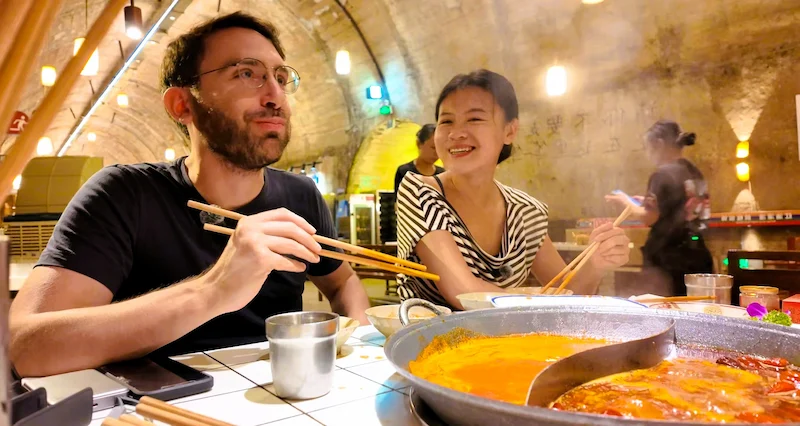
This restaurant takes you straight into the historical soul of Chongqing, as you will be eating the city’s famous hot pot inside an actual air-raid shelter. Chongqing has more than 1,600 shelters of this kind, built to protect the population from bombing during the Second Sino-Japanese War. It is wonderful to see how many of these spaces have since been transformed into places where people gather and enjoy everyday life.
The hot pot here is intense and delicious. And if you would rather avoid the heat, you can always dedicate one section of the pot to a non-spicy broth.
Yunnan: Fragrant Flavours, Wild Mushrooms, Flowers and Edible Insects
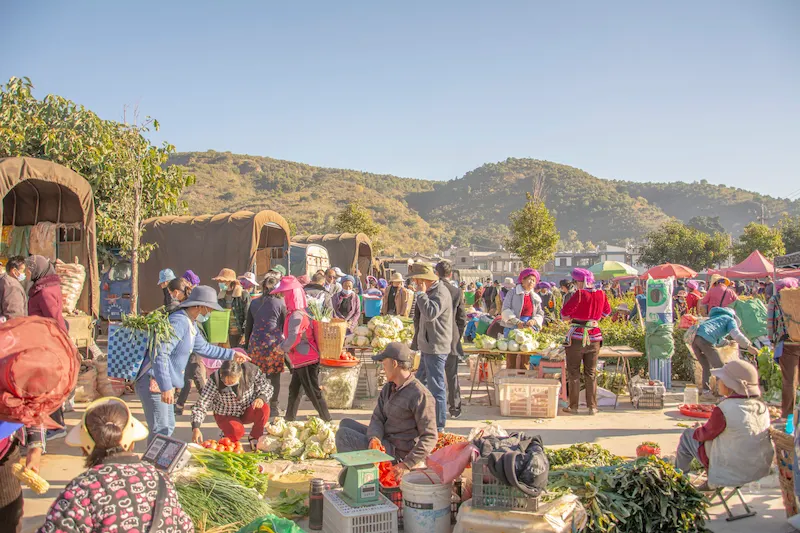
Yunnan is arguably one of the most fascinating regions of China from a culinary perspective.
Its geographical position, bordering Myanmar, Laos and Vietnam, together with its extraordinary variety of natural environments and ethnic communities, has encouraged the development of a cuisine rich in ingredients and influences.
Some of its most characteristic ingredients include wild mushrooms, aromatic herbs, local vegetables and numerous products rarely encountered in the Chinese cuisine most familiar to international visitors.
One of the most surprising aspects of Yunnan cuisine is the use of edible flowers. In different parts of the province, rose petals, chrysanthemums and other local varieties are used to prepare dishes, soups, omelettes and sweets. Among the best-known specialities are xianhuabing (鲜花饼), small pastries filled with rose petals.
Mushrooms also hold a special place in local culinary traditions. During the summer and rainy season, markets fill with numerous varieties of wild mushrooms, which are used in soups, stir-fries and a wide range of other preparations.
Another distinctive feature of Yunnan’s gastronomy is the consumption of edible insects. In some parts of the province, particularly within the food traditions of certain ethnic communities, ingredients such as bamboo larvae, silkworm pupae, grasshoppers and bee pupae are consumed.
These ingredients are often deep-fried until crispy and are part of a culinary tradition closely connected to the availability of natural resources and local knowledge.
Yunnan cuisine is not necessarily very spicy. Alongside its more heavily seasoned dishes, you will find plenty of aromatic and sweet-and-sour preparations that make excellent use of fresh ingredients.
One of my personal favourites is mixian (米线), the traditional rice noodles of Yunnan. They have a soft, slightly elastic texture and come in different thicknesses. They are often served in broth, accompanied by meat, vegetables and local seasonings. Perfect for both breakfast and lunch!
Our recommended restaurant in Yunnan
- Name: 岩哈傣味餐厅(勐腊县)
- Pinyin: Yánhā Dǎiwèi Cāntīng (Měnglà Xiàn)
- Address: 老213国道城子村安纳塔拉酒店西门西140米
At this small restaurant – located in Mengla County, in southern Yunnan, approximately 60 km from Xishuangbanna – we had the best mushrooms of our lives. They literally tasted of the forest. You know how people talk about farm-to-table food and locally sourced ingredients? Well, here it goes even further: the vegetable garden, complete with a small chicken coop, is literally right behind the restaurant. The ingredients are displayed in the fridge, and there is no conventional menu to browse. You simply point to what takes your fancy, and the family running the place takes care of the rest.
If you would like to explore the region further, you can also read our Yunnan travel guide.
Xinjiang: The Flavours of the Silk Road
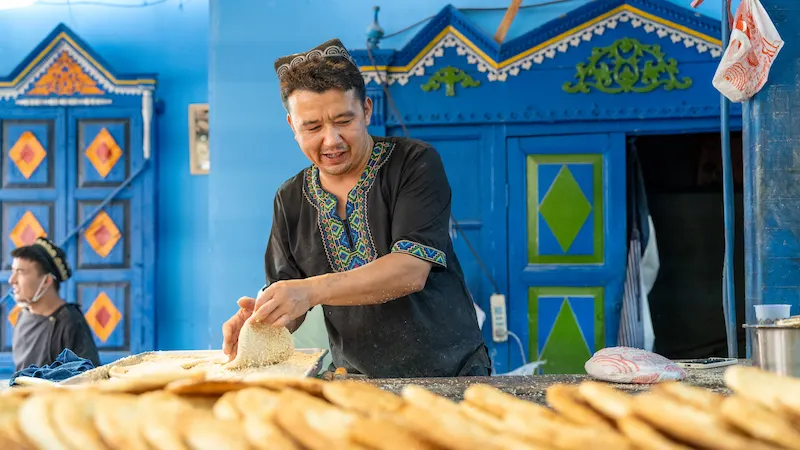
In China’s far north-west, Xinjiang offers a culinary tradition very different from that of the country’s eastern regions.
Here, the cuisine of the Uyghur communities, together with that of the region’s other ethnic groups, reflects a long history of cultural and commercial exchanges along the ancient Silk Road.
Lamb is one of the most widely used ingredients, often accompanied by cumin, onions and chilli.
Among the best-known specialities are lamb skewers (yangrou chuan), laghman, a dish of hand-pulled noodles served with meat and vegetables, and polo, a traditional pilaf made with lamb, carrots and onions.
Bread also plays an important role. Naan, traditionally baked in cylindrical ovens, accompanies many meals and comes in a variety of sizes and styles.
Uyghur cuisine is generally characterised by its use of meat, grains, vegetables and aromatic spices. Although spicy preparations are common, chilli is not necessarily the dominant flavour: cumin, onions and the natural aromas of the meat often play an equally important role.
Our recommended restaurant in Xinjiang
- Name: 诺澜美食
- Pinyin: Nuòlán Měishí
- Address: 解放北路18号(老新华书店隔壁)
Beyond the delicious food, what makes this restaurant particularly fascinating is its atmosphere, reminiscent of the Arabian Nights or an ancient Silk Road trading post. The moment you walk through the door, you are surrounded by a setting that transports you to another world. And while you take in the spectacle around you, don’t forget to pay attention to what is waiting on your plate!
In particular, we recommend trying jiàzi ròu (架子肉), a speciality of lamb cooked slowly in a traditional naan oven, suspended from a metal frame. It is among the best we have ever tasted.
If you would like to learn more, we have also written two articles sharing our travel experiences in Northern Xinjiang and Southern Xinjiang. A region as remote as it is extraordinary.
Guangdong: Cantonese Cuisine and the Art of Simplicity
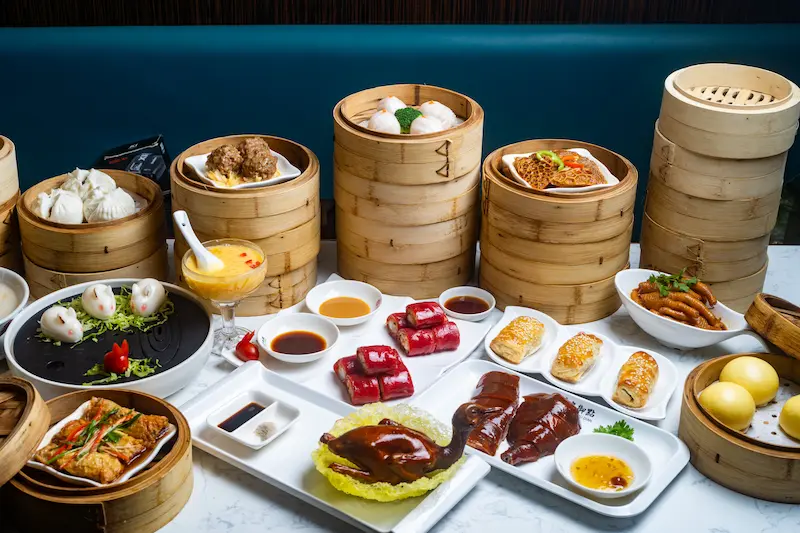
Cantonese cuisine, originating in Guangdong Province and particularly widespread around Guangzhou, is one of the best-known Chinese culinary traditions internationally.
Unlike Sichuan and Hunan cuisine, chilli is generally not a central element here.
Cantonese cooking places particular emphasis on the freshness of ingredients and on bringing out their natural flavours. Fish, seafood, meat and vegetables are prepared using techniques designed to preserve their original textures and characteristics.
Steaming, soup-making, braising and quick stir-frying are among the most common cooking methods.
One of the most characteristic gastronomic experiences is yum cha, a convivial tradition in which tea is enjoyed alongside a selection of small dishes known as dim sum.
Steamed dumplings, filled buns, rice noodle rolls and other specialities are served in small portions, allowing diners to sample numerous preparations during the same meal. The result is a succession of different flavours, often with a delicate hint of sweetness.
Another Guangdong speciality worth mentioning is roast pigeon (rǔgē, 乳鸽), usually prepared with particularly crispy skin and tender meat.
Our recommended restaurant in Guangdong
- Name: 大鸽饭(北京路店)
- Pinyin: Dàgē Fàn (Běijīng Lù Diàn)
- Address: 西湖路68号201、301房
Despite my initial hesitation, I discovered that roast pigeon is now among my absolute favourite delicacies. That said, if you don’t feel like trying it and would prefer something less unusual, the menu is very varied.
The restaurant also combines Cantonese cooking with distinctive interior design, making for a complete dining experience. It is a very popular place, so be prepared to queue and, if possible, book in advance.
Shanghai and the Cuisine of Jiangnan
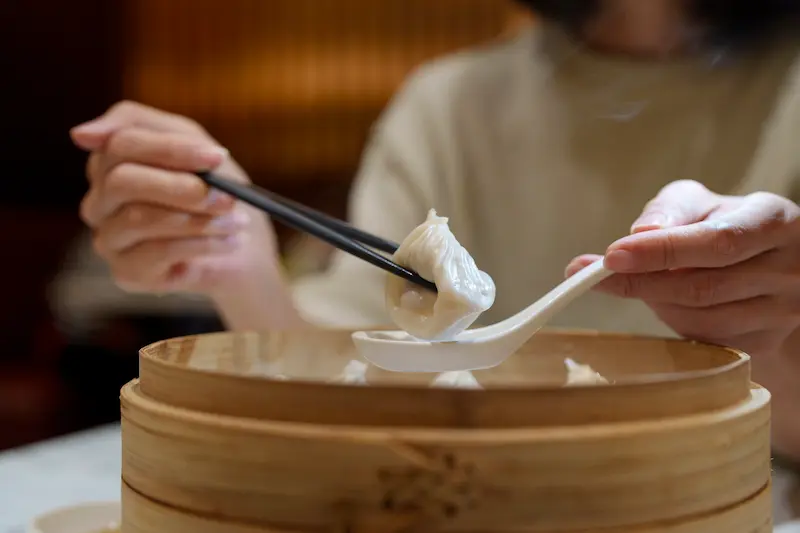
Shanghai has its own distinctive culinary identity, influenced by the broader gastronomic traditions of Jiangnan, the region south of the Yangtze River Delta.
Local cuisine is known for its combination of sweet and savoury flavours, the use of soy sauce and a variety of braised dishes.
Among the best-known specialities are xiaolongbao, small steamed dumplings filled with meat and broth, and shengjianbao, pan-fried buns filled with meat and characterised by their golden, crispy base.
Another characteristic dish is hongshao rou, pork braised in a rich sauce made with soy sauce, sugar and other seasonings.
Here too, there is no single culinary model: Shanghai’s food traditions form part of a broader gastronomic mosaic that also includes the neighbouring regions of Jiangsu and Zhejiang.
Our recommended restaurant in Shanghai
- Name: 喜鼎海胆水饺(长宁来福士店)
- Pinyin: Xǐdǐng Hǎidǎn Shuǐjiǎo (Chángníng Láifúshì Diàn)
- Address: 长宁路来福士广场东区2号古建1-2楼(东区商场2号门对面)
What we particularly like about this restaurant is its refined atmosphere and the care that goes into preparing its dishes. The crab-filled xiaolongbao and the hongshao rou are outstanding. What is even more surprising is how reasonable the prices are for a restaurant of this quality in Shanghai.
Dongbei: The Generous Flavours of China’s North-East
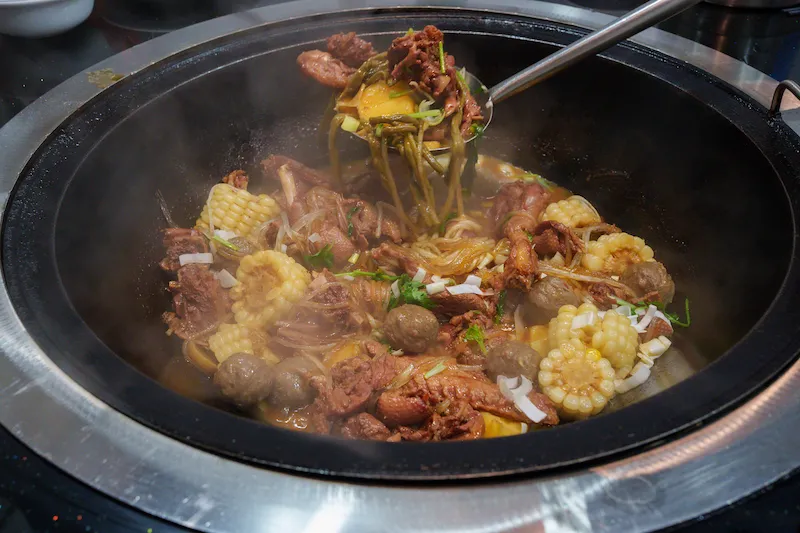
We decided to include Dongbei partly in honour of Martina, who is originally from China’s north-east and firmly believes that Dongbei has the best cuisine in the entire country! As we warned you, we were never going to be completely impartial…
Dongbei, which literally means “north-east”, is a geographical term referring to the provinces of Liaoning, Jilin and Heilongjiang. Its culinary traditions are quite different from those of southern China.
The continental climate, with its particularly harsh winters, has contributed to the development of a hearty cuisine based on ingredients that can be stored easily and on warm, nourishing preparations.
Potatoes, corn, grains, fermented cabbage, pork and vegetables are among the most commonly used ingredients. Soups, stews and dishes prepared in large pots are particularly popular.
Among the best-known specialities are guobaorou (锅包肉), thin slices of pork coated in batter, deep-fried and covered in a sweet-and-sour sauce, and disanxian (地三鲜), a dish made with potatoes, aubergines and peppers. Chinese dumplings (jiaozi) and dishes featuring fermented cabbage (suancai) are also widespread.
It is a generous, convivial cuisine, closely connected to family life and local traditions. Influences from neighbouring Korea, as well as from the different communities living in the north-east, have also contributed to its considerable variety.
Our recommended restaurant in Dongbei
- Name: 秀水铁锅炖(白山市店)
- Pinyin: Xiùshuǐ Tiěguō Dùn (Báishān Shì Diàn)
- Address: 浑江区怡滨小区5号楼(红旗街771号)
Here, we recommend trying tieguo dun (铁锅炖), literally a stew prepared in an iron pot. This is a particularly characteristic cooking method in north-eastern China: meat, vegetables and other ingredients are left to simmer together in large iron pots, often placed right in the middle of the table. In some preparations, small corn cakes are also attached to the sides of the pot, where they cook in the steam and absorb some of the stew’s aromas.
But the experience is about much more than the food. As Martina tells us, one of the things that best characterises people from Dongbei is their hospitality and sociable nature. Don’t be surprised if you are dining alone and someone spontaneously invites you to join their table. It is a gesture that says a lot about the generous and informal spirit of this region.
Inner Mongolia: Meat, Dairy Products and Steppe Traditions
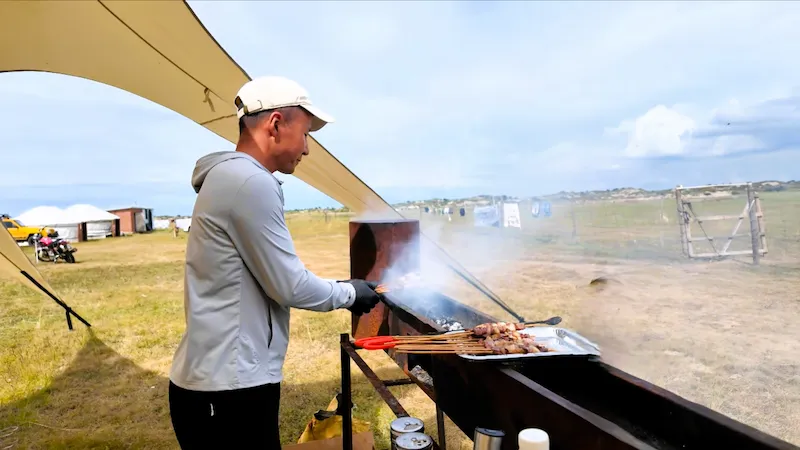
Inner Mongolia has a culinary tradition deeply connected to its landscape and to the pastoral culture of the communities that inhabit these vast territories.
Traditional Mongolian cuisine often distinguishes between two broad categories of food: the so-called “red foods”, mainly based on meat, and the “white foods”, which include milk and dairy products.
Lamb and beef play a central role. One of the most characteristic preparations is shǒubǎròu (手把肉), boiled mutton served simply and traditionally eaten with the hands. Fermented milk, local cheeses and salty milk tea are also widespread, often accompanied by toasted grains.
Among the most interesting dairy products is nǎipízi (奶皮子), literally “milk skin”. It is a rich layer of fat and protein that forms on the surface of milk and is traditionally collected, dried and used in various preparations.
Another speciality worth trying is nǎidòufu (奶豆腐), literally “milk tofu”. Despite its name, it has nothing to do with soy tofu: it is a traditional Mongolian dairy product made by coagulating and fermenting milk. It can have either a soft or a firmer texture and a mildly tangy or slightly sweet flavour. We particularly enjoyed it!
More recently, nǎipízi suānnǎi (奶皮子酸奶) has also become popular: yoghurt topped with a layer of milk skin, resulting in a particularly rich and creamy texture. It is an interesting way to discover a lesser-known aspect of local gastronomy.
Naturally, Inner Mongolian cuisine is much broader than these specialities and varies considerably from one area to another, reflecting the diversity of landscapes and communities across the region.
Our recommended restaurant in Inner Mongolia
- Name: 蒙元夏都旅游度假区
- Pinyin: Méngyuán Xiàdū Lǚyóu Dùjiàqū
- Address: 内蒙古自治区锡林郭勒盟正蓝旗上都镇巴音乌拉嘎查,G239国道上都收费站向西2公里处
Located roughly halfway between Duolun and Zhenglan Banner, this place serves traditional dishes with rich, authentic flavours. Dairy products and lamb come together seamlessly, offering a taste of the region’s nomadic culinary heritage.
Among the specialities we tried, my favourite was naidoufu (奶豆腐), literally “milk tofu”. Despite its name, it has nothing to do with soy tofu: it is a traditional Mongolian cheese made by coagulating and fermenting milk. It can have either a soft or a firmer texture, with a slightly sweet flavour.
To make the evening even more memorable, during the summer you may also have the chance to enjoy a throat singing performance, known as khoomei or Mongolian harmonic singing (呼麦, hūmài). It is a truly remarkable vocal technique in which a single singer produces several sounds simultaneously: a continuous low note over which higher-pitched harmonics emerge, almost creating a second melody.
This musical tradition is deeply connected to Mongolian culture and its relationship with the natural world. Its distinctive sound can evoke the wind sweeping across the grasslands, the calls of animals and the vastness of the steppe. Listening to it, perhaps during dinner in the heart of Inner Mongolia, is a truly moving experience.
If you would like to explore this extraordinary region, we can help you organise a tailor-made journey. To get inspired, you could start with our expedition to the Yin Mountains, where you can discover the flavours of nomadic traditions and immerse yourself in the more remote heart of this frontier land.
Discovering China Through Its Food
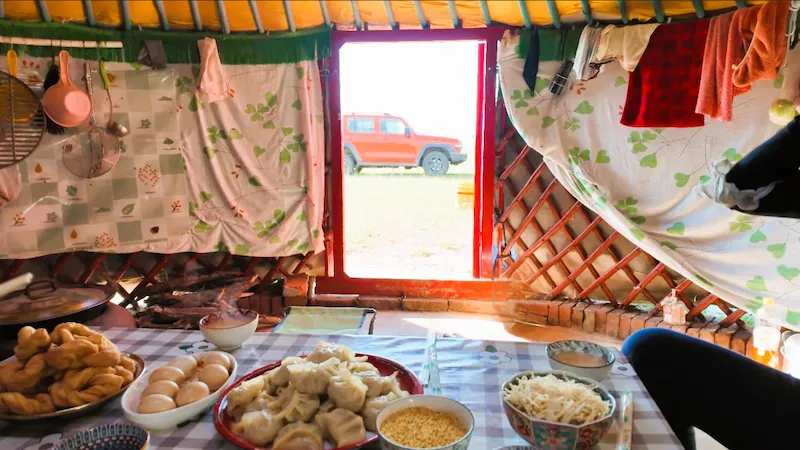
Travelling in China means crossing very different landscapes, discovering local traditions and encountering customs that may be far removed from those we are used to.
Food is one of the most interesting ways to understand this diversity. For this reason, when visiting China, it is worth looking beyond the dishes we already know and allowing ourselves to experiment.
Often, the simplest culinary experiences – perhaps in a small neighbourhood restaurant or at a local market – become some of the most memorable moments of a trip.
This is also the spirit in which we like to explore China: taking the time to discover its regions, meet local people and experience everyday traditions that often reveal far more than we might expect.
At Ink Voyages, we organise private journeys in China as well as small group journeys, designed to explore the country in depth while making room for encounters, local experiences and the discovery of its many regional cultures.
If you would like to discover China in greater depth, explore our small group journeys in China, or visit Ink Voyages to learn more about our approach to travel and our itineraries.


Leave a Reply