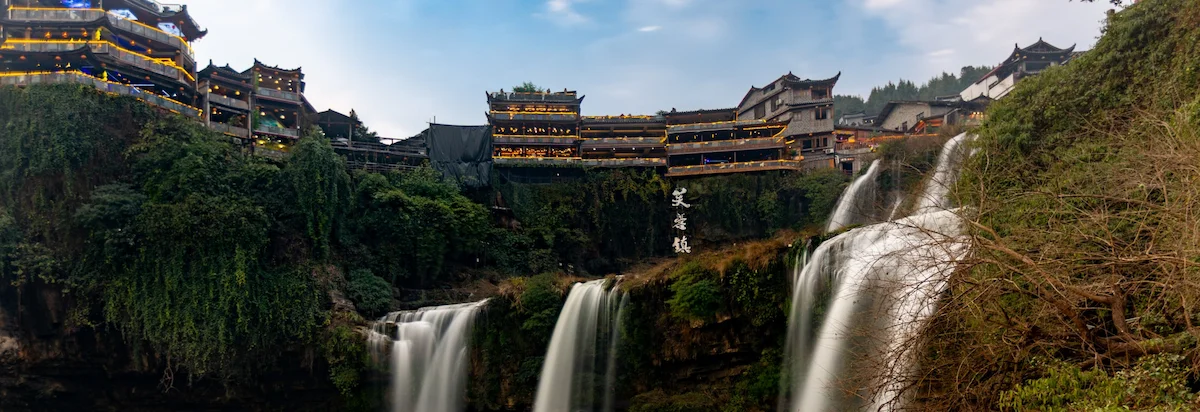
Travel Guide to Furong, the Hibiscus Town
Table of Contents
Where Furong is located and how to include it in your China itinerary
Let’s start by telling you that Furong is not actually Furong’s original name. Yes, because this name — 芙蓉镇, Fu Rong Zhen, meaning Hibiscus Town — was officially assigned to Furong only in 2007, in connection with a film by the celebrated Chinese director Xie Jin, who filmed Hibiscus Town (Fu Rong Zhen) here in 1986. The film, based on the novel of the same name by Gu Hua, later made the town famous throughout China.
Furong was previously known as Wangcun — meaning King’s Village; this rebranding also makes us think of another city, Shangri-La, which we discuss in our travel guide to Yunnan.
Furong is located in Yongshun County, within Xiangxi Tujia and Miao Autonomous Prefecture, in Hunan Province. Geographically, it lies along the road connecting Zhangjiajie with the famous ancient town of Fenghuang. Because of this location, a visit to Furong is almost always included in a single combined itinerary with Zhangjiajie’s three main attractions: Tianmen Mountain (with its long cable car ride and the Heaven’s Gate), Zhangjiajie Grand Canyon (famous for its glass bridge), and Wulingyuan National Park (the peaks that inspired Avatar).
Another analogy naturally comes to mind when considering the nickname given to Furong: “the thousand-year-old ancient town suspended over a waterfall”, which reminds us of another thousand-year-old settlement: Nuodeng’s “Millennial Bai Village”, in Yunnan, which we highly recommend exploring.
Ancient Town or Scenic Town? The Right Perspective for Visiting Furong
The first thing we want to tell you about Furong is that, in our opinion, the best way to enjoy your visit is to completely set aside the fact that Furong is an ancient town. It may sound paradoxical — especially because, as we will explain later, Furong is indeed an ancient town and is presented as such almost everywhere: “Furong Ancient Town”, after all.
We say this because, as often happens in China when a town’s name is associated with the words “ancient town”, very little remains truly ancient, as everything is heavily reconstructed and highly commercialized. As a result, the idea of a perfectly preserved historic settlement does not really fit places like Furong, or nearby Fenghuang, which is also a classic stop on an itinerary including Zhangjiajie and Furong.
This aspect, together with the concept of a “scenic area”, which we at Ink Voyages make a point of explaining when we talk about exploratory travel in China, is very important when visiting China, if only to have the right perspective on what you are going to see.
To be clear: there are places that are still genuinely “ancient”, such as Baoshan Stone Village in Yunnan, or genuinely “remote” places, such as the Yin Mountains in Inner Mongolia, but these are destinations outside the main tourist circuits. As a rule, if you start seeing lots of Instagram reels about an “ancient and authentic” place — a “hidden gem” — consider that it has very likely already entered the category of “ancient towns” that are no longer quite so ancient and “hidden” places that are no longer quite so hidden…
That said, we absolutely do not want to discourage you from visiting Furong — quite the opposite! Unlike other “ancient towns” — which, in our opinion, remain nothing more than tourist traps — Furong is genuinely spectacular, and it can leave you truly speechless, especially in the evening.
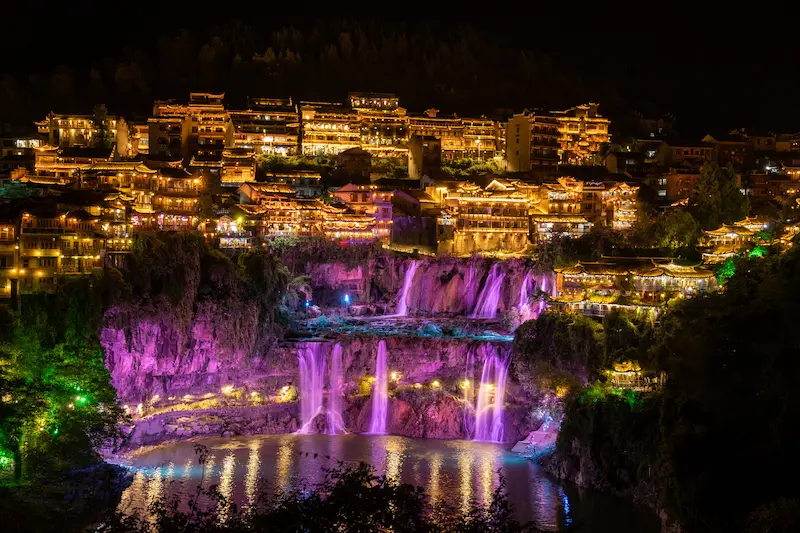
And it is from the viewing platform opposite the waterfall that the town truly gives its best: seeing the town lit up in gold and dotted with red lanterns, stretching all around the illuminated waterfall as if embracing it, is honestly breathtaking.
In this sense, think of your visit to Furong as a visit to a “scenic town”, rather than an “ancient town”. From this perspective, we believe you will enjoy the exploration much more, because you start with the right expectations: not historical and archaeological ones, but equally legitimate aesthetic and scenic ones, based on the sheer pleasure of discovering one of the most visually beautiful and fascinating places you can find.
The same reasoning also applies to Wangxian Valley, in Shangrao, another of the most spectacular places you can find in China. A true feast for the eyes! And if you are interested in discovering other destinations in China, you can also explore our private travel catalogue, featuring three collections of itineraries that can be customized according to your travel preferences.
What to See in Furong: Highlights of the Route
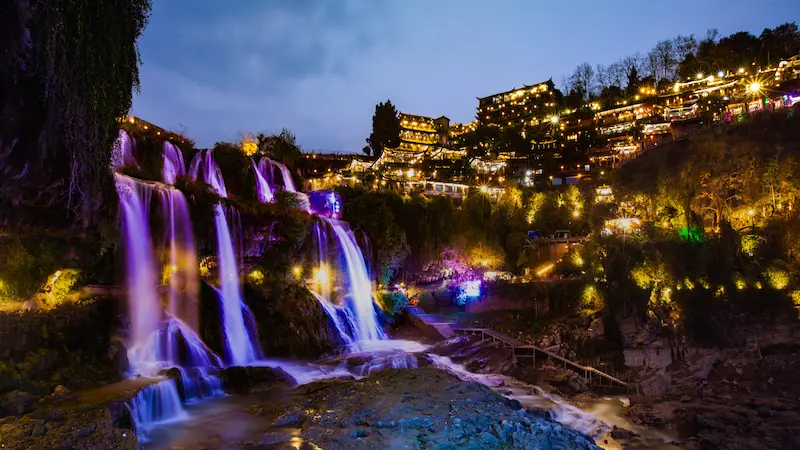
Let’s enter Furong! During our most recent visit, the entry system was still somewhat convoluted. Having tickets for the scenic area is not enough: you still have to go to the tourist centre, present your passport and undergo a facial scan. After that, you can proceed to the entrance gates and, finally, enter. (Bear in mind that, even before reaching the viewing platform from which you can admire Furong in all its beauty, you will have to pass through additional gates.)
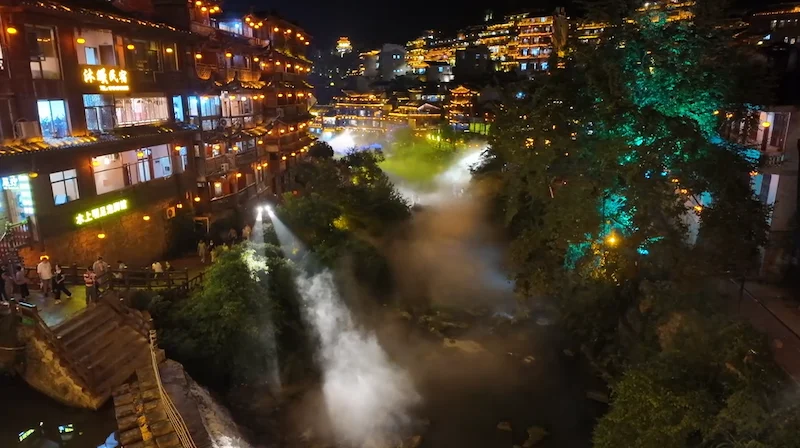
Visiting the town itself is very straightforward and requires no particular explanation. There are plenty of signs and, above all, everything is very intuitive. Below, we describe the highlights of a visit to Furong:
- Furong Waterfall: Approximately 40 metres wide, with a total drop of 60 metres spread over two levels, it is the largest waterfall in western Hunan. You can walk along a path carved into the rock behind the curtain of water (the Water Curtain Cave). If you decide to do it… be prepared to get soaked!
- Tusi King’s Palace: Perched on the cliff right beside the waterfall, this wooden palace was the summer residence of the Tujia rulers, whom we will tell you more about below. Its architecture, perfectly adapted to the terrain, is characteristic of the local traditional style.
- Tujia Architecture – Diaojialou: The urban fabric is dominated by typical stilted wooden houses (Diaojialou), anchored to rocky walls and slopes, with upturned eaves and balconies projecting over the waterfalls and river. The same architectural style can be found at Hongya Cave in Chongqing.
- Wuli Stone-Paved Street: An ancient pedestrian street more than 2.5 km long, entirely paved with slabs of green stone, which is the main street featured in the film Hibiscus Town.
- Xizhou Bronze Pillar: A nationally protected historical artefact. Cast in 940 AD, it was erected by the King of Chu and the chieftain Peng Shichou following the Xizhou War, to seal the alliance and define the boundaries of political sovereignty.
Beyond the Scenery: The History of the Tusi Kingdom and the Tujia Ethnic Group
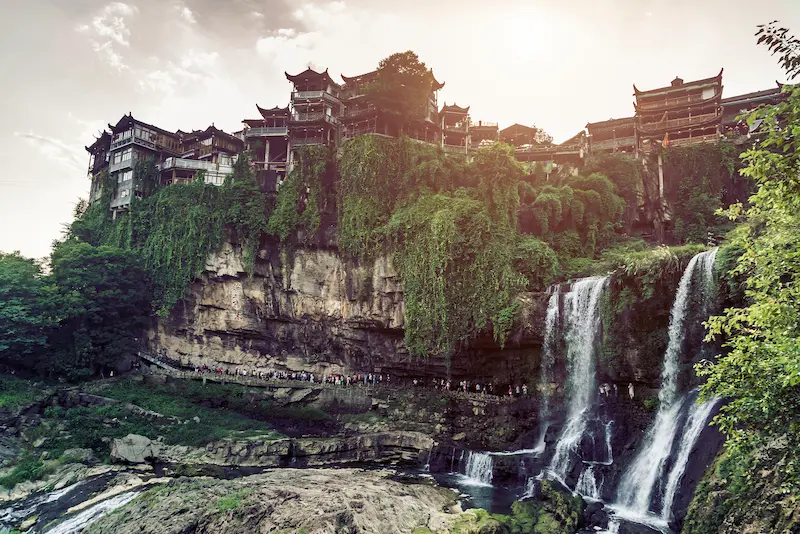
Before wishing you a wonderful visit to Furong, however, we would like to share a little more information about the history of this town. As you may have gathered from the references above to the Tujia ethnic group and the Xizhou Bronze Pillar, there is genuine historical depth hidden behind the town’s scenic appearance.
The Tujia are one of the oldest indigenous ethnic groups in southwestern China (predominantly settled across Hunan, Hubei, Guizhou and Chongqing). In 910 AD, Peng Shichou was the Tujia leader who unified the Tujia tribes of western Hunan and established his power base precisely in Wangcun (now Furong).
Through the Tusi system, the Han emperor recognized a so-called “governed autonomy” for local ethnic leaders, who ensured stability in the more turbulent regions of China that the Han could not directly control. The Tusi system therefore involved recognizing a local leader, who swore allegiance to the emperor and was, in practice, left to govern his own territory.
The Peng family ruled the Yongshun Tusi for more than 800 years and 35 generations, becoming one of the longest-lasting dynasties in Chinese history. The story of the bronze pillar mentioned above has its origins precisely in these complicated relations between the local ethnic groups and the Han, which were far from stable.
In 939 AD, a fierce war broke out between the Tujia governed by Peng Shichou and one of the neighbouring Han kingdoms, ruled by Ma Xifan, the ruler of the state of Chu. After bloody battles, an agreement was finally reached in 940 AD: a 2,500 kg bronze pillar was erected at Furong along the riverbank, at the site of the ancient battle, as a symbol of peace.
The entire text of the peace treaty was engraved on its surface, formally establishing the autonomy of the Tujia territory and becoming one of the earliest “constitutional charters” of ethnic autonomy in China. The Xizhou Bronze Pillar is now kept inside the dedicated museum pavilion in the historic centre of Furong and is recognized as a Nationally Protected Cultural Heritage Site.
If you are interested in learning more about China’s ethnic complexity, with its 56 officially recognized ethnic groups, you can also explore Yunnan and its travel itineraries here: a region that alone is home to 25 of them.
And with this historical background in mind, you are finally ready to set off! From the Ink Voyages team, all that remains is to wish you a wonderful journey! If you would like to explore this extraordinary country in depth, you can also take a look here at our recommended itineraries for travelling in China.