A Journey to Nuodeng: the Salt Village on the Slope of the Tigers
Table of Contents:
The Slope of the Tigers
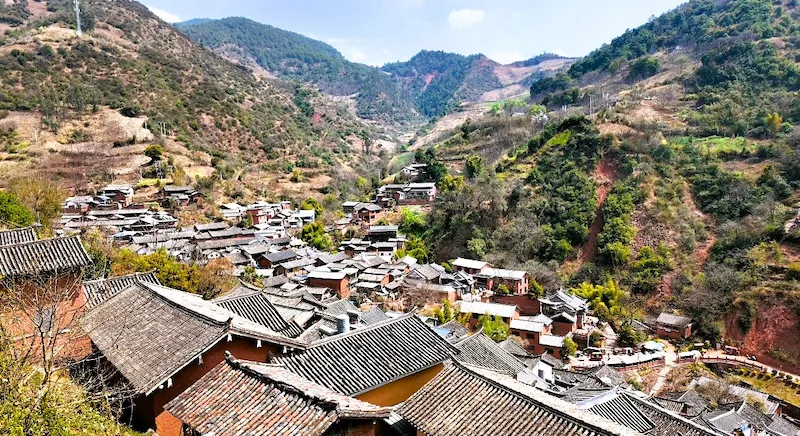
If during your journey in Yunnan you have reached Dali, we truly recommend that you make the roughly 170 km journey to Nuodeng: a village located in Yunlong County and inhabited by the Bai minority, well worth at least half a day.
In truth, if you really want to immerse yourself in its traditional atmosphere and properly take it in, the Ink Voyages team suggests spending at least one night in the village. You won’t regret it!
In a sense, Nuodeng — which according to some interpretations means “the Slope of the Tigers” in the Bai language — lives up to the epithet often attributed to it as an ancient Bai village far better than the Ancient Town of Dali, which has been too commercialized to truly evoke the atmospheres of the past.
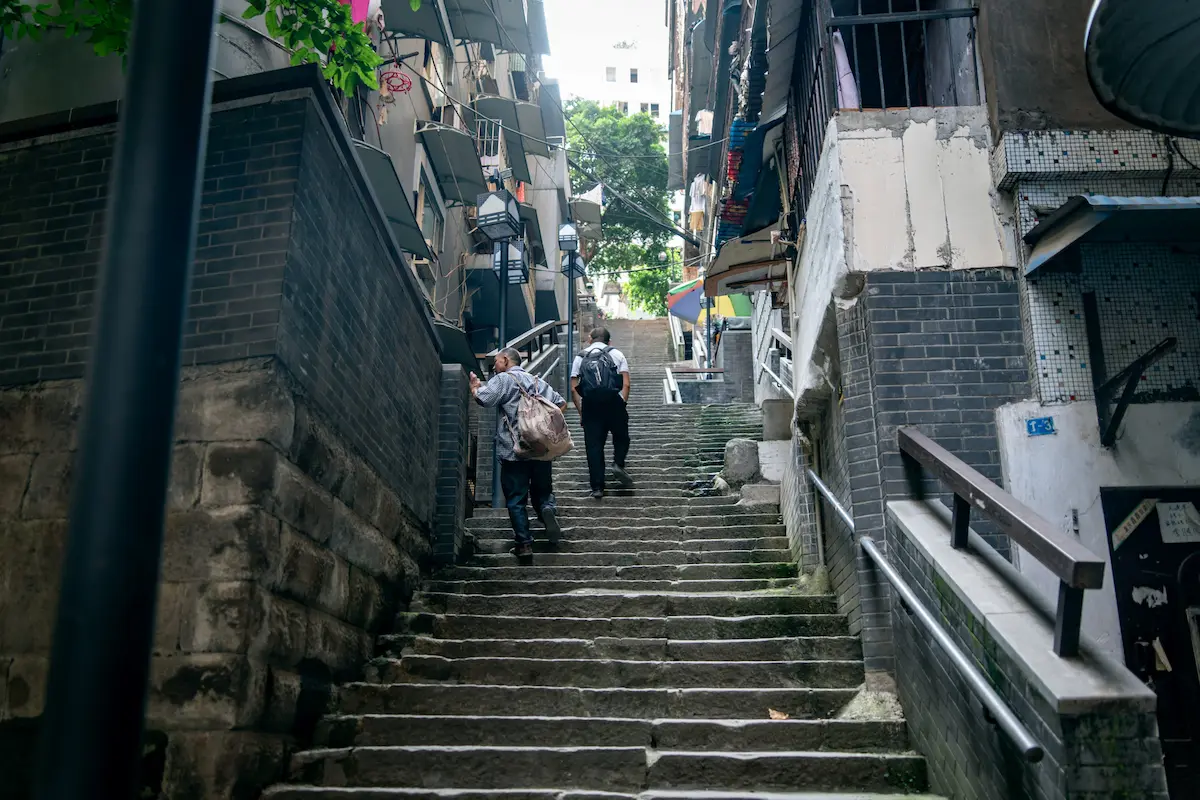
In recent years, the village of Nuodeng has gradually opened up to tourism, as you’ll notice on the way in. The road will lead you to a parking area, where you will need to leave your car before beginning to “climb” and explore the ancient stone alleys that wind up the hillside among the red houses of Nuodeng.
However, this remains, for now, only limited development — one that is not invasive, and that we sincerely hope will remain so. Here, the rhythms and sounds of the countryside will envelop you, and you will find yourself immersed in the reassuring, soothing slowness of an ancient way of life that still endures.
If you would like to learn more about Yunnan, you can read our travel guide to the region here and discover some customizable itineraries here.
After leaving your car at the parking area, head into the village by crossing one of the bridges over the stream. Make your way uphill, among red-orange walls, the same color as the earth of the surrounding mountains from which they emerge as both human and natural extensions. The same color — one might say — as the coats of the tigers evoked by the village’s name.
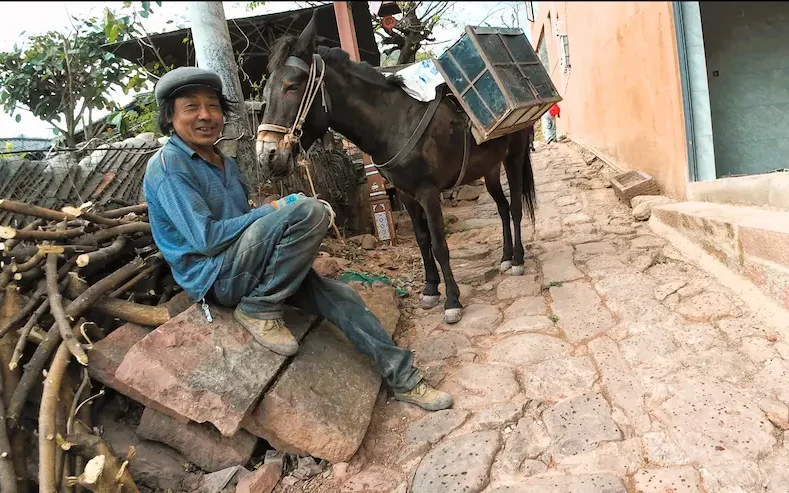
As you ascend, you’ll likely come across the residents of Nuodeng, sometimes accompanied by their tireless mules, which carry out most of the physical work, as the limited accessibility leaves little room for more modern means of transport.
As you are heading toward the far end of the village, despite the many steps, it’s worth going all the way, where you can stop for a great meal at a local restaurant, complete with a panoramic view.
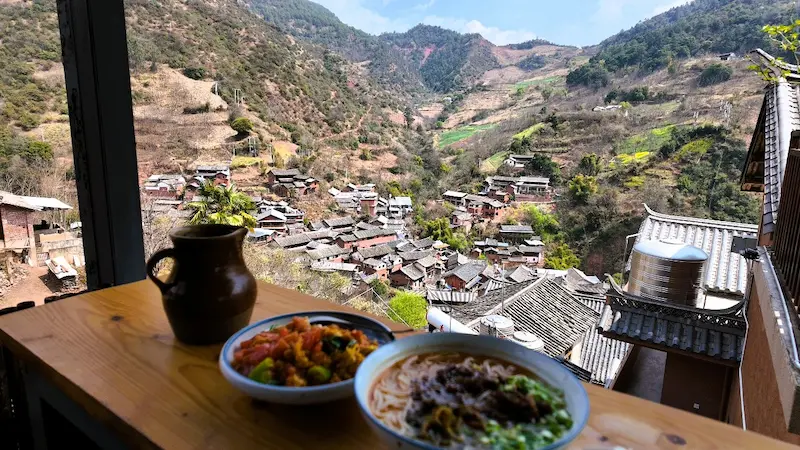
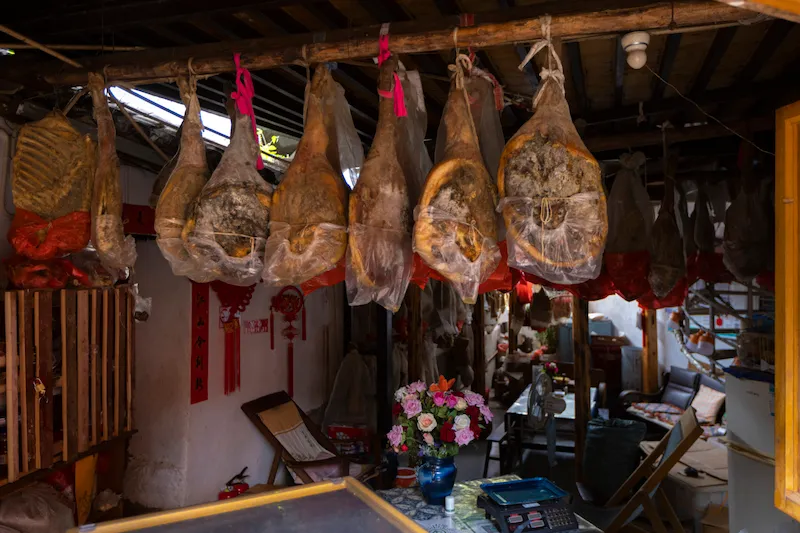
In Nuodeng, we suggest trying the local ham, which has become renowned throughout China, and which you will see hanging from the wooden beams inside courtyards, waiting to be enjoyed — of course, enhanced by the local salt!
After that, at the café located right opposite, a great coffee made with Yunnan beans awaits you (they also make an excellent espresso!).
Practical note: you will know you have arrived when you find yourself in front of a Baoyan tree, whose majestic size will surely inspire you to take a few photos!
The Gate & The Temple
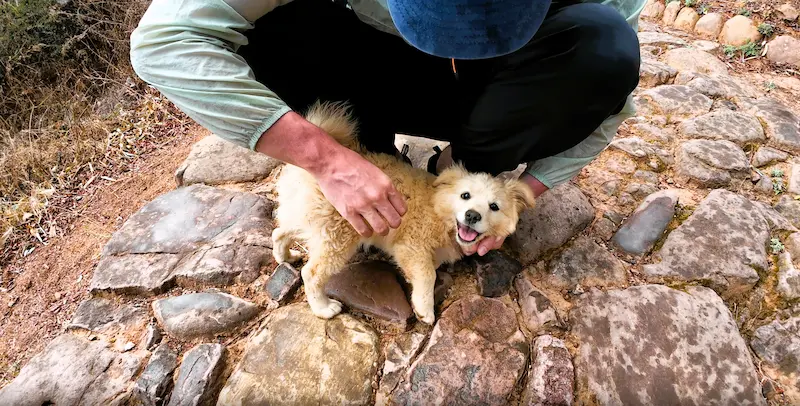
We told you that you had reached the top… Yes, but only the top of the village! The climb is not over yet! After recharging your energy, we recommend continuing your ascent, leaving the last houses behind you, to encounter, one after the other, the two most remarkable historical buildings in Nuodeng (if you are lucky, along the way you may also meet a very friendly companion to share the effort of the steps with):
The Lingxing Gate
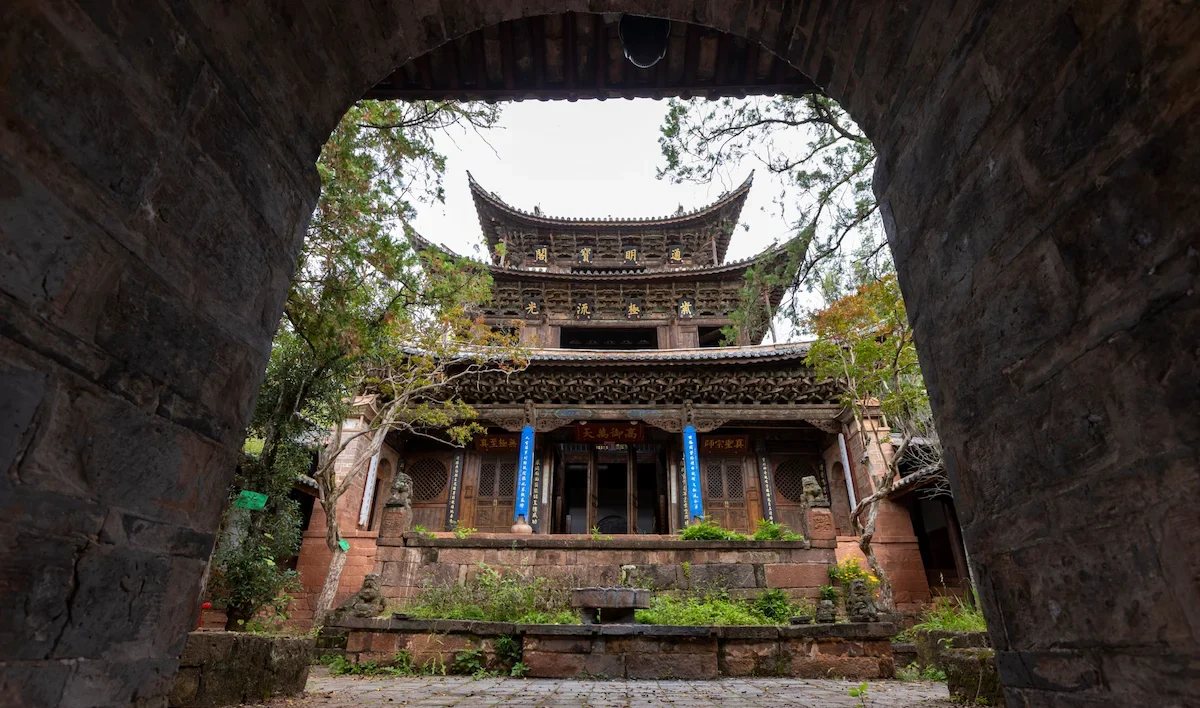
It is a magnificent wooden gate, believed to be the largest and oldest of its kind in Yunnan. On the front side is written “腾蛟” (Téng Jiāo), meaning “Soaring Dragon”; on the back, “起凤” (Qǐ Fèng), meaning “Rising Phoenix.” For this reason, it is also known as the “Gate of the Dragon and the Phoenix.”
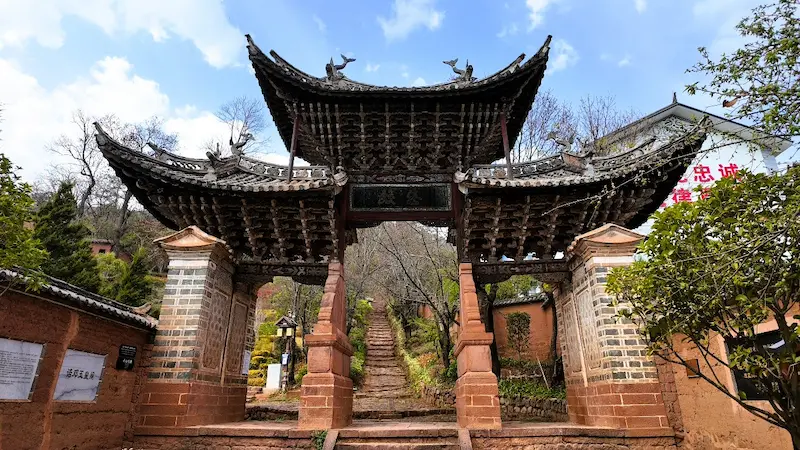
In Confucian tradition, it symbolizes access to knowledge and the imperial examinations. In Nuodeng, which was not a county seat and therefore did not host imperial exams but still had an important Confucian temple, it represented the village’s aspirations and prestige, made possible by the wealth generated by salt.
The Yuhuang Temple
It is the northernmost and highest point of the village, as well as its most emblematic structure. It is a Taoist complex that includes: the main Yuhuang Pavilion, the Confucius Temple with a very rare statue of Confucius portrayed as an ordinary man (not in imperial robes), and the Guan Yu Temple (Wumiao / 武庙), dedicated to the god of war and loyalty (Guan Gong).
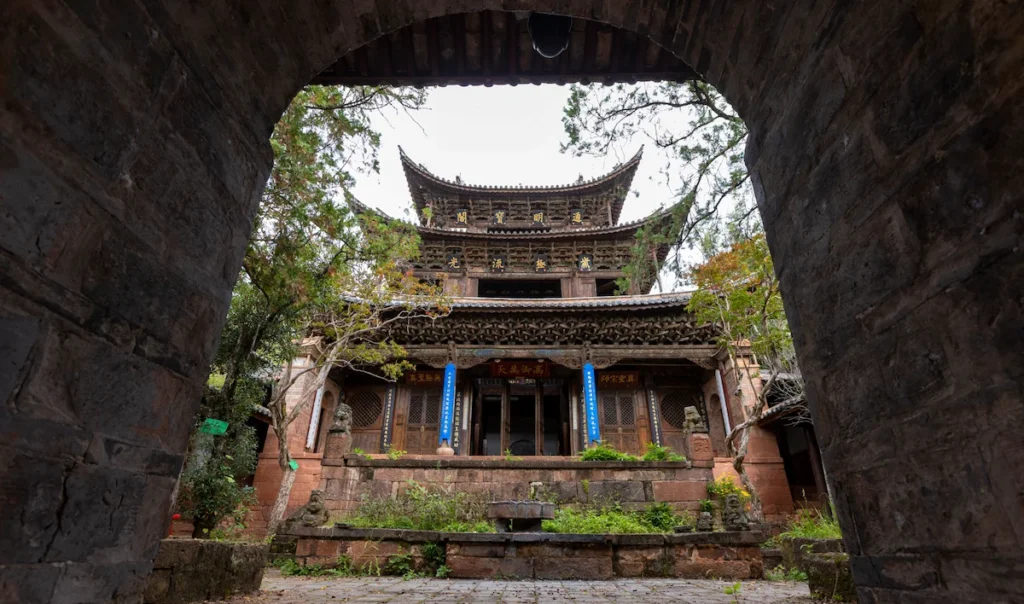
On the ceiling of the upper floor of the main pavilion, there is a beautiful coffered painting depicting the map of the 28 constellations, a representation of ancient Chinese astronomy, cosmology, and art.
The History of the Salt Village
The history of Nuodeng makes what is, in our opinion, one of the most beautiful villages in Yunnan even more fascinating — a true gem that enriches the Dali area, fortunately still somewhat off the main tourist circuit.
If you are interested in exploring China in depth, you can also browse our catalog of private journeys here to inspire your next adventure.
To tell the story of Nuodeng, one must begin with salt. Yes, salt — because the fortune of this settlement is closely tied to it, and to its 21-meter-deep well from which it has been extracted here for around two thousand years.
Extracting salt from naturally occurring brine springing from the ground was a millenary practice. In this area, according to a local legend, it was the benevolence and protection of the Dragon King that allowed the salt to continue flowing from the earth.
Nuodeng truly rose to prominence during the Tang dynasty (8th–9th century), when the village flourished and prospered (the oldest historical text of Yunnan, the Man Shu (863 AD), already mentions it as an important settlement).
During the Ming period, the imperial government selected it as the main administrative center for salt production across the western region (1383 AD): in this area there were the “Five Salt Wells” — including the Nuodeng well, which was the most productive and had the highest salinity — along with a tax office that collected tens of thousands of taels of silver each year from the trade of this valuable resource.
Its importance was also closely linked to that of the Ancient Tea Horse Road, which, rather than a single road, was a network of routes that allowed goods to move across the region, including salt.
The village prospered for over 2,000 years thanks to salt, and its decline began gradually with the end of the Qing dynasty (1911), becoming irreversible in the 20th century, when the mule caravans that once traveled the Tea Horse Road disappeared in favor of modern trade routes.
At the same time, the salt wells lost economic importance due to the introduction and nationalization of the sea salt industry, which was easier and cheaper to produce and therefore quickly replaced mountain well salt like that of Nuodeng, which was more costly and artisanal.
Commercial salt production in Nuodeng definitively ceased in the 1990s. From that point on, the large wells were abandoned or reduced to symbolic/artisanal use (mainly for the famous local ham).
Paradoxically, this decline saved the village: precisely because it lost its central economic function, Nuodeng was not modernized or industrialized. It remained “frozen” in time, preserving almost intact its Ming-Qing houses, temples, and ancient atmosphere that make it so special today.
With this article, we hope to have sparked your curiosity and inspired your next visit. We can only hope that Nuodeng can remain somewhat off the path of commercialization which, too often, ends up eroding what makes places special. If all goes well, its steep alleys will protect its ancient charm for a long time to come.
Inviting you to explore our catalog of tailor-made journeys in China to discover more destinations, Ink Voyages wishes you inspiring journeys ahead!