
Datong Travel Guide: Yungang Grottoes, Hanging Temple & Dragon Wall
Table of Contents
The Threshold of the Steppes: Why Datong is Worth the Trip
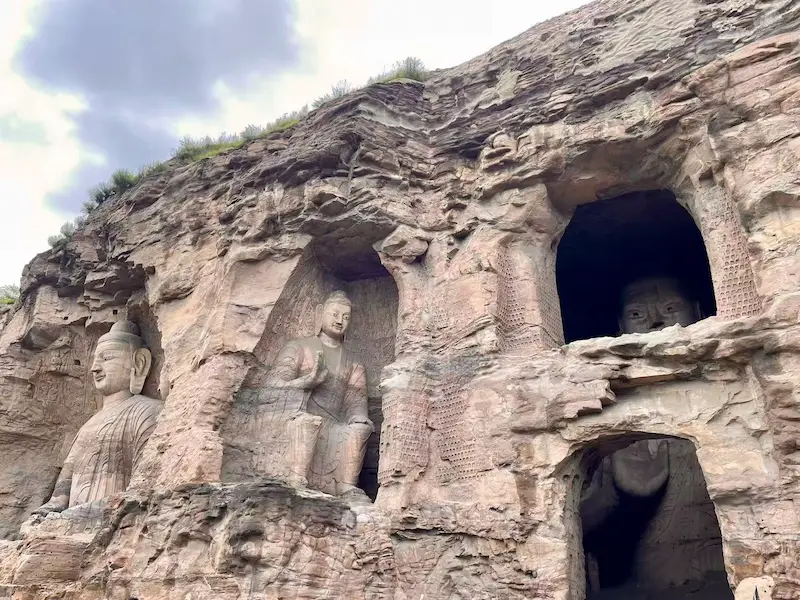
What are the most beautiful Buddhist grottoes in China (a title contested by those in Dunhuang and Longmen) doing in a place where, just a few decades before their construction began, Buddhism itself had been banned, and all its symbols destroyed by fire and the sword?
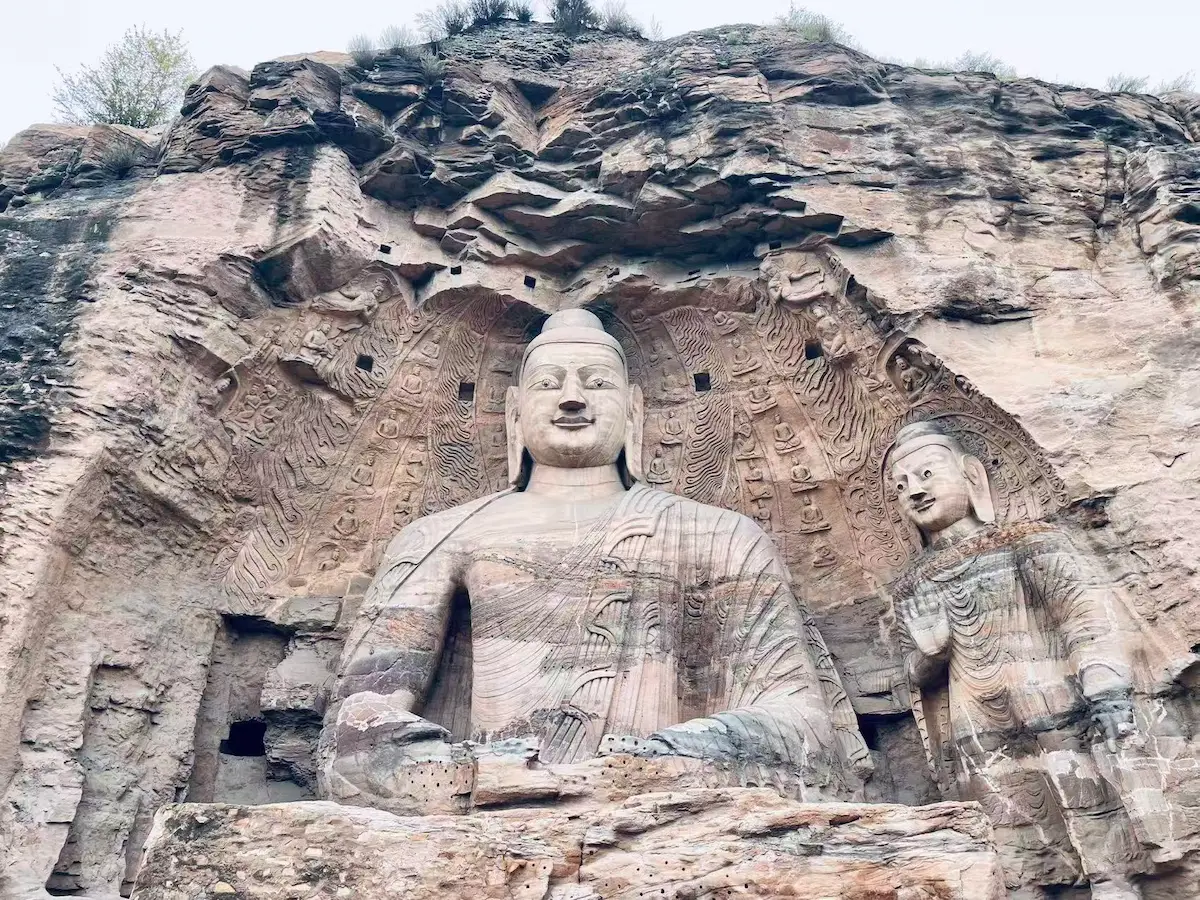
When the Ink Voyages team talks about Datong—a city located in northern Shanxi, about 300 kilometers west of Beijing (easily reachable in about two hours by high-speed train) with a population of around 3.1 million today—we are first and foremost talking about the spectacular Yungang Buddhist Grottoes.
Although they are not as trendy on social media as their spiritual sibling, the Hanging Temple (Xuankong Si), we believe they represent the true heart of a visit to this area.
From Persecuted to Deities: The Imperial Rebirth of Buddhism
To understand why these caves were built, we must first look at the historical context of Datong. A great place to start when telling Datong’s complex story is to remember that, long before it was called Datong, it was known as Pingcheng. It was established as a military outpost under the Qin Dynasty to contain the incursions of the Xiongnu, a nomadic steppe confederation that raided Han territories along the frontier of the Yin Mountains for decades.
Later, it became the capital of the Northern Wei Dynasty (386–534 AD), a dynasty of Mongolian origin (the Xianbei ethnicity, Tuoba clan) that unified all of Northern China after a prolonged period of political instability (the Sixteen Kingdoms period).
When standing before the serene majesty of the Buddhas of Yungang, consider that the reign of the Northern Wei actually began with the persecution of Buddhism. The ruling class viewed the religion as an obstacle to establishing state authority: monasteries had become immensely wealthy, tax-exempt entities that served as refuges for thousands of men seeking to evade military conscription, thereby undermining the fledgling state’s economic and military foundations.
The rehabilitation of Buddhism took place under Emperor Wencheng (452–465 AD), who chose a radically different strategy. Observing that Buddhism persisted despite repression, and recognizing the risk of social fragmentation posed by a confrontational approach, he decided to convert it into a state ideology.
The Faces of Yungang: Stone Giants on the Silk Road
Buddhism thus became the cultural tool for state cohesion, and the Yungang Grottoes are the grandest physical expression of this political maneuver. Monk Tanyao, advisor to Emperor Wencheng, developed a doctrine—following a long historical tradition—declaring the reigning emperor to be the living reincarnation of the Buddha. Through this identification, worshiping the Buddha became synonymous with expressing faith in the emperor and the Northern Wei Dynasty.
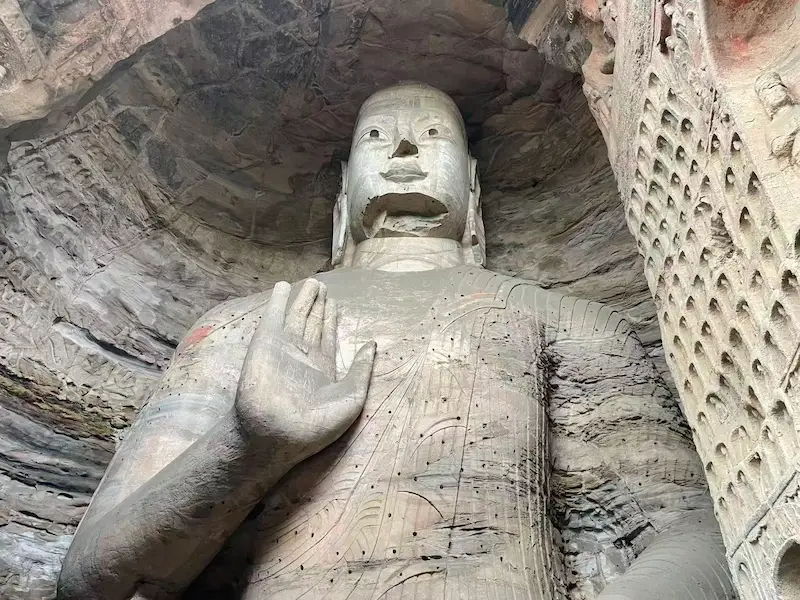
As you stand before the five caves numbered 16 through 20, keep in mind that the monumental Buddhas before you were commissioned to physically represent the first five Northern Wei emperors—including Emperor Taiwu, who had persecuted Buddhism, whose criminal record against Buddhism was magically wiped clean.
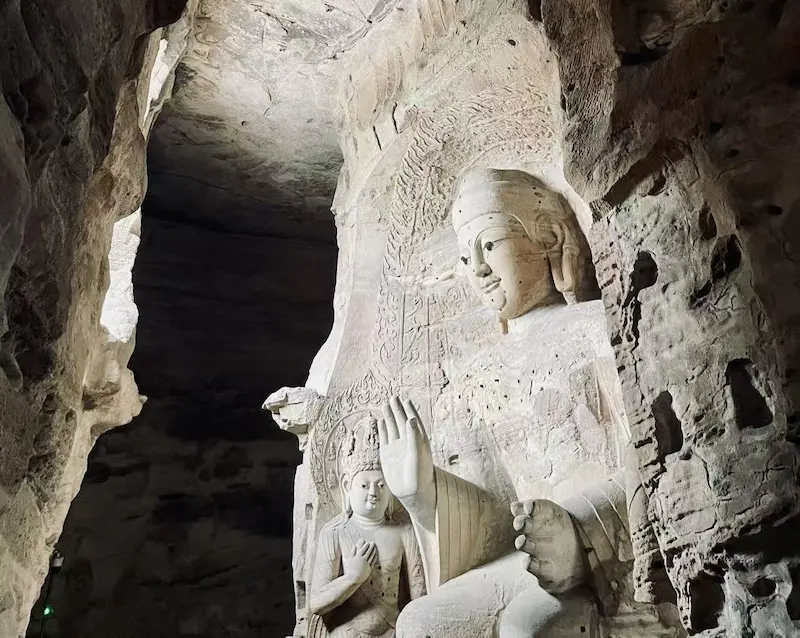
Another culturally fascinating aspect is the gradual Sinicization of the Buddhas’ facial features. You will notice that the early Buddhas, characterized by distinctly Western and Indo-Greek influences (square faces, sharp noses, and classical drapery), gradually give way to figures adopting markedly Han Chinese traits (elongated faces, subtle smiles, and broad-sleeved monastic robes). This shift demonstrates the gradual domestic adaptation of a cultural element originating in India and entering China via Tibet and the Silk Road.
If you wish to delve deeper into this topic, you can also read our article on the Dongzhulin Monastery, where we summarize the fascinating history of the spread of Buddhism across the Tibet and Kham region.
For us at Ink Voyages, visiting the Yungang Grottoes is far more than a tourist excursion; it is a spiritual experience. Without exaggeration, encountering these colossal statues for the first time leaves you speechless. Contemplating these extraordinary works of art, with their serene faces and meditative poses, transports you into a personal state of Nirvana. That is, of course, if you are fortunate enough to visit without being surrounded by crowds of tourists—a factor that can present a slight obstacle to your path toward enlightenment.
To plan your visit, note that the archaeological site is located about 16 km west of downtown Datong and requires an average of 3 to 4 hours of exploration. The complex comprises 252 caves housing over 51,000 statues carved into the sandstone cliff, with the Tanyao Caves (16–20) undoubtedly being the most spectacular.
The most poignant aspect of admiring such artistic magnificence is noticing the faint traces of pigment clinging to certain walls, realizing that what we see today is merely a pale shadow of the vibrant splendor this Buddhist sanctuary once possessed.
Nevertheless, it remains an extraordinary experience. To be completely candid, this is for us the single most essential reason to recommend a trip to Datong. If you are interested in discovering an even larger Buddha, you can take a look at this itinerary in Sichuan, which includes the Leshan Giant Buddha.
Hanging Over the Canyon: The Engineering of the Hanging Temple (Xuankong Si)
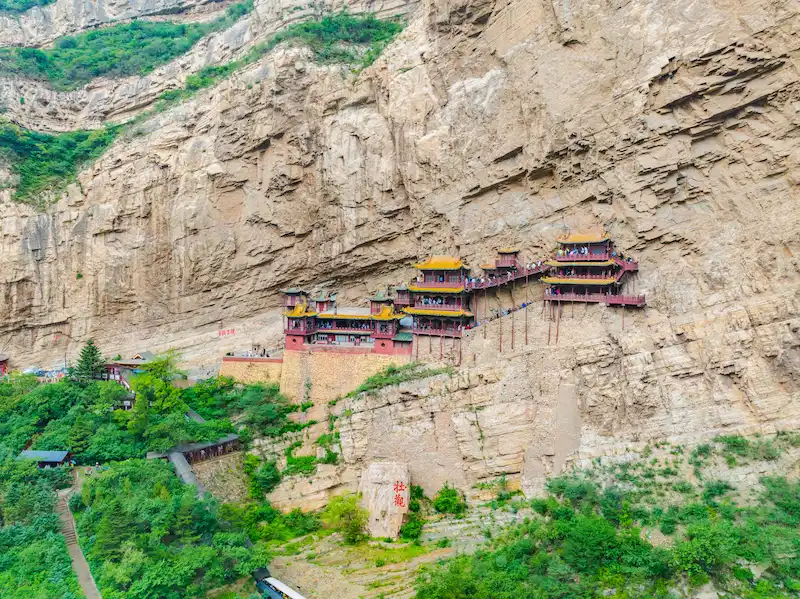
Another key landmark associated with Datong—and perhaps its most famous—is the Hanging Temple (Xuankong Si), also known as the Hengshan Hanging Temple. Like the Yungang Grottoes, it is not located directly in Datong itself; you must drive about 65 kilometers southeast (approximately a 1.5-hour drive) to reach it, perched precariously inside the deep Jinlong Canyon gorge.
Because of this, if you plan to visit both the temple and the grottoes while exploring the city itself, you should set aside two full, action-packed days in Datong. To be upfront, in our opinion, it does not match the artistic grandeur of the grottoes. However, it remains a vital historical witness to the sociocultural atmosphere of the period.
Shortly before the Northern Wei capital moved south to Luoyang in 494 AD—part of a broader movement toward cultural integration between the Xianbei and the Han—legend holds that the monk Kou Qianzhi instructed his followers before his death to build a sanctuary suspended in mid-air, secluded from worldly noise.
Built in 491 AD, the Hanging Temple evolved into a syncretic shrine. Originally a symbol of state Buddhism, it later incorporated statues of Confucius and Laozi, the founders of Confucianism and Taoism, under a single roof.
An interesting architectural insight: despite the optical illusion suggesting the temple rests on slender vertical stilts, the entire weight of the pavilions is actually supported by ingenious horizontal oak beams inserted deep into the solid mountain bedrock. The vertical stilts were added centuries later primarily for psychological reassurance and seismic stability.
A practical note: if you decide to visit the Hanging Temple, keep in mind that a standard entrance ticket does not automatically allow you to climb up into the structures. The base ticket grants access to the scenic area at the bottom of the canyon. To climb up and walk through the temple corridors, you must purchase the additional “boarding ticket.” If you visit during peak travel season, be prepared for substantial lines.
A Millennial Wooden Miracle: The Yingxian Pagoda
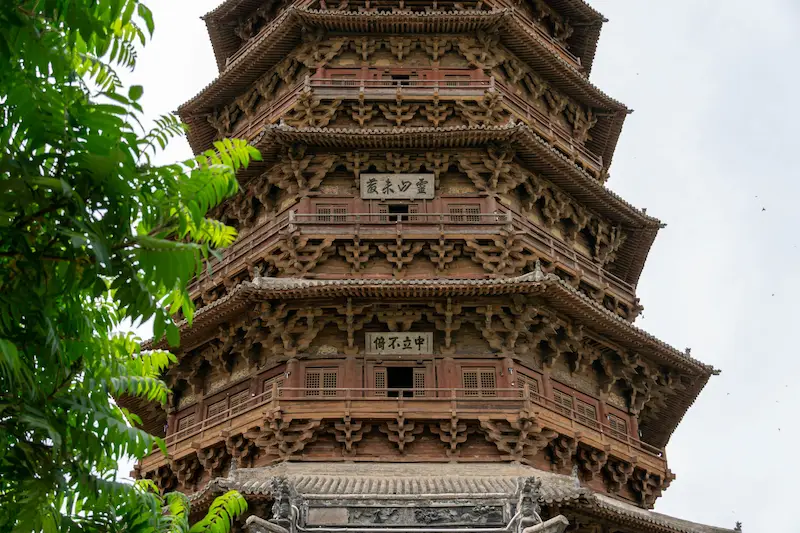
Another major historical monument associated with Datong, though located outside the city proper, is the Yingxian Pagoda. Erected in 1056 during the Khitan Liao Dynasty, this monumental tower stands over 67 meters tall and holds the record as the oldest and tallest fully wooden pagoda in the world.
What makes it a masterpiece of ancient engineering is that it was constructed without using a single iron nail. Instead, it relies on dougong, an extraordinarily complex interlocking wooden bracket system that allows the structure to flex and absorb the impact of numerous major earthquakes over a millennium.
It is a genuinely awe-inspiring landmark. As with the grottoes and the Hanging Temple, visiting it requires some logistical coordination. In our view, it is even more rewarding than the Hanging Temple and possesses immense historical appeal.
Beyond the Walls: What Remains of Historic Datong
After exploring the surrounding area, the final section of this article brings us into Datong’s city center. This sequence is intentional: in our view, Datong serves primarily as a convenient hub for visiting the grottoes rather than being a primary destination in its own right.
As is our custom, and in line with our philosophy of exploratory travel, we want to give you an honest perspective on the urban transformations affecting certain historic destinations. For a smooth journey free of unpleasant surprises, you can explore our recommended private tours, which we can fully tailor to your personal travel preferences. Nevertheless, since you have made the journey here, take the time to visit the parts of the city center that have retained their genuine historical character.
It must be noted that present-day Datong is the result of a massive urban reconstruction project aimed at recreating its historic layout. Until the 2000s, Datong was a heavily polluted coal-mining industrial hub. Starting in 2008, an ambitious redevelopment project demolished vast modern residential blocks to reconstruct the grand Ming Dynasty city walls and classical architectural complexes from the ground up.
In this regard, it can be compared to Wangxian Valley in Shangrao, though the aesthetic execution in Shangrao proved superior. When visiting Chinese “ancient towns,” as we explained in our article on Furong Ancient Town, one must generally set aside expectations of unblemished antiquity, as most have been substantially rebuilt and adapted for modern tourism.
However, while places like Shangrao, Furong, and Fenghuang remain scenic and visually impressive destinations despite their modern reconstruction, we feel the same cannot quite be said for Datong’s old town center: Datong contains magnificent individual historical treasures, but the city center as a whole is not particularly scenic.
Here are the sites within the city center that we consider genuinely worth visiting:
- Huayan Temple and Shanhua Temple: Two magnificent wooden religious complexes dating back to the Liao and Jin dynasties that have miraculously survived with their original millennial structures and statues intact.
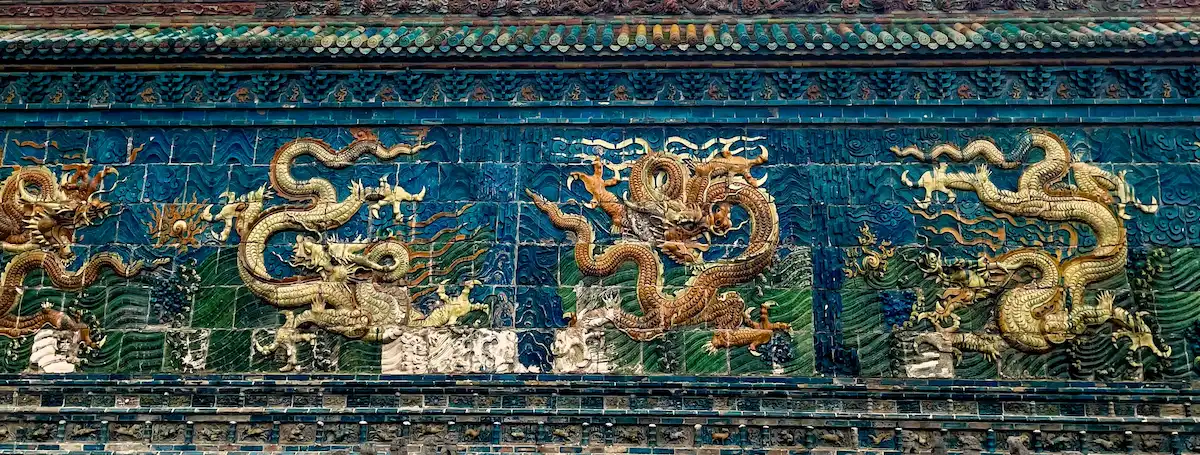
- The Nine-Dragon Wall: A magnificent Ming Dynasty masterpiece made of glazed ceramic tiles, which is larger and older than the famous Nine-Dragon Wall in Beijing’s Forbidden City.
- The City Walls: Completely rebuilt over the past fifteen years, they nonetheless offer an enjoyable location for a sunset stroll. To complete your itinerary, if you wish to visit another fortified historic settlement after Datong, you can head south to include the historic city of Pingyao in your trip.
Is Datong Worth the Trip? Practical Tips from Ink Voyages
We hope this guide helps you decide how to structure your journey through this region. To answer the ultimate question—is Datong worth visiting?—our answer remains a clear yes, if only to experience the awe-inspiring Yungang Grottoes.
An alternative strategy worth considering is skipping an overnight stay in Datong altogether: you can base yourself in Beijing and take a round-trip day journey via high-speed rail if your primary goal is to tour the grottoes.
From all of us at Ink Voyages, we wish you a wonderful journey and invite you to explore our curated itineraries to discover the real China.


