
What to visit in Chongqing through local life, hot pot and teahouses
Part 2: local life and the flavors of Chongqing
Table of Content
This is the second part of our travel guide to Chongqing. On our blog, you can also find the other three parts, to explore this city with us in greater depth.
If you want to see with your own eyes what we are going to talk about in this article, you can find here our vlog & travel guide episode dedicated to exploring Chongqing.
To help you find your way through the guide, here is a brief summary of the themes covered in each part:
Part 1: the strange beauty of Chongqing, between rivers, mountains and bunkers
Part 2: local life and the flavors of Chongqing
Part 3: Chongqing, the city of eight dimensions
Part 4: the old, the new and the wild side of Chongqing
And for more ideas for exploring China, you can browse our regional catalog of customizable private journeys.
The ancient soul of local life
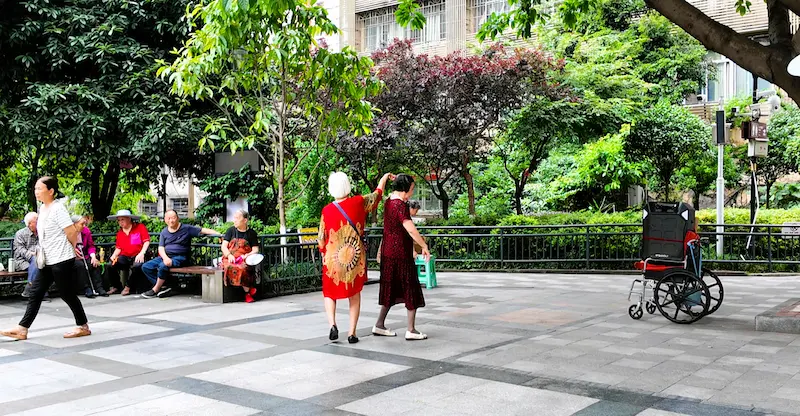
One of the aspects that makes Chongqing one of our favorite cities in all of China is its local lifestyle. Compared to other major metropolises, Chongqing has a more relaxed atmosphere: at almost any time of day, you can see people resting in parks, playing cards or Chinese chess — xiangqi — dancing or exercising in public squares. In Chongqing, quite spontaneously, any square can easily turn into a meeting point for collective activities.
Despite this relaxed atmosphere, keep in mind that Chongqing is still a chaotic megacity, where the sound of car horns is a constant. The city is always alive, noisy, and at any hour of the day or night you can find something open — because Chongqing never sleeps.
We want to pause for a moment to talk about the local life and flavors of Chongqing, which belong to the historical tradition of this city. Inside this maze of “eight-dimensional” buildings, which has become famous on social media for its futuristic side, there is also an ancient soul, made up of many small elements that in a certain sense belong to the past, but still emerge on the surface of its forward-looking present.
Let us mention one of them, perhaps the most striking one, because it speaks so well of a place — and of a country — suspended between past and future, so vast that it allows you to experience something almost paradoxical: in the same place, at the same moment, you can have glimpses of the past and visions of the future right in front of you.
To begin with the past, then, know that in Chongqing you might see this kind of scene take shape before your eyes: an elderly woman, kneeling in front of a stool, cleaning a customer’s shoes with a brush. It looks exactly like a scene you might see in a black-and-white photograph from a bygone era — but not entirely gone.
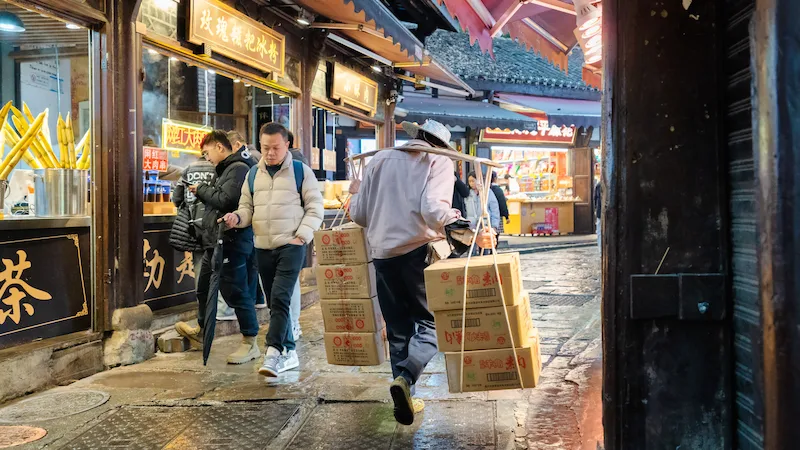
In the streets, you may also see workers carrying two overflowing baskets attached to ropes and to a bamboo pole resting across their shoulders, like figures from Chongqing’s past — a past that, effort after effort, helped the city blossom into the dazzling metropolis it is today, and that the city still carries in its belly. These tireless porters are the famous Bangbang Men, the “stick army.” For decades, before technology and modern delivery systems transformed urban logistics, the Bangbang were the true arteries of Chongqing, able to climb thousands of steps with impossible loads on their shoulders. Today, their numbers are decreasing drastically, but seeing them move with their steady rhythm among glass skyscrapers is a powerful reminder of the human effort on which this megacity was built.
The Ma’anshan neighborhood
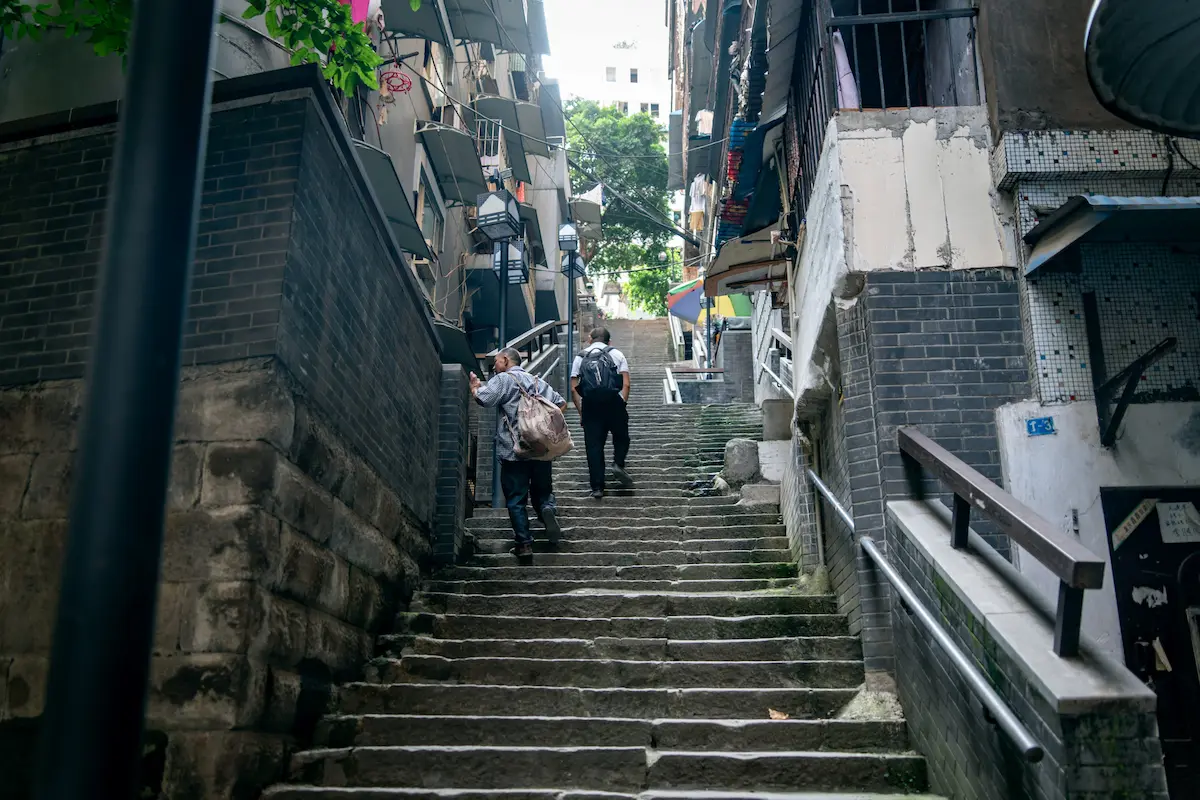
Our favorite place to immerse yourself in local Chongqing is Ma’anshan, a neighborhood that climbs up the side of the mountain, where houses are literally built one above the other, in a fascinating mix of buildings, paths and vegetation. Step after step, you find yourself in the heart of a working-class neighborhood, where the noise of the street below slowly fades as you keep climbing. The residents will look at you with some surprise — keep that in mind — as you continue toward the top.
Because there are several forks in the path, it is easy to get lost and therefore struggle to reach the top. Our advice: if needed, with the help of a translation app, you can tell locals that you are going to the restaurant located at the highest point of the neighborhood, so they can point you in the right direction.
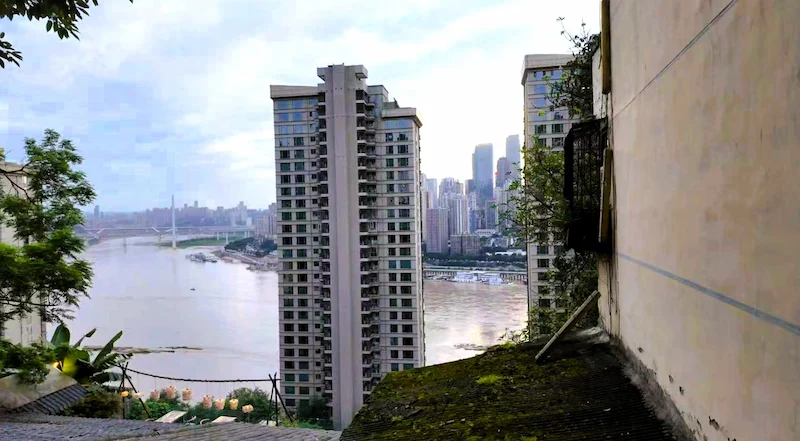
Once you arrive, cross the open space in front of you and immediately turn right. Here, you will find what, in our opinion, is one of the most intimate and interesting viewpoints in the city: a glimpse of the river opening between moss-covered metal rooftops and leafy branches, facing a tall, abandoned-looking building that seems to rise directly from the waters of the Yangtze. At sunset, in this solitary corner, you will feel light years away from the city’s tourist attractions, and you will be able to contemplate one of the many faces that make up the strange beauty of Chongqing.
Practical note: when visiting Ma’anshan, bring mosquito repellent with you.
The flavors of the city
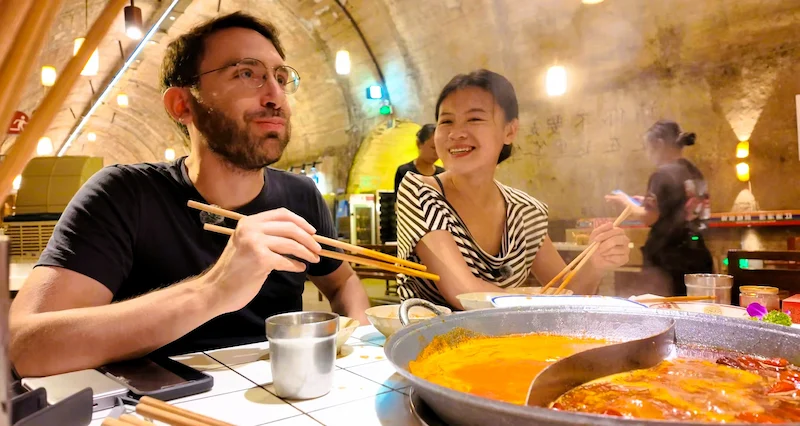
Another defining feature of Chongqing is the strong flavor of its cuisine, which reaches you from the street as you explore the city — tempting you, and also intimidating you a little, because your sense of smell already warns your tongue that some seriously spicy moments are coming.
In fact, as we also had the chance to share with Fodor’s, Chongqing is one of the spiciest cities in China, where it is not easy to find food that is truly “not spicy,” even when you explicitly ask for it. Somehow, in Chongqing, spice always seems to find a way into your plate.
Our advice is not to miss Chongqing hot pot, an experience that can be challenging but just as rewarding. Hot pot here is truly one of the pillars of local culture and has deep roots, beginning with humble origins and later spreading across all levels of society until it became one of the great symbols of Chinese conviviality.
If you want to try a really good one, with a truly unusual and spectacular setting, we recommend not missing the one located inside one of the bunkers near the Beilou Zhuanxian market. You will be amazed by the beautifully lit depth of the tunnel, which has now been transformed into a joyful and convivial place, while still preserving its historical memory.
But let us come to the connection between hot pot and spiciness, which can also be explained through its origins. In hot pot, it was not — and still is not — only fine cuts of meat that ended up in the pot, but also organs, offal and, more generally, parts with strong flavors, which spiciness could help make more pleasant.
There is also another reason for Chongqing’s love of spice, one that goes beyond hot pot and is linked to the extremely humid climate of this area. To prevent humidity from remaining in the body, people in Chongqing traditionally believe that the body needs to sweat a lot — and if the many slopes and steep stairways they have to face while moving around the city are not enough, then spicy food takes care of the rest, stimulating sweat and helping people stay healthy.
If you are a food lover looking for strong flavors, you might also consider exploring Sichuan, a region of China as famous for pandas as it is for chili peppers.
Teahouses
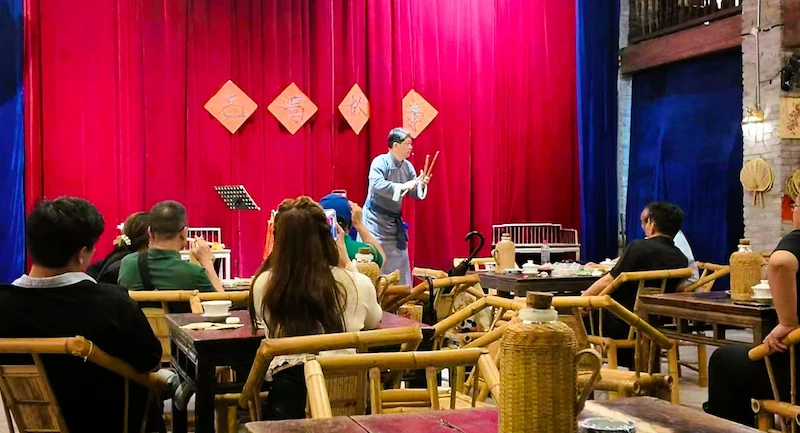
And if your throat burns too much after the meal, don’t worry: right next door, in a connecting tunnel, you will also find a teahouse, where you can enjoy refreshing teas.
When visiting Chongqing, we recommend taking some time to enjoy the atmosphere of a local teahouse. Drinking tea is a true social ritual, which can be accompanied by card games, chess, and even performances by local actors who tell fascinating traditional stories. They bring to life a world that — even if you do not understand what is being said — can still enchant you through the sounds, masks and traditional movements of Chinese theater. If you want to attend this kind of performance, the right teahouse is the historic Changle Yongkan, which will surround you with its traditional and welcoming setting.
Continue exploring Chongqing with Ink Voyages in the next part, where we enter the city’s most surreal urban side: impossible buildings, rooftop squares, cableways and magic escalators.
Read Part 3: Chongqing, the city of eight dimensions.


Leave a Reply