
What to visit in Chongqing, the city of eight dimensions
Part 3: impossible buildings, cableways and escalators
Table of Contents
This is the third part of our travel guide to Chongqing. On our blog, you can also find the other three parts, to explore this city with us in greater depth.
If you want to see with your own eyes what we are going to talk about in this article, you can find here our vlog & travel guide episode dedicated to exploring Chongqing.
To help you find your way through the guide, here is a brief summary of the themes covered in each part:
Part 1: the strange beauty of Chongqing, between rivers, mountains and bunkers
Part 2: local life and the flavors of Chongqing
Part 3: Chongqing, the city of eight dimensions
Part 4: the old, the new and the wild side of Chongqing
And for more ideas for exploring China, you can browse our regional catalog of customizable private journeys.
A city of eight dimensions
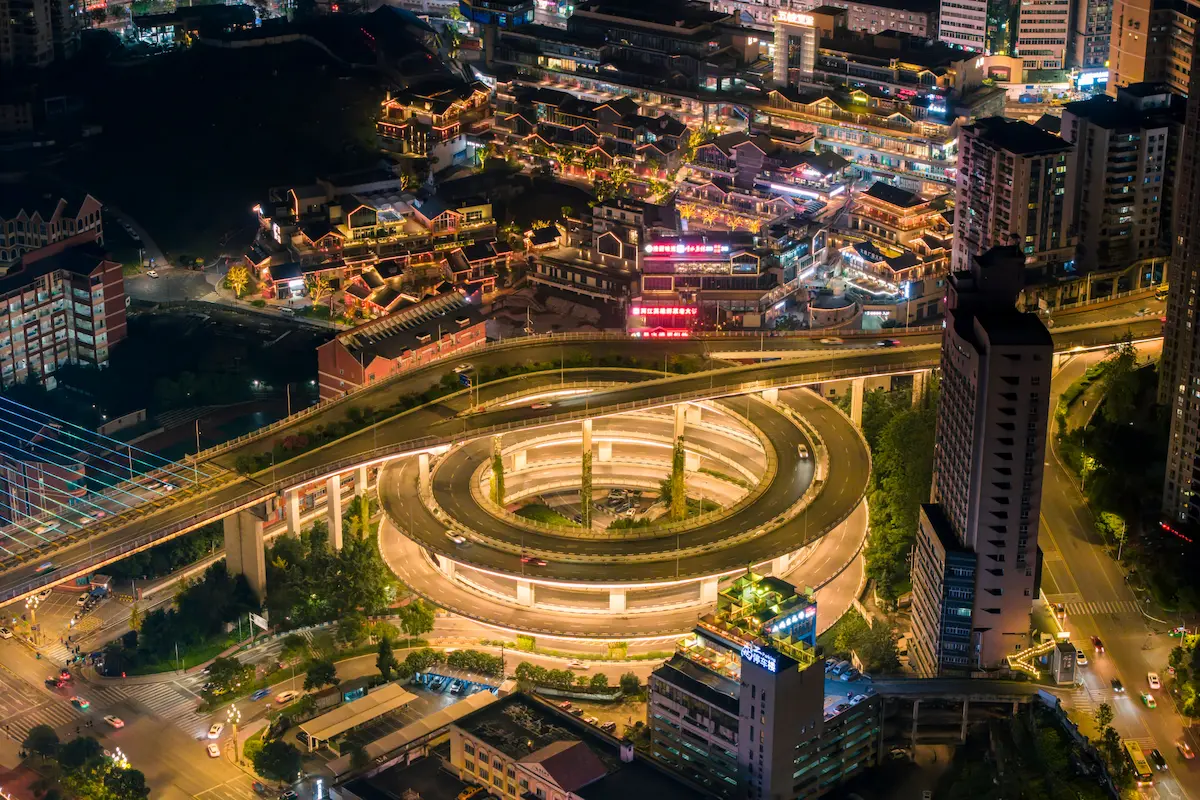
Let us now move on to the theme that has brought Chongqing onto the international stage: its vertical, surprising and seemingly irrational urban layout. There are at least five iconic symbols of the so-called “8D” effect, which, in our opinion — beyond the media overload they have received, often inflating reality in a sensationalistic way — are objectively fascinating.
Baixiang: the White Elephant Building
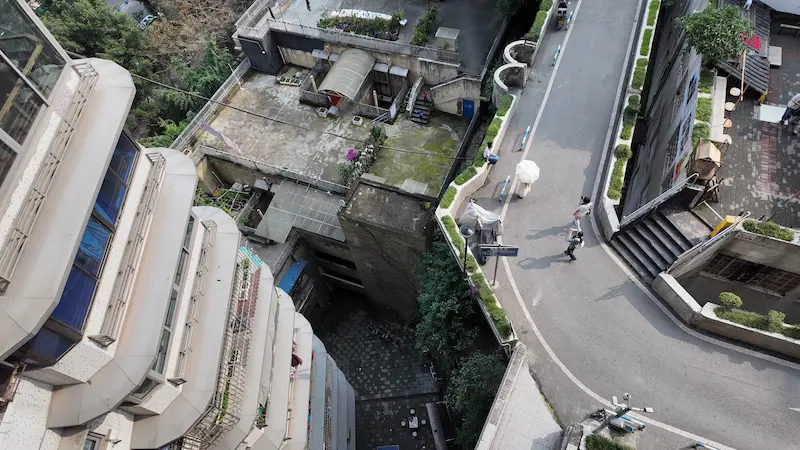
Let us start with our favorite. This is a 24-storey building with no elevator, where the staircases split and branch off, making life difficult for tourists and sometimes even for locals. During our last visit, for example, we came across a shifu — a delivery worker — who was trying in vain to figure out where to drop off an order inside the building.
This labyrinthine building is called Baixiang, meaning the “White Elephant”. To experience the “8D” effect here, we recommend doing the following: first, go to the entrance facing the square with the characteristic white elephant statue on Baixiang Street, at No. 24 Baixiang Junction. From this point, looking around, it will seem as if you are on the first floor. Everything feels normal.
Enter the building and start walking through the corridors, lined with small stalls selling all kinds of food. At the end of the first corridor, above the door on the left, you will find a blue ceramic tile with the number 12 written in white.
Yes, exactly: even though you have only crossed a corridor, you are actually already on the 12th floor. To convince yourself, keep walking through the corridors and you will gradually reach number 16. At this point, you will be fully convinced that it is not a mistake, because from the balcony on your right you will see that you are indeed very high up, with a beautiful view of the Yangtze River and some skyscrapers on the opposite bank.
The square on the roof of a building: Kuixing Lou
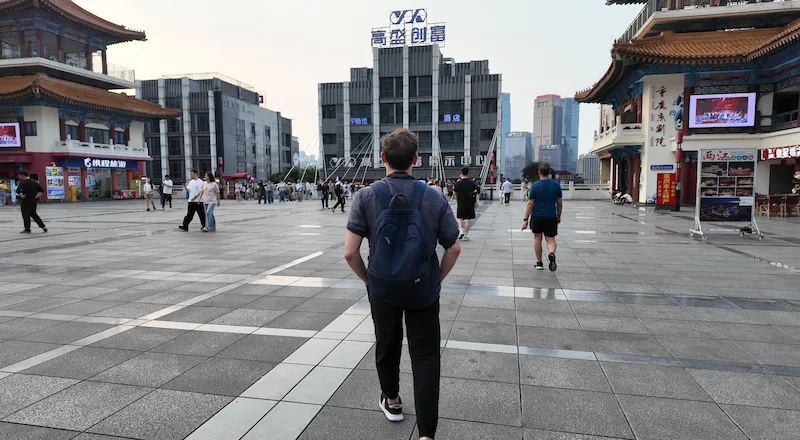
Another expression of Chongqing’s strange beauty is the square of Kuixing Lou. Here, you can experience another “8D” moment: when you enter the square, it will once again feel as if you are at ground level. To be precise, the square is located on the roof of a building adjacent to a hospital complex and commercial offices, but the lower entrance is effectively at street level, and to reach the square above, you simply need to climb a short staircase. And there you are: standing on a rooftop square, looking at the traditional-style structures built on top of it.
The feeling is that of being in a normal square, only slightly raised above the street you have just come from. However, walk across the square to the opposite end and look down. Hold on to the railing, because you are actually standing above an urban precipice, 22 floors above ground level.
Next to you, you will see a metal bridge leading to another building. As you cross it, if you look to your left, you will see two buildings in the background, also connected to each other by a bridge. Squares on top of buildings, bridges connecting them, first floors turning into twenty-second floors without interruption: welcome to Chongqing.
The cableway over the Yangtze River
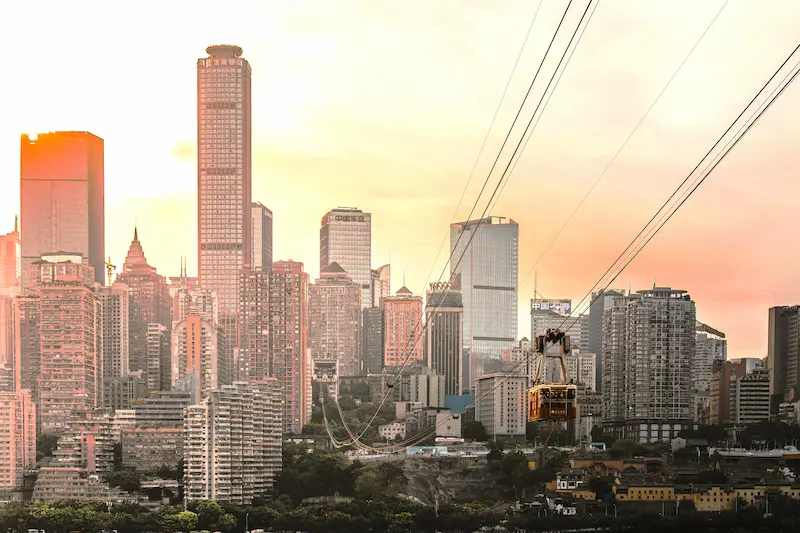
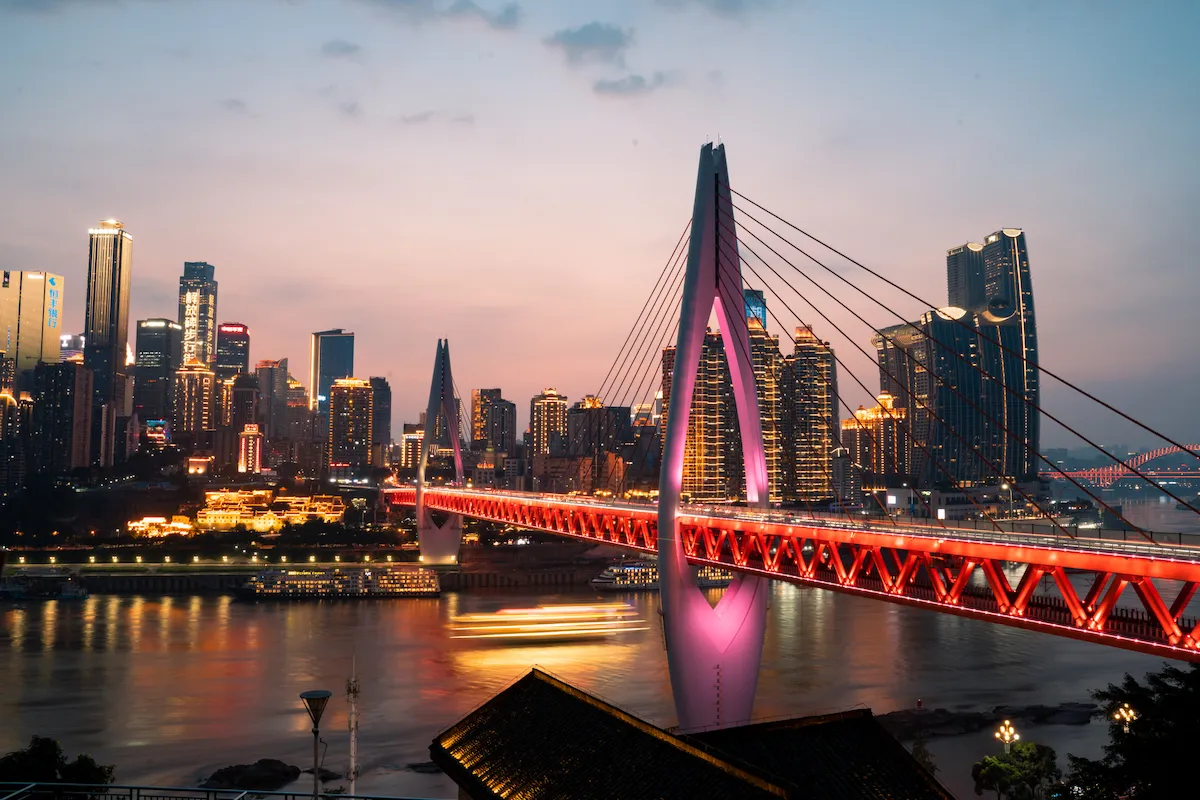
Another experience we recommend not missing in Chongqing is crossing the Yangtze River by cableway: the Changjiang Cableway. Its beautiful red cabin allows you, for only 30 yuan — about 3.5 EUR — to travel from one bank to the other and enjoy a beautiful view of the Dongshuimen Bridge, which cuts through the city night like an arrow of fire.
A practical note: to take the cableway, you need to have your passport with you, or at least a photo of it, to show when buying the ticket. Otherwise, you may not be allowed to board. In general, when traveling in China, it is always a good idea to carry your passport with you, as it is often required at the entrance of major attractions.
The Chongqing cableway is another symbol of the “8D” city, simply because having a cableway in the heart of the city is already something crazy and spectacular — even more so because it offers extremely photogenic views. Not only from above the cableway, but also from below — and perhaps even more than when you are inside it — the red metal cabin floating above the city is the perfect symbol of this urban jungle, where roads are not enough, and so the city had to resort to vines.
In particular, we recommend watching the cableway from Chongqing’s riverside, where you can stroll while enjoying its acrobatic movement above the river waters, and from one of the places mentioned above: Baixiang. Shortly after entering the building, you will notice a very crowded corridor. From here, roughly every 5 to 10 minutes, you can see the cableway passing right in front of the building’s windows.
But do not stop there. Go down to the 9th floor — from the 16th floor, on the split staircase, keep right and continue descending until you find the exit to the 9th floor. Then head right. After a few meters, you will notice two buildings that create a perfect frame for photographing the cableway as it passes between them.
Liziba: the train that passes through a building
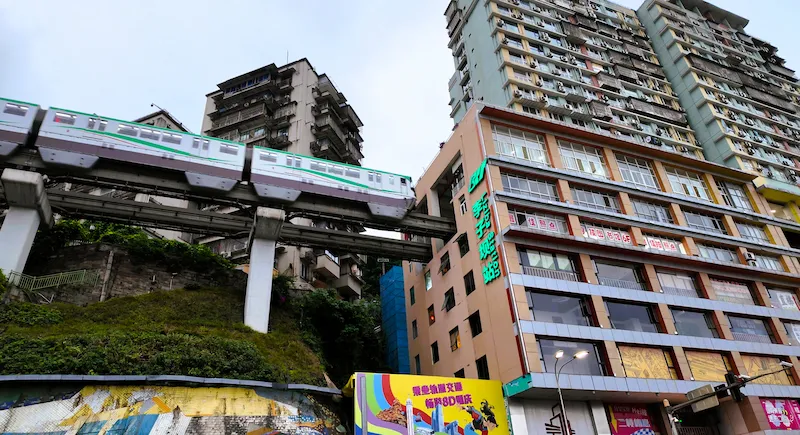
Last but not least: the train that passes through the building at Liziba Station, on Line 2, which has become one of the most hyped places on social media in recent years. In itself, in our opinion, it is not particularly spectacular, but it is still fun and interesting to include this stop in your Chongqing checklist, because it fits organically into the urban oddities of this metropolis, as one of the many pieces that make up its strange and fascinating shape.
It should be said that, like everything else, making a train pass through a building was not a tourist gimmick. Chongqing’s urban planning is always guided by its own special logic, through which the city has learned over time to deal with a difficult and stubborn territory.
And since we have made it to Liziba, if you are driving a car and want to experience another “bunker” moment, know that not far from the station entrance there is one of the most unusual places where you can refuel: a Sinopec gas station built inside one of the city’s many air-raid shelters. Practical note: remember that entering on foot is not allowed.
Other symbols: the magic escalators
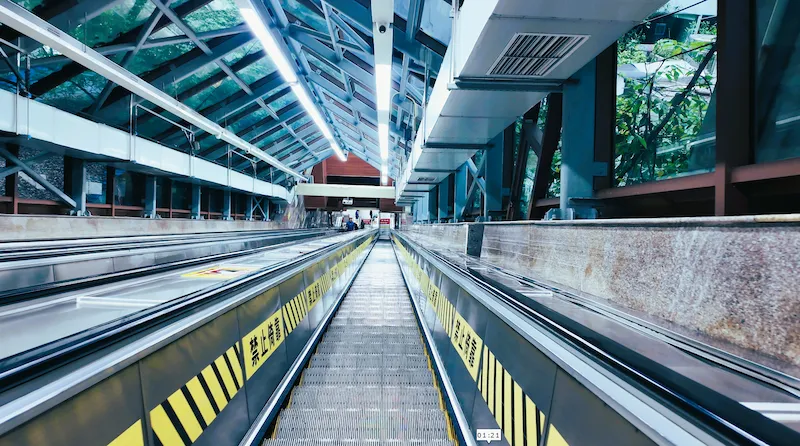
Unlike those at Hogwarts, Chongqing’s stairs do not like to change, but they are very mobile — and, in a certain sense, also quite magical.
The Crown Escalator
The most incredible one is the Crown Escalator — Huangguan Escalator — which is so long that it counts as a real form of urban transport. You need to pay a ticket of around 2 RMB, less than 30 euro cents, to use it. It is also so steep that at the entrance there are staff members making sure passengers follow the safety instructions before stepping on.
It takes around two and a half minutes of continuous movement to get from one end to the other, covering a vertical drop of more than 50 meters with a breathtaking 30-degree inclination.
We recommend experiencing it in both directions, to get a clear idea of just how steep it is — without risking turning around while going up or down, because it is easy to lose your balance.
The deepest metro station in China
There is also another escalator — or rather, a series of consecutive escalators — that you can take if you want to experience reaching the deepest metro station in all of China. We are talking about Hongyancun Station, or Hongyan Village Station, on Line 9, a recently opened station that descends to a record depth of 116 meters below ground level, surpassing the previous record held by Hongtudi Station. This incredible depth is comparable to the height of a building of almost forty floors dug entirely underground.
In itself, since it is not a single escalator and the slope is distributed more gradually, the experience is less impressive than the Crown Escalator. Still, you might consider descending into the bowels of the earth if this station is convenient for reaching your hotel by metro.
The disorienting thing is that, after all that descending, once you take the train and look out of the window, you will soon realize that you are not underground at all. In front of you, the city suddenly opens up under the sky, above a suspended viaduct.
Another Chongqing-style magic trick.
Continue exploring Chongqing with Ink Voyages in the final part, where we discover the old, the new and the wild side of the city. Read Part 4: Hongyadong, temples, skyline and urban trekking in Chongqing.


Leave a Reply