A Journey to Longmoye: Where Spirits Gather
Table of Contents
The Wa People, Headhunting and the Spirits of Nature
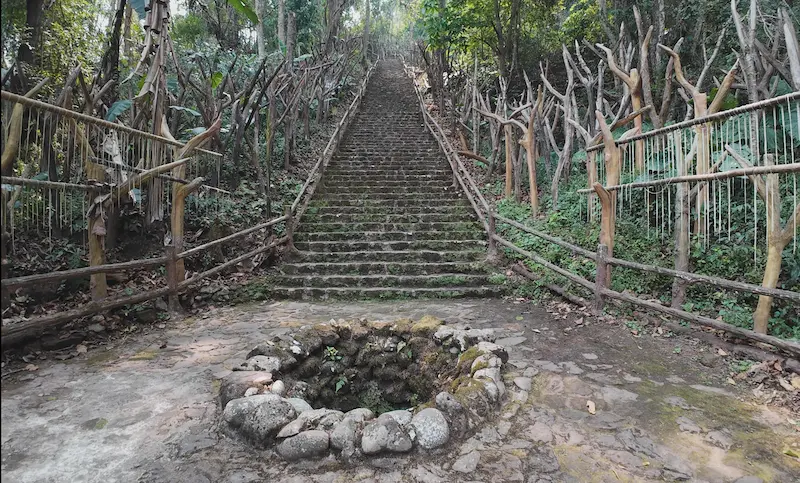
According to us at Ink Voyages, there is no need to rely on imagination to immerse yourself in the unsettling sacredness of Longmoye. A long and forbidding dark stone staircase is the first test you must overcome to be admitted into the presence of the spirits.
At the top of the staircase stands a first altar, where an ox skull awaits you — one that has watched your ascent from the depths of its hollow eye sockets. It is only a foreboding symbol of what lies ahead, should you decide to continue along the path of Longmoye…
In the local language of the Wa people, “long” means “spirit” and “moye” means “gathering.” Longmoye is therefore the place par excellence where spirits gather, and where the Wa minority carried out propitiatory sacrifices for centuries.
The Wa minority today numbers around 430,000 people in China (over one million including those living in Myanmar), mainly concentrated in Yunnan, in southwestern China, along the border with Myanmar.
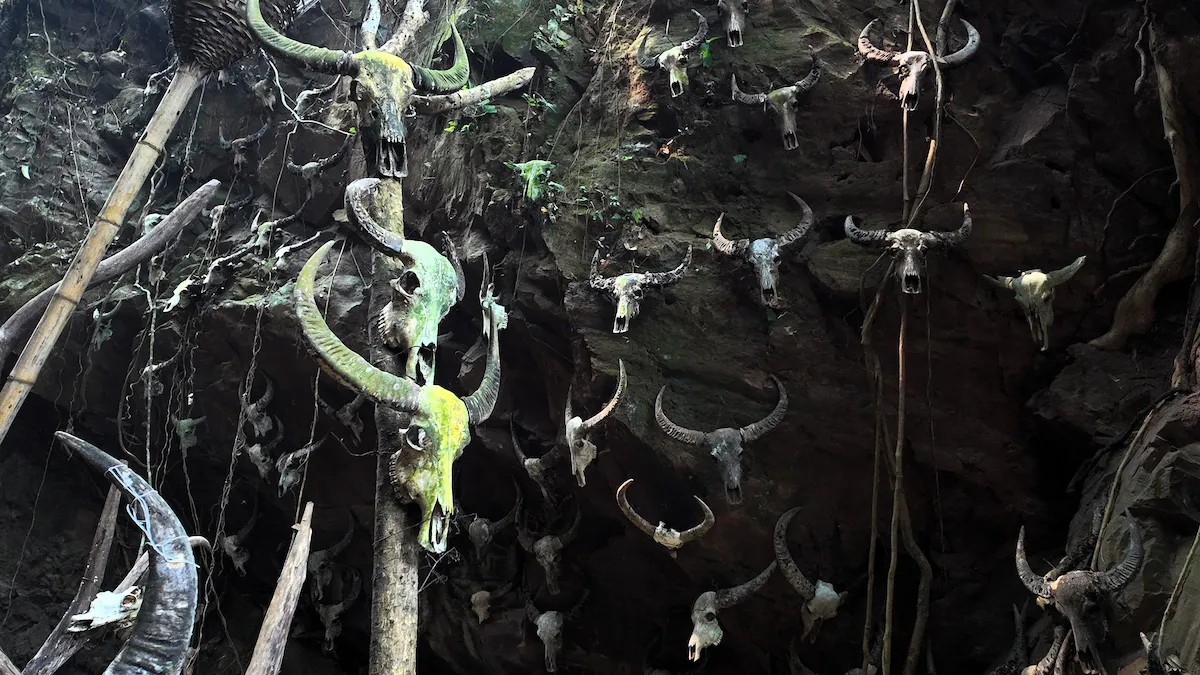
The history of Longmoye is as fascinating as it is bloody: where ox skulls are now attached to the tops of wooden poles planted in the ground, human skulls once stood — at least until 1958 (the year of the last large-scale headhunting practices, before reforms imposed by the Chinese government).
The fate of those captured by the Wa people was far from enviable… Those taken prisoner during headhunting raids or conflicts were destined to become intermediaries with the spirit world. The price of this mediation was their own lives.
It is also interesting to note that headhunters did not choose their sacrificial victims at random, but rather preferred those with long hair and beards, as these were seen as a sign of a stronger connection to the spirit realm.
From Human Skulls to Ox Skulls
If you are now considering shaving your beard and head before visiting Longmoye, we can reassure you that there is no need! And in general, it is not a dangerous place in any way.
The process of softening these sacrificial practices began several decades ago and, as mentioned, was formalized in 1958 through a reform that imposed the replacement of human skulls with ox skulls.
In addition to this change, during the ceremonies that still take place in Longmoye today, animal sacrifice has increasingly been replaced by plant offerings, with fruits and vegetables now presented to the spirits on altars that once received very different kinds of gifts.
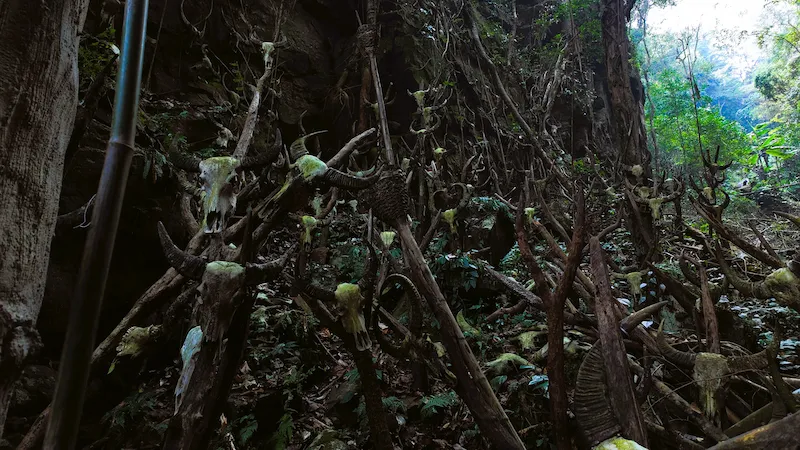
If you continue beyond the staircase and follow the stone path that unfolds before you, you will move deeper into the mountain. At a certain point, you will notice the first poles emerging among the foliage, and you will see the empty eye sockets of ox skulls watching you as you walk forward.
The intensity of this place will make you forget that you paid an entrance fee (30 RMB / about 3.5 euros). Standing before Longmoye and its constellation of ox skulls — mounted on poles, hanging from rock walls, or scattered along the stream whose waters were once said to run red — you no longer feel as though you are in a tourist attraction, but rather in the presence of a special place. It is a place capable of radiating a powerful spirituality, where you can clearly sense the pulse of ancient rituals and beliefs that still survive in the cultural fabric of the Wa minority.
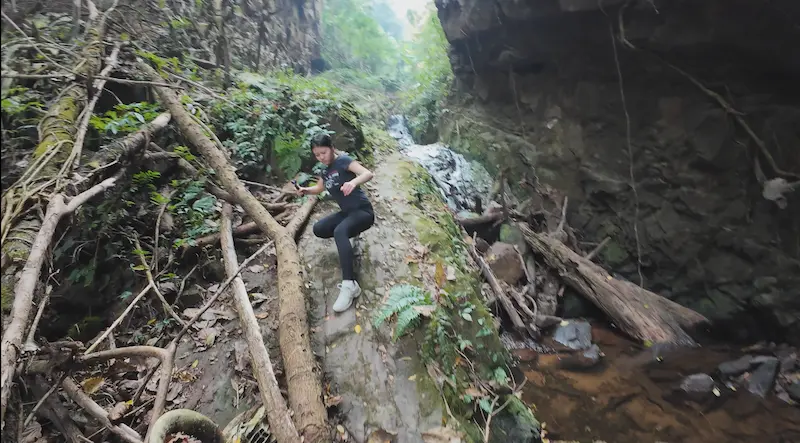
If the sight of the skulls has not discouraged you, for an even more immersive experience you might consider walking upstream along the stream. You will be surprised to see how far the skull-crowned poles extend. In that case, be careful: the ground is extremely slippery, the stones are wet, and there is a real risk of falling. Walking up the stream is thrilling — something we highly recommend, as long as you remain cautious.
As you leave the sacred site, you will gradually feel lighter. You can choose to walk along the pathways that have been laid out around a lake located at the center of the area: both the right and left paths will lead you to the exit. The lake and the walk will gently guide you, step by step, from the realm of spirits back to that of humans.
To deepen your understanding of this region, you can read our Yunnan travel guide. And for further discoveries, you can also explore our catalog of tailor-made journeys in China.
A Living Culture, Between Symbols and Traditions
Beyond Longmoye, what we particularly appreciate about this area is the county in which it is located: Ximeng. As you walk through its streets, you will notice the widespread presence of symbols representing ox skulls — on manhole covers, atop street lamps, on house walls, even as emblems above certain shops, and more.
This gives you the impression of a living culture, one that actively draws from its traditions and remains in constant dialogue with its past, without becoming merely museum-like.
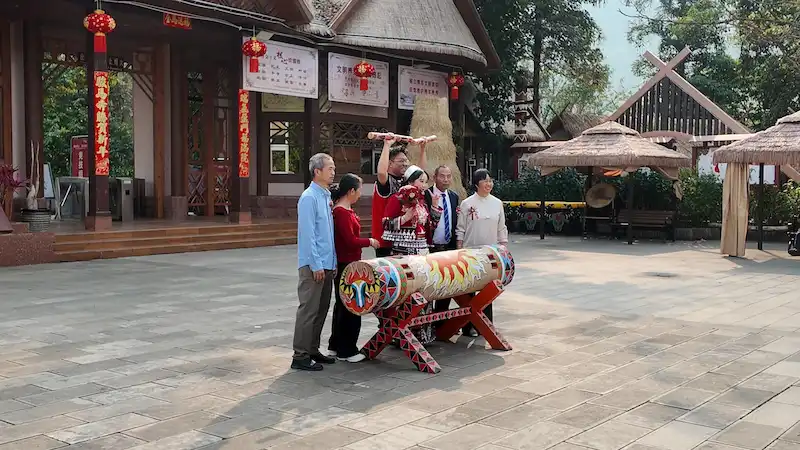
During our most recent visit, we also had the chance to witness a wedding: the bride and groom, dressed in traditional attire, gathered in front of the entrance to Longmoye. At the center of the square stood a kind of altar (a horizontal totem resting on a wooden support), where the ceremonial photos were taken.
The groom was also holding two wooden cylinders/totems, which at one point he placed above his head, almost joining their ends — a gesture that seemed to us like a clear reference to ox horns.
The importance of the ox in Wa culture — as is now evident — is fundamental. In this animal, the Wa people see a symbol of strength, well-being and prosperity. Through its sacrifice, they expressed devotion and respect toward the spirits of nature, to whom they addressed — and continue to address — their prayers.
With the promise that you will face no danger and will not witness the beheading of any ox, we hope we have sparked your curiosity enough to explore southern Yunnan.
At Ink Voyages, we remain at your disposal to help you plan your tailor-made journey to China, and we wish you all the best for your next adventures!