Yuanyang and the Hani Rice Terraces: a Mosaic of Earth, Water, and Sky
Table of Contents
Wonder, Time, and the Logistics of a Rural Exploration
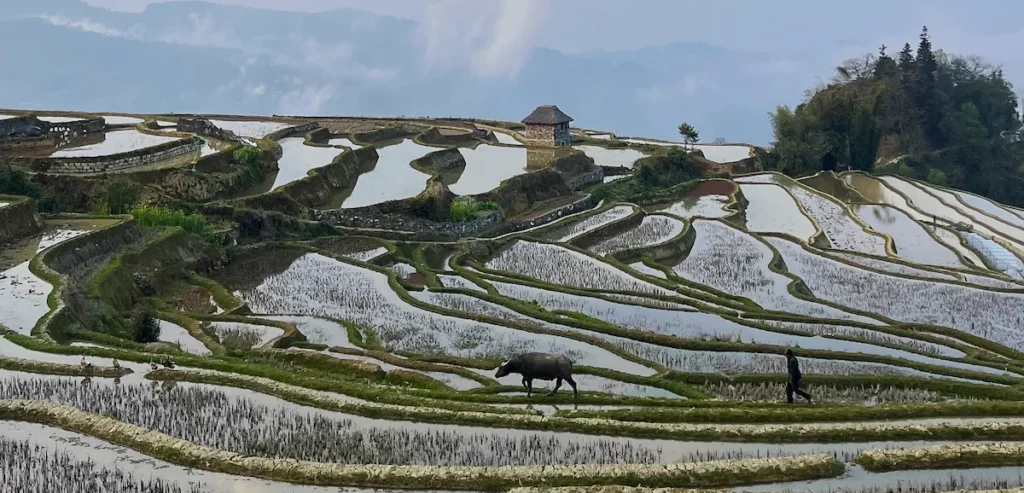
Yuanyang is one of those places that seems suspended in time, where the life of the Hani people still follows ancestral rhythms, rooted in age-old agricultural traditions that give rise to breathtaking landscape geometries.
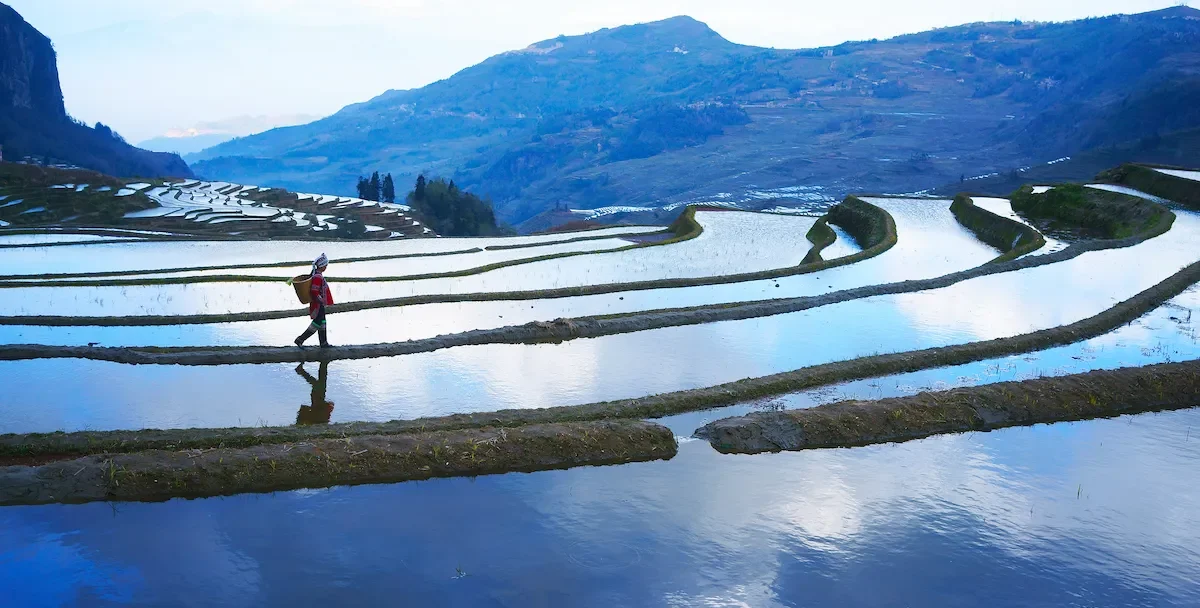
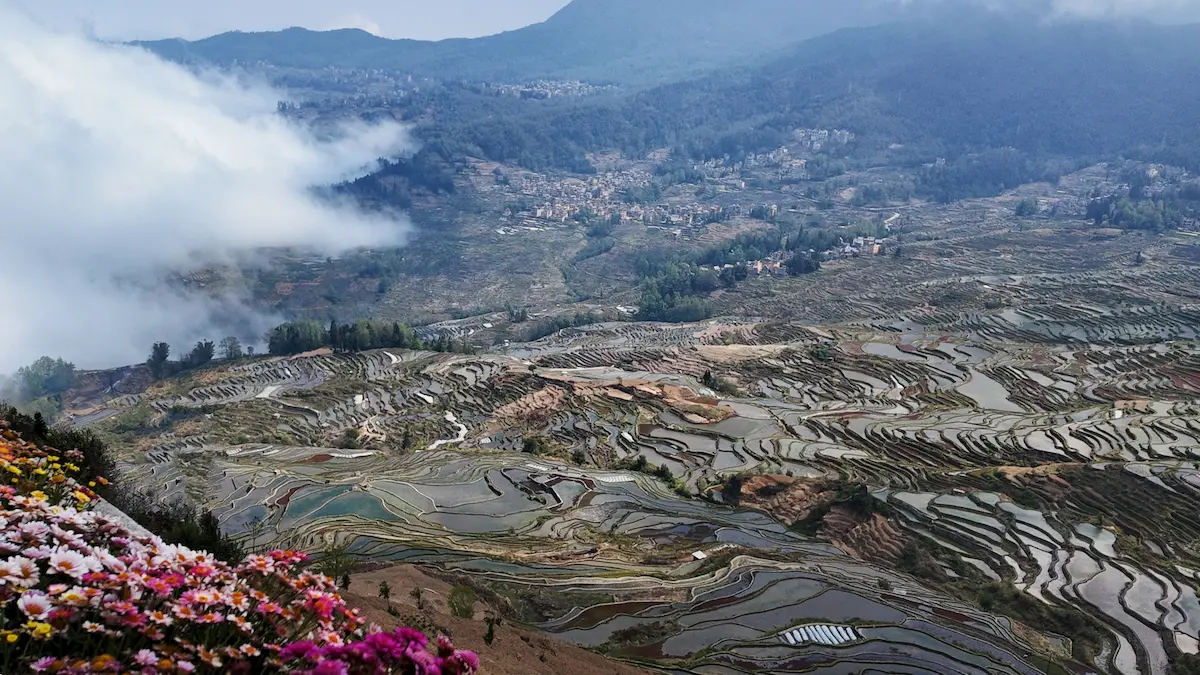
The best way to realize this? The Ink Voyages team suggests stopping at one of the viewpoints in the area to admire the expanse of Hani rice terraces which, when filled with water, reflect the sky—absorbing its blue and fragmenting it into a stunning mosaic.
Getting to Yuanyang is no shortcut journey: the trip is demanding, and this destination should be included as part of a broader itinerary through southern Yunnan—for example starting from Xishuangbanna—or, if you wish to explore it on its own, you should still account for a round trip from Kunming (around 4.5 hours each way). If you’re interested in exploring Yunnan further, we’ve also included a link to our travel guide.
To immediately clarify the challenges involved in experiencing the Hani rice terraces—both a human and natural spectacle—we want to share the following:
The terraces are at their best when filled with water, which happens during winter, roughly between December and mid-March. However, don’t expect the entire area to transform overnight at the beginning of December.
In reality, the flooding process is gradual. So, for example, if you visit around Christmas, the effect is already visible, but not as intense or widespread as it becomes toward late February or early March.
At the same time, don’t wait beyond mid-March, because the rice begins to grow, and the mirror effect disappears—which we strongly recommend prioritizing if you decide to visit Yuanyang.
Then there’s the weather factor, which you must seriously consider and for which there are no guarantees. If you’re lucky enough to have sunny days during your stay, the terraces will truly shine—literally reflecting and absorbing the color of the sky.
At sunset and sunrise in particular, they offer a spectacle of rare beauty, becoming almost idyllic if you find yourself alone among them, surrounded only by the sounds of the countryside: birds chirping, ducks quacking, a distant rooster crowing, and the constant murmur of water flowing through the channels that feed the terraces.
And just when you think the scene couldn’t be more perfect, with a bit of patience and luck, you might even see the silhouettes of a farmer and an ox appear in the distance, returning to the village after a long day of work.
That’s if the sun is out. If it’s cloudy, much of the terraces’ charm is lost. For this reason, when planning your trip, it’s wise to allocate three days in the area to increase your chances of catching some sunshine.
The good news is that the period when the terraces are filled with water coincides with Yunnan’s dry season (the rainy season runs from June to August), which naturally reduces the risk of bad weather.
A final practical note: in March, it’s common for farmers to burn crop residues to create fertilizer. This practice is also widespread across Southeast Asia (Myanmar, Laos, Thailand, Cambodia, Vietnam), which is relatively close to Yuanyang.
Due to monsoon winds, smoke from these regions can drift into China, making the sky hazy and the air acrid. In our opinion, this isn’t a major deterrent to visiting the area, but it’s worth mentioning—especially if you have respiratory issues.
The purpose of an article like this is to share our experience transparently. That’s why we wanted to highlight the challenges of visiting Yuanyang right from the start. Now that these aspects are clear, we can return to what we said at the beginning: this place is truly breathtaking.
If you enjoy traveling deeply into a destination, we strongly recommend including Yuanyang in your Yunnan itinerary. In a way, the fact that it’s not easily accessible—both logistically and seasonally—makes it all the more worthy of a “true” exploration.
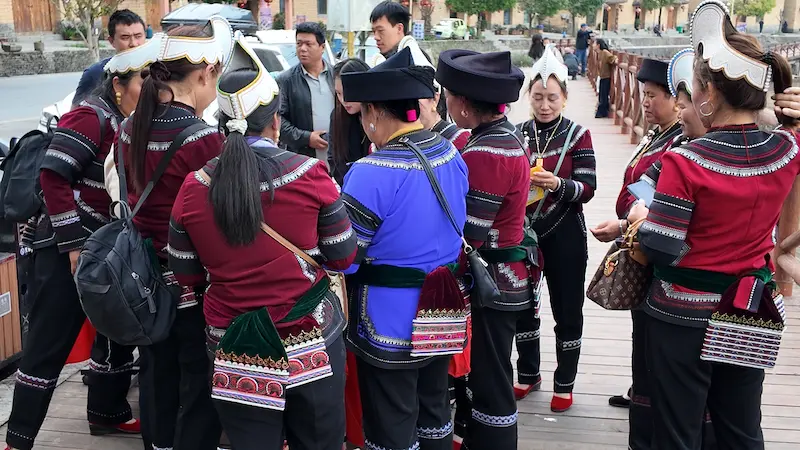
Moreover, the beauty of this area is not only tied to the rice terraces, but also to a culture with ancient origins that still pulses through every part of this land.
If you’re interested in further exploring China, you can also check out our catalog of customizable private trips.
What we love most about Yuanyang
Here’s what we love most about Yuanyang:
The Hani Rice Terraces
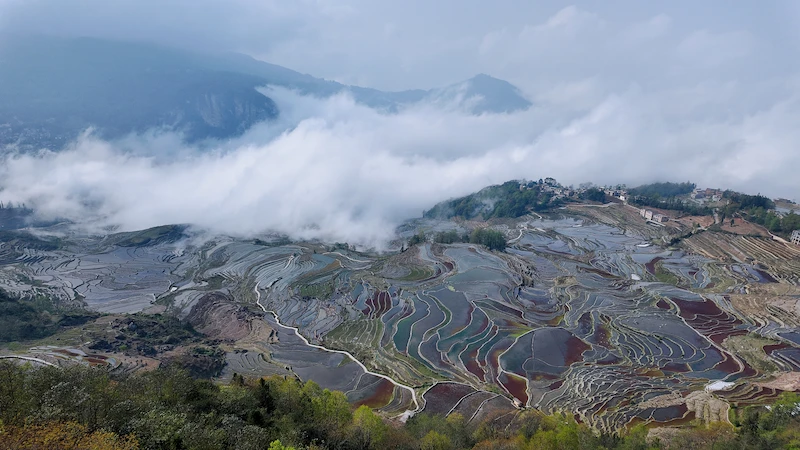
First of all, visiting the Yuanyang rice terraces is an itinerant experience: Yuanyang refers to an area with multiple villages and numerous terraces. The best way to explore them is by moving by car from one point to another to enjoy different perspectives.
There are various viewpoints: some are simple roadside stops with small parking areas, while others are more structured and require a parking fee. In some cases, you may also need to pay a small “access fee” to cross private land.
Costs are generally low (around 10–25 RMB per stop, roughly under €3 per person). However, what can be slightly annoying—at least from our perspective—is the frequency of payments rather than the amount itself. It somewhat detracts from the spontaneity of the visit, although it’s understandable given the effort generations of Hani people have invested in shaping this landscape.
Two tips: when visiting the terraces, don’t just admire them from the viewpoints—try to go down and walk among them as well. The edges of the terraces can be tricky, but you’ll notice that in some areas there are slightly wider paths that will allow you to venture into the landscape—without overdoing it and always with discretion—so you can truly feel surrounded by this mosaic of water, earth, and sky.
Sunset can truly make a difference, offering unique views of both the terraces and agricultural life. Sunrise can be equally spectacular, but also riskier in terms of weather, especially cloud cover.
Here are some of our favorite viewpoints:
• Quanfuzhuang viewpoint: small parking next to the platform. If full, consider parking at a nearby hotel (about 300 meters before the viewpoint). This is our favorite spot—not the most panoramic, but it allows you to walk into the terraces.
• Hadanpu viewpoint: easy to reach from village parking. Don’t stop at the first lot—drive further down the main road to get closer.
• Duoyishu viewpoint: harder to find, but worth it. A lesser-known spot accessible via a small road behind a hotel, offering spectacular views.
An intact rural atmosphere
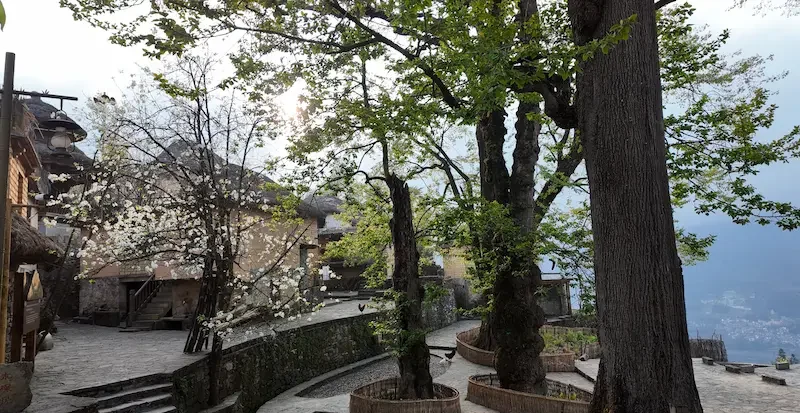
Yuanyang is not just about rice terraces, but also the rural life surrounding them. Life here remains deeply traditional, tied to ancestral rhythms involving everyone—from children to the elderly—in agricultural work.
There’s a pervasive sense of constant, generational effort, shaping a people marked by both the beauty and the hardship of this way of life.
One striking memory for us was seeing a man carrying a tree trunk on one shoulder—something we wouldn’t manage even for a few steps. It takes true Hani strength!
The villages in the area largely retain an unspoiled charm, having been only lightly touched—not transformed—by tourism. Despite UNESCO World Heritage recognition —perhaps because Yuanyang remains relatively difficult to access, and the peak of its beauty is limited to a short period (just a few months, from late December to mid-March)—the atmosphere remains deeply local and, for this very reason, offers glimpses of rare beauty.
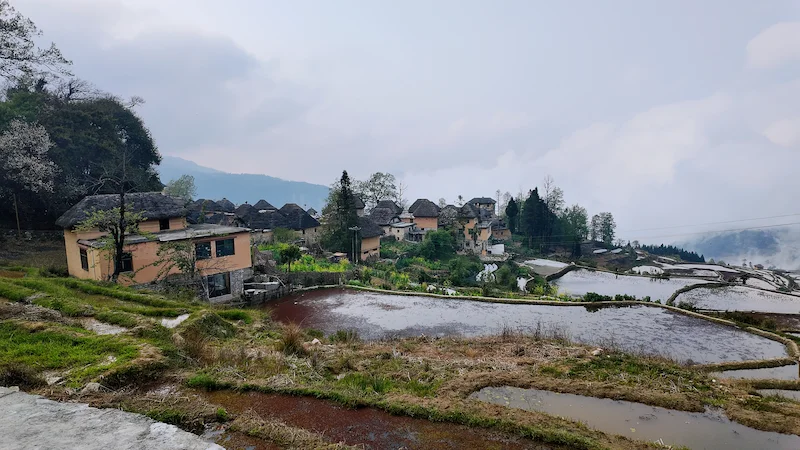
Architecturally, you’ll notice distinctive “mushroom-shaped” thatched roofs (Mogu Fang), typical of Hani style, especially in Azheke village (entrance fee applies). Legend says the Hani were inspired by mushrooms’ ability to withstand the elements.
The Hani ecosystem
The Hani minority, although also present elsewhere in southern Yunnan—for example in the Jingmai Mountain area—is primarily concentrated in the Yuanyang and Honghe regions. One of the most fascinating aspects of visiting these places is discovering the Hani tripartite ecosystem, of which the rice terraces are only one part:
- Forests (above)
- Villages (middle)
- Rice terraces (below)
Each is essential:
Forests regulate water flow. Villages are the center of agricultural knowledge and irrigation systems. Terraces provide sustenance, especially red rice, known for its slightly sweet flavor.
Vegetables are also grown here, including wild greens (Yě cài, 野菜), which we highly recommend trying.
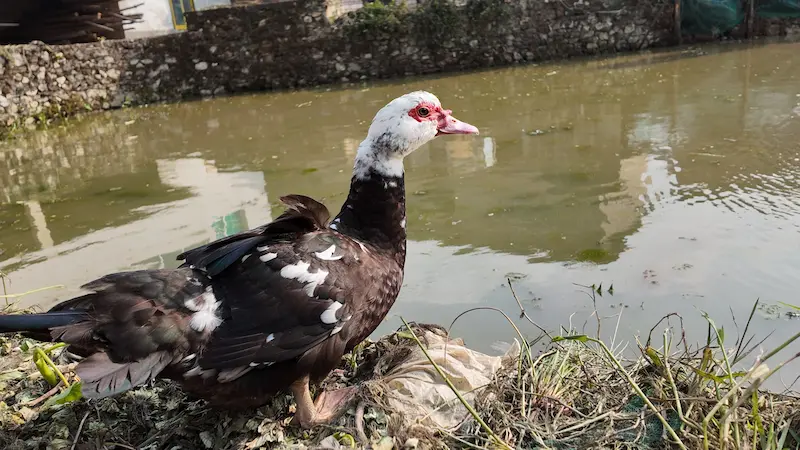
The terraces themselves form a micro-ecosystem: ducks and fish naturally fertilize and protect crops. Fish also help oxygenate the soil. When rice grows, ducks are removed, while fish remain—eventually becoming a perfect accompaniment to the rice they helped cultivate. A bit ironic…
Yuanyang is one of our favorite places in Yunnan, and despite the challenges, we truly recommend visiting it.
If you have more time, consider Samaba terraces: less spectacular but more remote and authentic.
With this article, we hope to inspire one of your future journeys. If you want to explore China authentically, check out our tailor-made travel catalog.
From all of us at Ink Voyages, we wish you the very best for your next adventures!