Discover Jingmai Mountain and its Millenary Tea
Table of Contents
Ethnic minorities, tourism, and tea leaves
Jingmai Mountain lies in the southern part of Yunnan Province, in southwest China, near the border with Myanmar and Laos.
The most evident sign that this is a relatively recent destination for local tourism is the road you must take to reach the villages scattered across Jingmai Mountain: your car will experience a constant vibration due to the uneven surface made of roughly laid stones.
Work to improve the logistics of the area is underway, but — honestly — we prefer the shaking to perfectly smooth asphalt. This becomes clear if we place Jingmai Mountain within the broader issue (or opportunity) of the commercialization of the area. Since at Ink Voyages we believe strongly in sustainable tourism, we pay close attention to the consequences and impacts of commercialization. But we will return to this topic later.
First of all, we would like to tell you about this special place, a UNESCO World Heritage site and a true stronghold of tea culture and the traditions of the Bulang and Dai ethnic minorities (other groups such as the Wa, Lahu, and Hani also live in the region, though they are less represented in this particular area).
If you would like to learn more about the history of Pu’er tea and discover how far it was transported, you can read our article about the Ancient Tea and Horse Road. For a complete travel guide to Yunnan, you will also find additional useful information here.
What we like (and don’t like) about Jingmai Mountain
Traditional Bulang and Dai villages
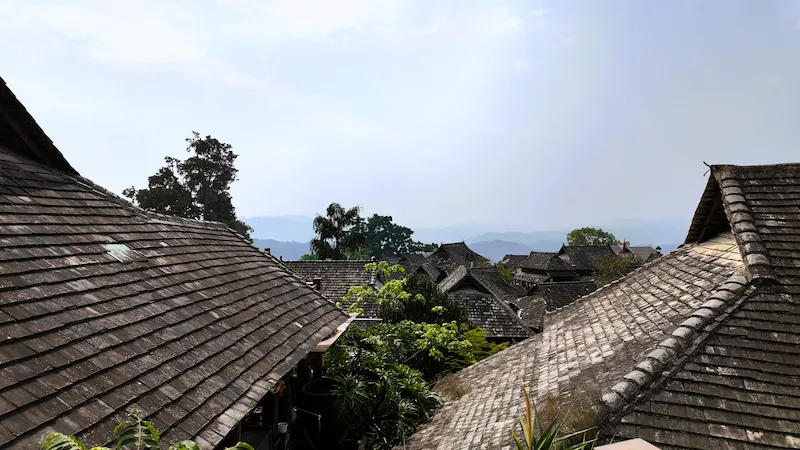
Beyond the shaking mentioned above, reaching the traditional Bulang and Dai villages is relatively easy: road signs allow you to move from one place to another without much difficulty. Near the villages, small parking areas have been set up. Alternatively, you can simply leave your car by the side of the road.
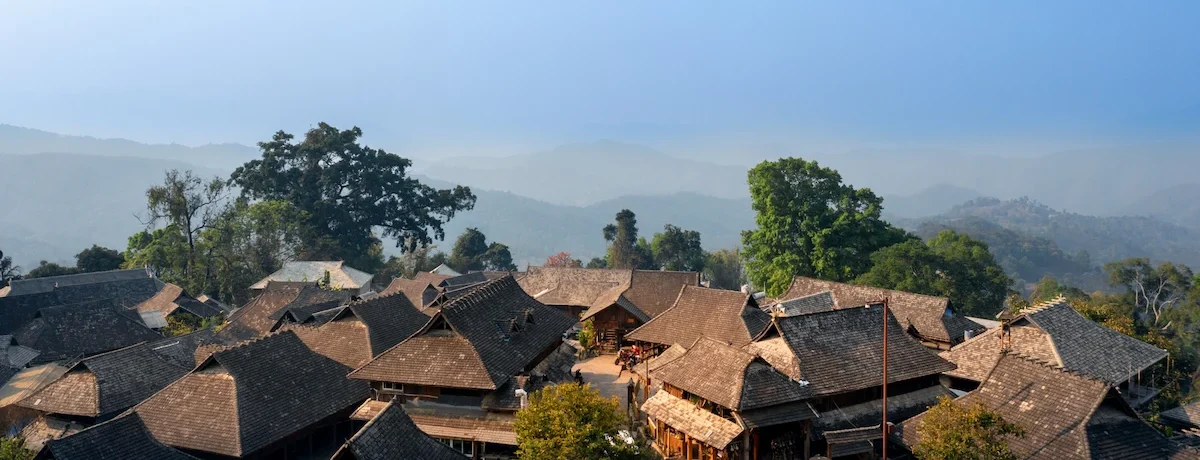
As you enter these villages, you are immediately struck by their traditional architecture: wooden houses immerse you in an atmosphere from another era, rooftops peek through the vegetation, and the faces of the inhabitants tell a story of hard work carried out along the mountain’s slopes.
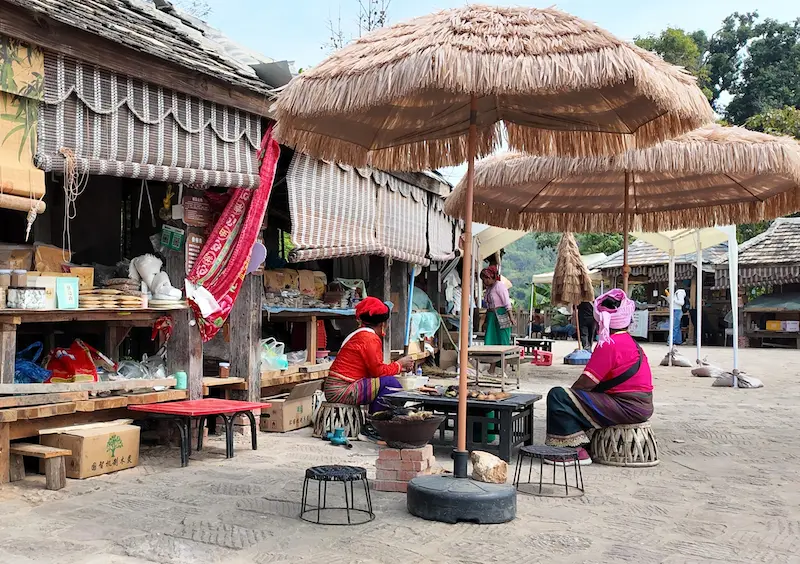
The streets are narrow, and the houses that line them do not seem to define a closed space. Instead, they appear constantly oriented outward through small courtyards. In addition, the houses are all built on two levels — with the ground floor often remaining open to the village and frequently used as a small shop or commercial space.
The main villages you can visit include Wengji, Nuogang, Mangjing, and Manghong. You will immediately notice the family resemblance that connects the style of these settlements. We recommend exploring two or three of them — which is more than enough to gain a fairly accurate impression. In total, there are fourteen villages in this area (including nine particularly traditional), and visiting two or three of the best-known ones is a good way to discover the “postcard” side of Jingmai Mountain.
As mentioned earlier, however, commercialization has reached this area. You should keep in mind that these villages do not exist in a timeless bubble, and the recent growth of tourism has transformed many homes into souvenir shops, restaurants, and cafés (both tea and coffee from Yunnan are highly renowned).
On the one hand, this has certainly allowed local residents to develop a less physically demanding and more profitable lifestyle; on the other hand, the overall charm of the experience inevitably suffers. Finding a balance between preservation and tourism is never simple, despite efforts to keep tourism as “sustainable” as possible. In any case, considering the abundance of cafés in Nuogang, we recommend trying a delicious cup of xian hua kao nai: a drink made with hot milk, tea, and flowers — all delicately roasted together. (Don’t worry about the flowers: they are edible, and Yunnan has a long culinary tradition based on the consumption of flowers. Fragrant — and delicious!)
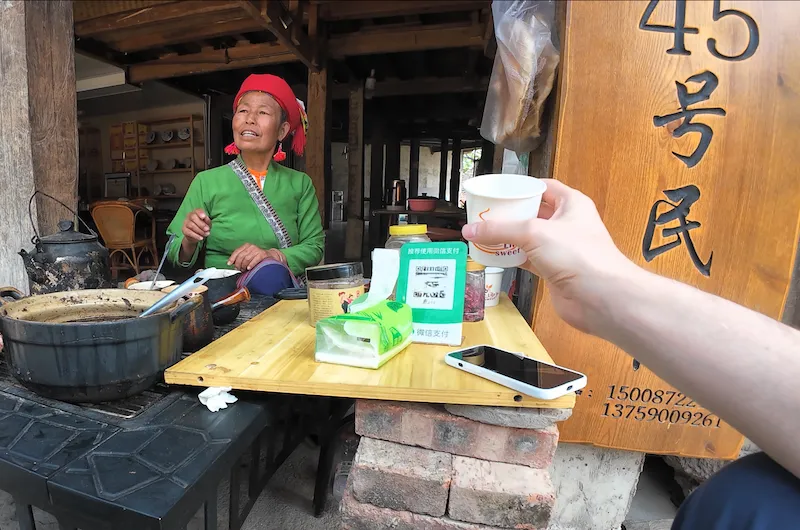
If you wish to explore further, we recommend venturing toward lesser-known villages, where you will not find tourist shops but rather glimpses of truly traditional rural life, such as in Mangyun or Panayang. Always remain discreet during your visit, as the inhabitants here are not particularly accustomed to tourists.
A practical tip: do not drive your car into the villages. Although it may not be easy to find parking, we recommend leaving the car by the roadside and continuing on foot. The streets within these villages are extremely narrow, and it can quickly become very difficult to maneuver. (Do not be fooled by the cars you might see parked beneath the porch of some houses: locals possess almost superhuman driving skills when it comes to squeezing cars through tight corners and barely passable streets.)
The lesser-traveled roads
If you are looking for a bit of adventure without taking real risks, we suggest exploring the more peripheral roads that branch away from the main route connecting the primary villages. In this way, you can experience Jingmai Mountain in a much more personal way.
Indeed, as soon as you move away from the best-known stops, you will discover the quieter and more adventurous side of this territory. At Ink Voyages, we are particularly fond of the road that continues past the Fengshen Tree, a tree entirely covered with beehives, which cuts horizontally across the area before reconnecting with the G219 highway. If you decide to take this route, we strongly recommend having a 4×4 vehicle: in some places you will need to drive over large stones, and if your car does not have sufficient ground clearance, the experience could end rather badly.
A note about this road: near the end, when you are close to reconnecting with the G219, you might encounter an improvised checkpoint set up by some locals, who may block the road with tree trunks. This is not exactly a legitimate operation… let’s say it is a local initiative to earn a little something from the (rather limited) flow of tourists. A proactive way of benefiting from tourism development in the area — even though it rarely reaches these more remote zones.
The “toll” is negligible — about 10 RMB (roughly one euro) — and if you happen to see a bunch of bananas on a table or bench, do not hesitate to ask if you can have one. You might end up with four extremely fresh bananas in your car — more than enough to compensate for the cost of the toll!
Another beautiful road is the one leading to Mangyun, which then branches into several smaller tracks. These routes allow you to venture into areas mostly used by farmers’ carts, revealing the tea plants that blanket the mountain slopes.
Semi-abandoned huts and ancient trees
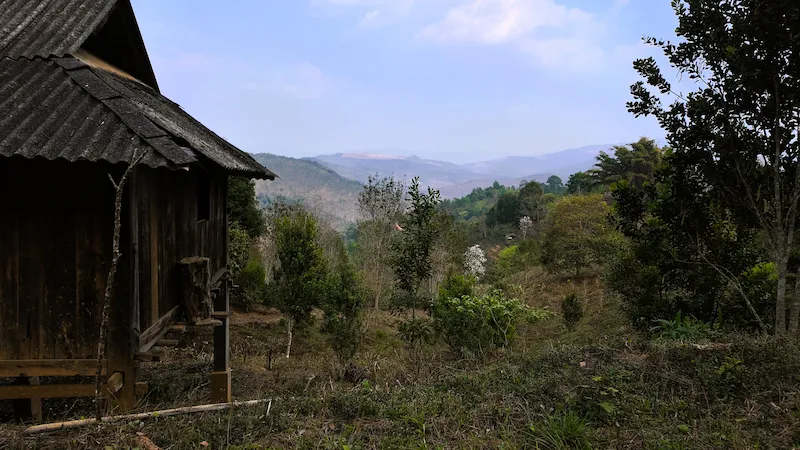
In this region, several villages have been abandoned, dismantled, or relocated over the past decades. For this reason, it is still possible to find houses emerging from the vegetation, as well as huts and other residual structures that continue to serve as support points for local farmers working in the fields.
Exploring them is fascinating: you may discover abandoned objects, baskets once used for tea harvesting, and tools resting beneath wooden roofs waiting to be used again, while the chickens — guardians of these places — scratch beneath the porches.
When approaching, always remember to call out: “Ni hao, you ren ma?” (“Hello, is anyone there?”), as a way to break the ice and avoid unexpected encounters that might cause discomfort.
Finally, a special mention must go to the ancient trees you will encounter during your exploration. These are Baoyan trees, which have an almost awe-inspiring appearance, with trunks resembling twisted pillars and crowns branching into spectacular shapes. Standing before these natural formations that seem to defy the passage of time is a truly moving experience.
A final suggestion regarding your starting point: if you want to fully immerse yourself in Jingmai Mountain, consider spending the night directly in one of the villages in the area. In recent years many hotels have appeared (perhaps even too many), some of them quite luxurious. Staying there also allows you to enjoy magical moments such as sunrise, when the famous “sea of clouds” spreads across the landscape, floating like waves before your eyes.
For more affordable accommodation, you can choose the village of Huiminxiang, from which it is still easy to reach the inner area of Jingmai Mountain.
With this, we hope we have sparked your curiosity about this remote corner of China, where traditions endure and the fate of ancient villages remains tied to the emerald green leaves of centuries-old tea trees.
If you would like to travel through China in a deeper and more meaningful way, you can also browse our catalog of customized journeys. From all of us at Ink Voyages, we wish you the very best for your next adventures.