
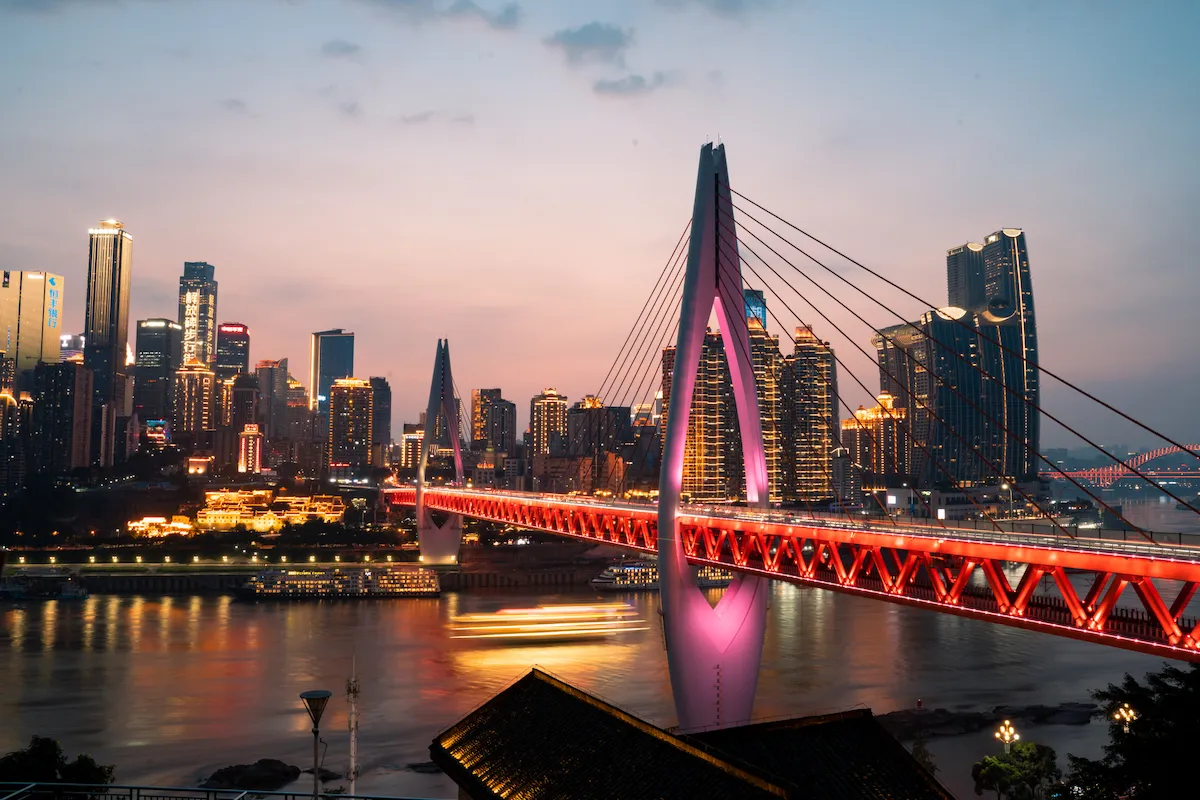
What to visit in Chongqing among temples, skyline and urban trekking
Part 4: the old, the new and the wild side of Chongqing
Table of Contents
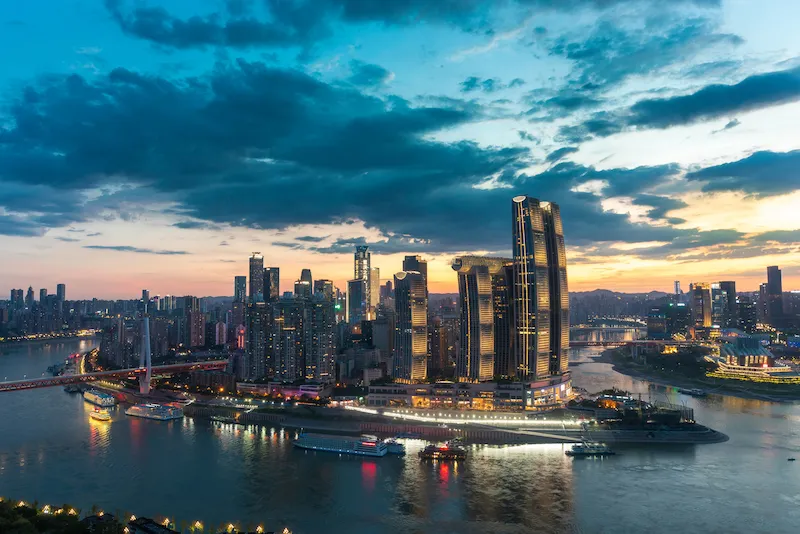
This is the fourth part of our travel guide to Chongqing. On our blog, you can also find the other three parts, to explore this city with us in greater depth.
If you want to see with your own eyes what we are going to talk about in this article, you can find here our vlog & travel guide episode dedicated to exploring Chongqing.
To help you find your way through the guide, here is a brief summary of the themes covered in each part:
Part 1: the strange beauty of Chongqing, between rivers, mountains and bunkers
Part 2: local life and the flavors of Chongqing
Part 3: Chongqing, the city of eight dimensions
Part 4: the old, the new and the wild side of Chongqing
And for more ideas for exploring China, you can browse our regional catalog of customizable private journeys.
Hongyadong
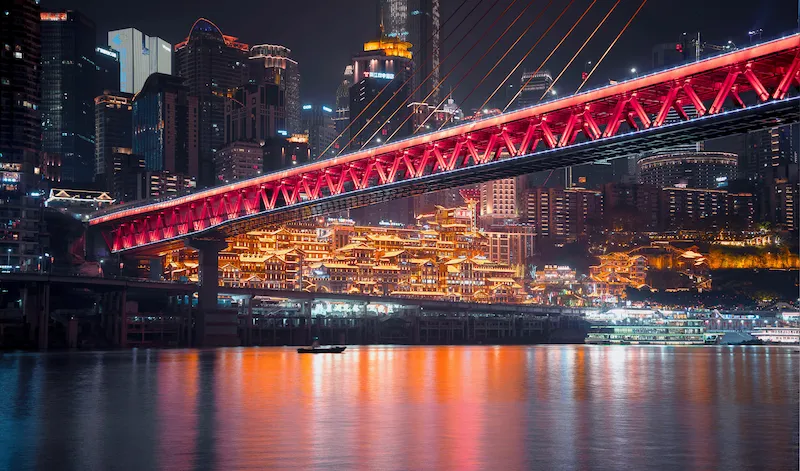
Let us now enter classic Chongqing before taking a leap forward into its futuristic side, and talk a little about Hongyadong — for better and for worse. This is one of Chongqing’s most iconic buildings, and also one of the most crowded with tourists. Expect a very high density of people when you find yourself in front of it.
For a better view, we recommend walking to Qijiang Bridge, or to the nearby Jialing River Bridge, from where you can observe it from a distance. To reach this viewpoint, you need to go down a staircase, cross an underground parking area, take an elevator and then continue toward the bridge. To keep things simple and avoid getting lost, we suggest simply following the river of people heading in the same direction.
The building is not particularly impressive during the day, so make sure to arrive after 6:30 p.m., when the lights begin to turn on and the sky grows darker. In fact, if you want the most spectacular view, our advice is to avoid the queues that form at the viewpoints — both on the bridge and in front of it — and take a boat ride instead: the famous Chongqing Two Rivers night cruise. This will allow you to enjoy Hongyadong at its best, as part of a route that reveals the city’s most dazzling side.
The history of Hongyadong is rooted in the traditional culture of the Bayu people: the structure reproduces the ancient stilt houses, known as diaojiaolou, perched along the cliff. Originally, this site represented one of the ancient fortified gates of the city. Although the current complex was entirely rebuilt in a modern form in 2006, the visual impact of this cascade of illuminated roofs hanging above the river remains unique.
A practical note: if you want to visit Hongyadong by land and avoid getting stuck in Chongqing’s “8D” traffic, we recommend the following route. After crossing Kuixing Lou Square — from the side where you are on the 22nd floor — cross the metal bridge in front of you and turn right. You will enter a corridor where there is an elevator: take it down to the first floor. At this point, all you need to do is cross the road and continue to the right. In a few minutes, you will reach Hongyadong.
The Taoist temple of Laojun Dong
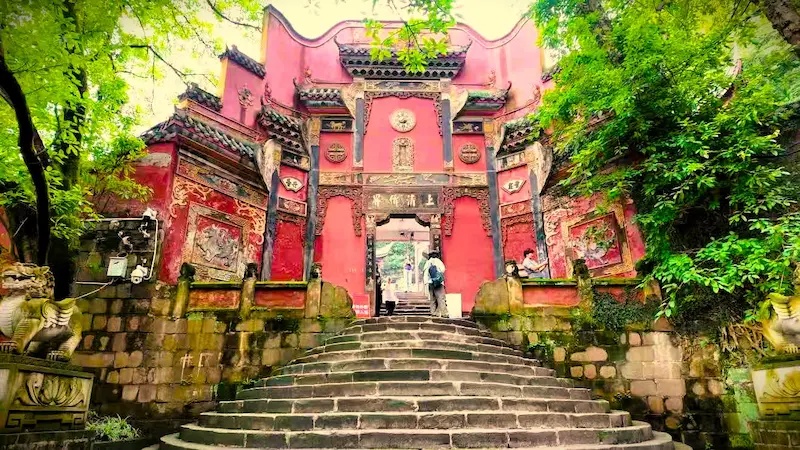
Laojun Dong Temple, perched on the wooded hills of Mount Nanshan, is the most important and ancient Taoist site in the city, with a history dating back to the Tang dynasty. Taoism, China’s only native religion, focused on harmony between human beings and the forces of nature — the Dao — finds here one of its finest architectural and spiritual expressions.
The complex extends over a fairly large area, filled with a quiet and meditative atmosphere. You will notice people lighting incense sticks and bowing ritually in front of the altars. When visiting, do not miss the beautiful Gate of the Three Pure Ones — Sanqing Men — an ancient red portal that creates a mystical contrast between ascetic calm and the frenzy of the megacity.
A practical note: when you are at the gate, you can descend toward the city by taking a staircase, about 30 to 40 minutes on foot. If you decide to call a Didi — the app used to book a car — we recommend not doing it from this point, which is difficult for cars to access and may involve long waiting times. It is better to retrace your steps and take a car from the main entrance of the temple.
Luohan Temple
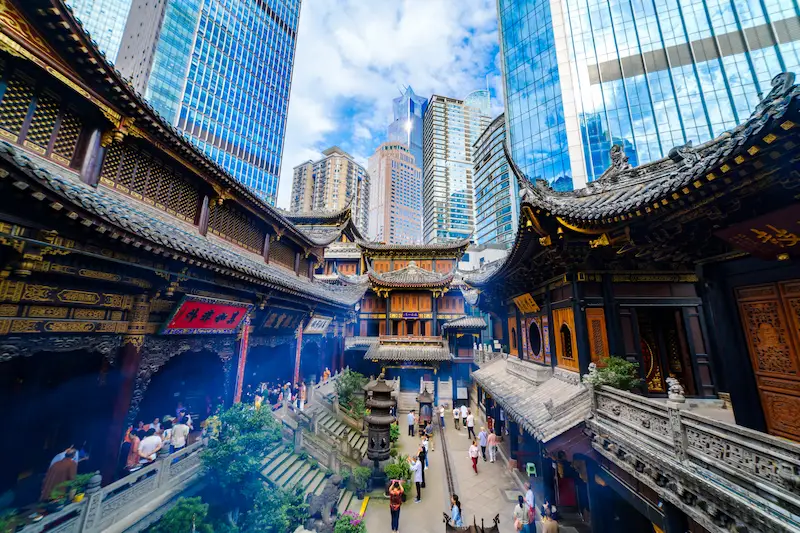
If you are interested in the spiritual side of Chongqing, we also recommend visiting Luohan Si, the Temple of the Arhats: a Buddhist oasis dating back more than a thousand years, incredibly embedded and almost squeezed between the glass and concrete skyscrapers of the Jiefangbei financial district. Inside, you can admire the spectacular hall that houses 500 golden terracotta statues of the Arhats, each with a unique and different facial expression.
If you are passionate about history, we also recommend adding Beijing and Xi’an to your China itinerary, where you can come face to face with classical Chinese history and some of its most representative monuments.
A futuristic city
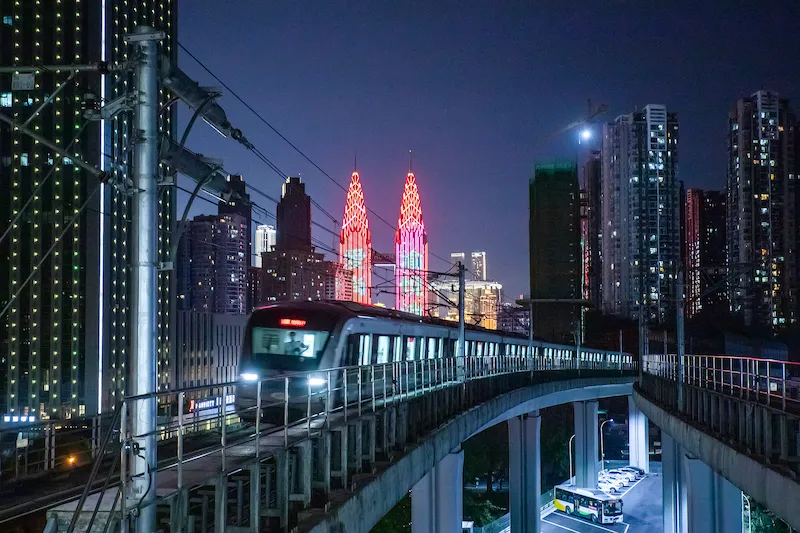
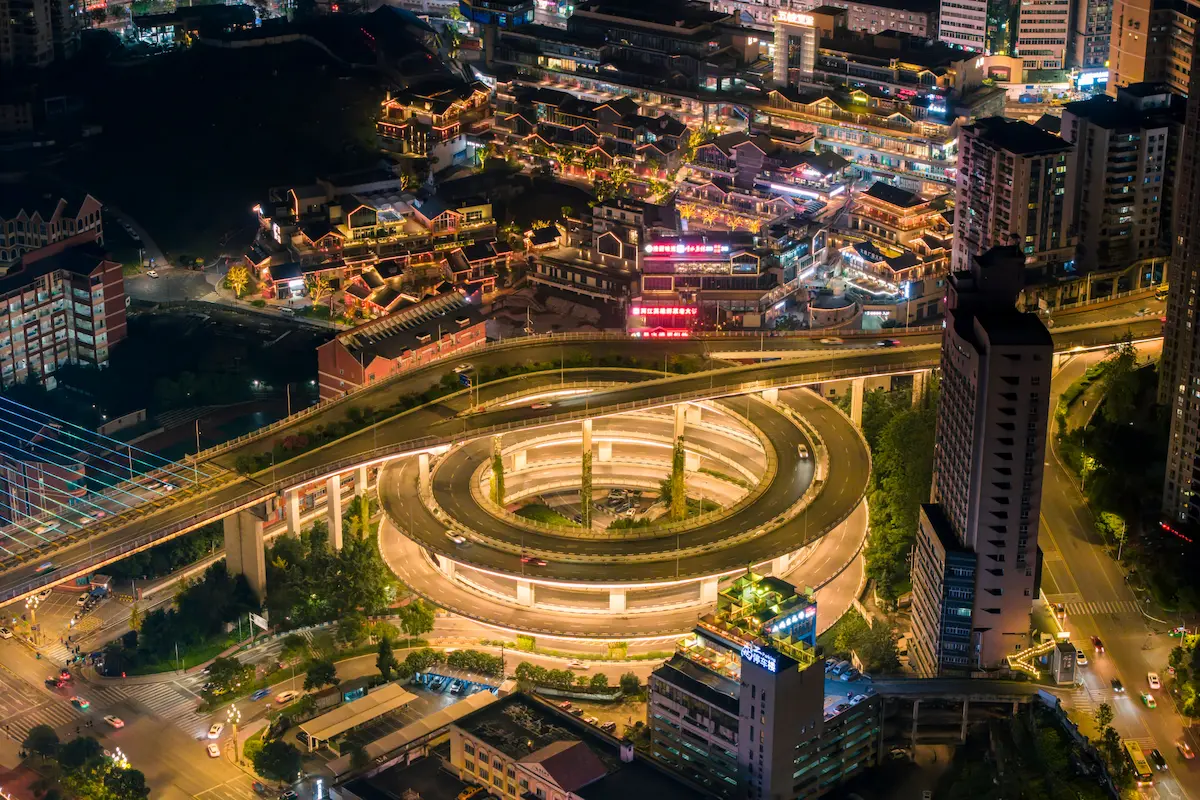
Let us now talk about the futuristic side of this city, which will certainly leave you speechless. Beyond its cyberpunk reputation, which in our opinion is slightly exaggerated, it is impossible not to praise Chongqing when describing its skyline — which is simply breathtaking.
The nerve center is the Yuzhong Peninsula and the Chaotianmen area, located between the two rivers. This can be considered the geographical heart of Chongqing and the perfect setting for a glimpse into the future: skyscrapers, river waters reflecting their colorful silhouettes at night, the red cable car cabin floating from one side to the other, the Dongshuimen and Chaotianmen bridges, also red, each with its spectacular design, flowing into the city center like powerful arteries, and the illuminated boats navigating the Yangtze River, joining the city’s light shows as they cut through the dark waters and break the reflections of the buildings.
For another incredible skyline, you might also consider visiting Shanghai, where the illuminated view of the Bund pairs perfectly with an evening cocktail on a panoramic rooftop.
And if all this is not enough to leave you speechless, then make sure to stay in Chongqing at least for a Saturday. Yes, because currently Saturday is the day of the drone show, except during national holidays, when it may sometimes be moved to Sunday.
The drone show is truly the cherry on top of Chongqing. There are several places from which you can watch it, and we recommend getting into position at least half an hour before the show starts if you want a front-row spot.
These are the main places from which you can watch it:
The front square of Chaotianmen, which offers the classic and monumental view, but is extremely crowded.
Our favorite spot, instead, is the one that allows you to watch the drone show from behind. You can access it by going up to the fourth floor of the iconic Raffles City building. From here, you see the show from an elevated perspective: the drones keep rotating and reveal the three-dimensional figures in all their splendor. This spot is definitely less touristy than the riverside viewpoints and is an ideal choice for hotter and more crowded months such as August.
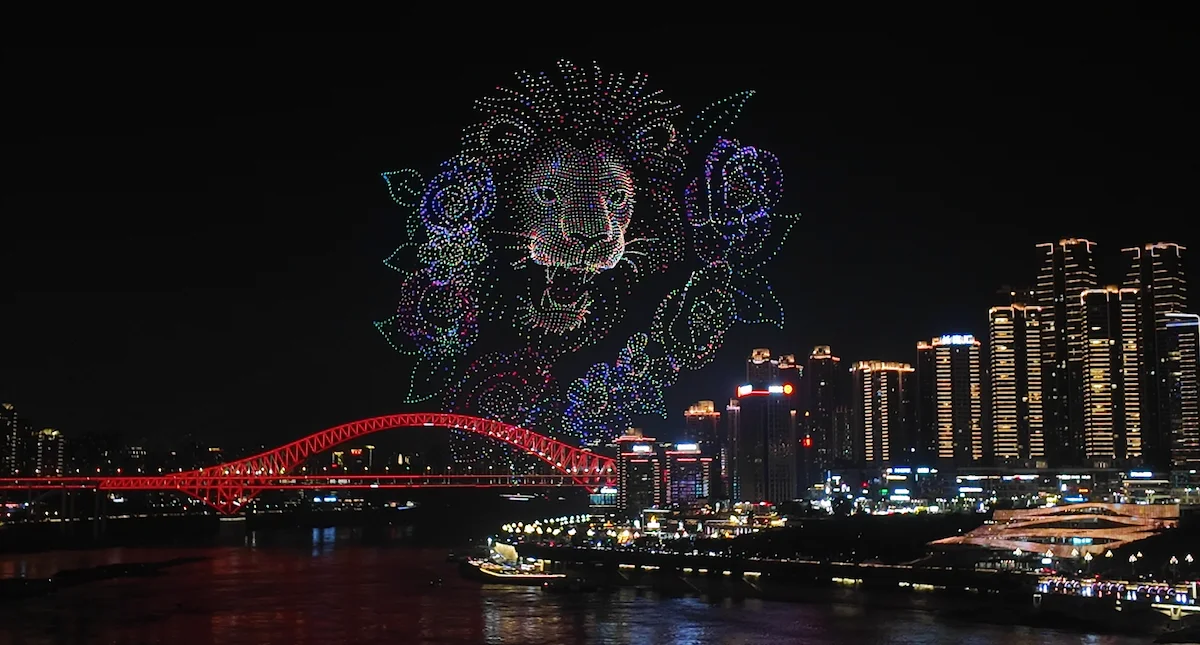
Watching the drone show makes everyone feel like a child again. In a sense, it feels like the modern version of fireworks — quieter and more elegant. Seeing the drones dance in the dark sky, forming and dissolving into multiple geometries, before unexpectedly creating a variety of figures against the backdrop of Chongqing’s skyline, is truly a unique and moving experience.
You will be surrounded by the “wows” of other spectators throughout the show, which lasts about twenty minutes and starts at around 8:30 p.m. Eventually, the drones leave the scene like a bright, orderly swarm above the river. The figures change every week, and the sky of Chongqing is never the same.
During our last visit, the show was dedicated to Children’s Day, with many figures directly inspired by this theme. In general, they are always very beautiful, and what is even more surprising is that they are not static. To give you an idea: at one point, a bubble gun formed in the sky and started shooting soap bubbles. The bubbles were represented so well that they spun and gently oscillated in the air exactly like real soap bubbles.
Or suddenly, a warrior with a spear appears — inspired by the mythical figure Nezha, an absolute icon of Chinese pop culture and animation — and you find yourself admiring the movement of the sharp spear tip, which seems almost ready to pierce one of the skyscrapers standing in front of it.
These are only examples, but we hope they give you an idea of the harmonious precision that makes these twenty minutes one of the most special moments you can experience in Chongqing. The truth is that it is genuinely emotional. There is no way around it. This tech version of fireworks goes straight to the childlike heart inside each of us.
The only negative note, and a very minor one: the drone show, which is free, does contain some advertising moments. Toward the end, you may see the drones form promotional messages. Usually, these are the only figures that do not produce the “wow” effect among the crowd, but overall, it is a very negligible off-note.
Trekking in the urban jungle
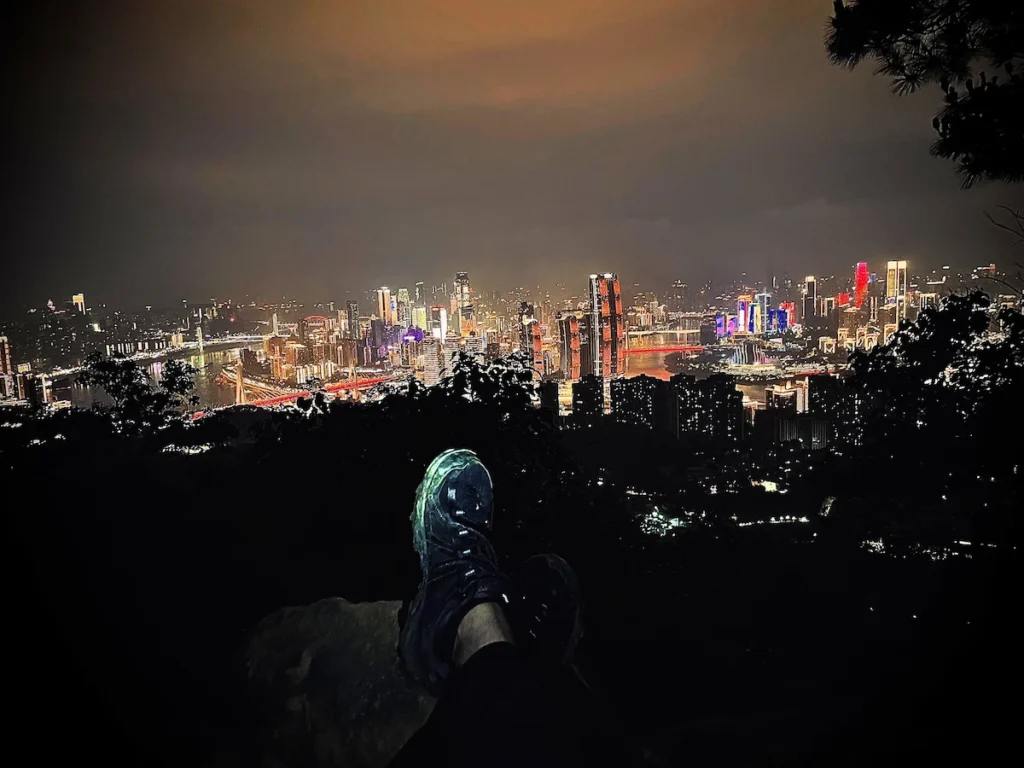
If you want to have a truly special experience in Chongqing, we finally recommend not missing the chance to go on a real trek inside the city and, at the same time, in the mountains. As paradoxical as it may sound, since we are talking about Chongqing, everything becomes possible.
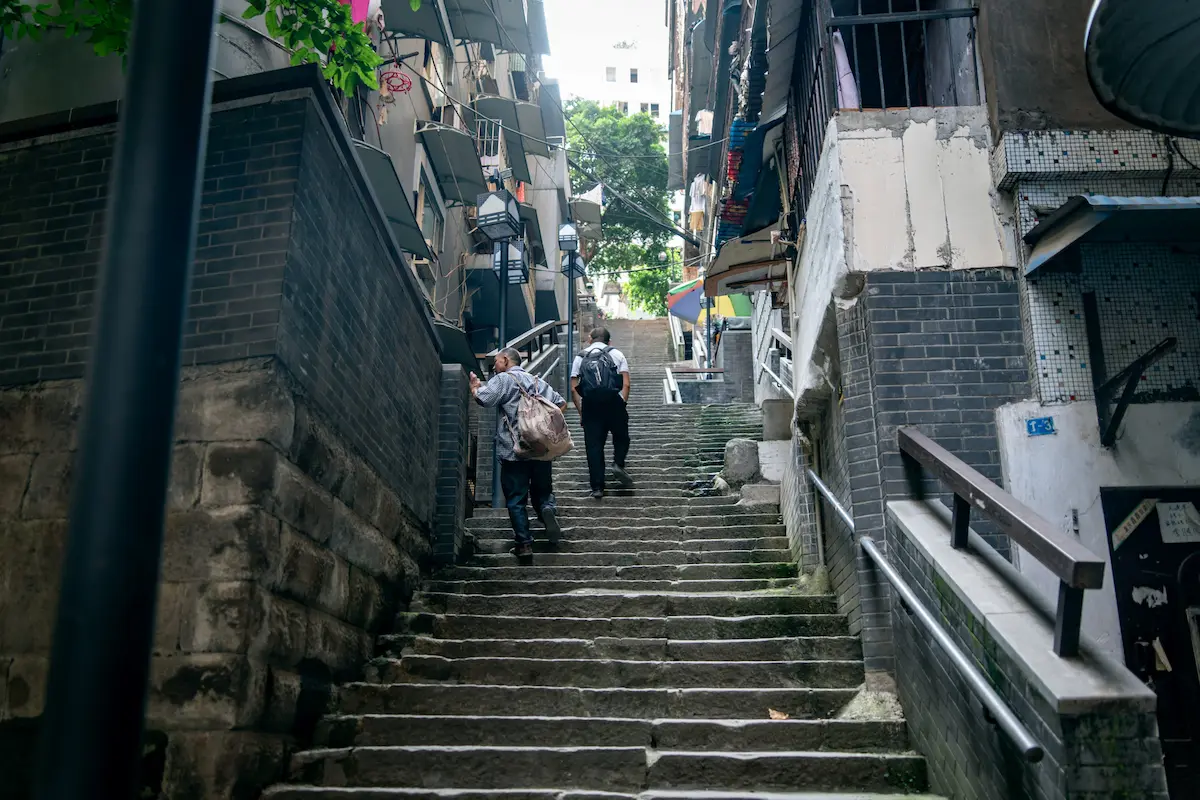
Ask a Didi to take you to the entrance of the Nanshan hiking trail, near the old Shangxin Jie area, where you will see the beginning of a staircase climbing toward the mountain. In our opinion, this is the most convenient starting point for this experience, because it allows you to cut out a rather long part of the route.
If you want the full experience, you can instead set Tushan Station, Exit 1, as your starting point. You will have to cross a market, walk along a stretch of road, pass through a railway underpass, and then begin climbing the mountain, finding yourself on a stepped path that leads into thick vegetation, while at the same time passing the homes of some residents who seem to have taken refuge in the forest like hermits fleeing the megacity.
In any case, regardless of the starting point, this is a trek of about three hours in total, drawing a semicircle through the mountains of Chongqing. Its central section winds between peaks that offer what may be the most beautiful view of the city. Ideally, you should reach the top at sunset, and then wait as the sky darkens and the lights of the city begin to turn on.
Be careful, though: we recommend doing this activity only with an experienced guide. The trail is far from obvious, it is steep and slippery even when it is not raining — because humidity is everywhere — and stopping to admire the city after sunset inevitably means having to descend along the trail in the dark.
For another trekking idea in China, you can watch our vlog about Baoshan Stone Village, where we attempted — not without a few thrills — one of the most beautiful treks in China. You can also read our Yunnan travel guide if you are interested in exploring a region rich in spectacular hikes.
In our opinion, the simplest option is to go up and down from the same point, avoiding completing the semicircle, because the second half of the trail is more demanding and, at times, difficult to find. In fact, there is an intermediate path that allows you to cut through the forest, making the descent easier and faster. Keep in mind, however, that in any case this remains a complicated trek: our advice is truly not to take the risk of doing it without professional accompaniment.
The experience, however, is memorable: being in the city and, at the same time, in the mountains; having the rocks of a summit you have laboriously conquered behind your back, after crossing a dense vertical forest, while the dazzling skyline of Chongqing rises in front of you; seeing with your own eyes this irrational coexistence of contrasting landscapes is truly an experience that few cities in the world can offer. And very few can do so with the intensity, and the strange beauty, with which Chongqing does.
We have reached the end of this journey, which has allowed us to cross one of the most fascinating cities in China. We hope this article has conveyed to you our passion for exploratory travel: a way of visiting in depth, and of bringing home not only photos, but a complete experience of a territory. We also hope we have managed to share with you at least a little of the sense of wonder that Chongqing inspires in us.
If you are interested, you can also get an idea of the different regions of China by browsing our catalog of private journeys.
From Ink Voyages, all that remains is to wish you the very best for your next adventures.


Leave a Reply