
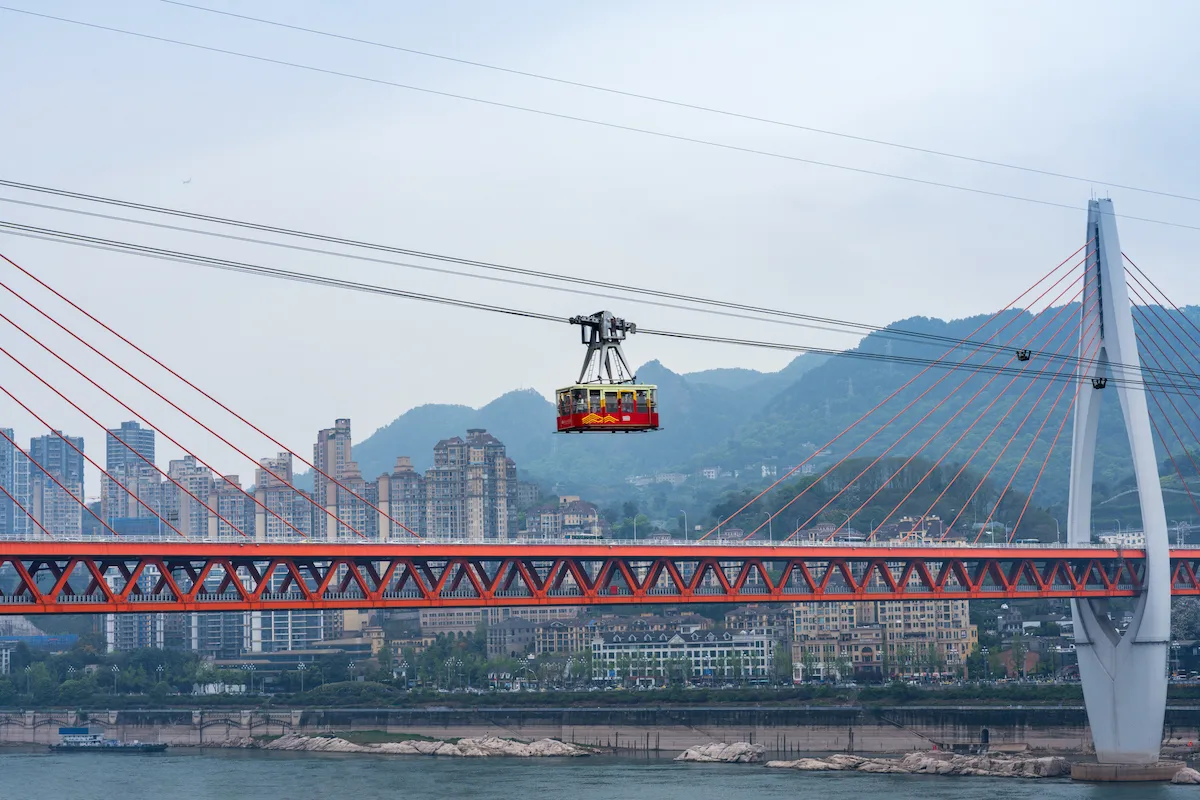
What to visit in Chongqing, China’s most surprising city
Part 1: the strange beauty of Chongqing, between rivers, mountains and bunkers
Table of Contents
The strange beauty of Chongqing
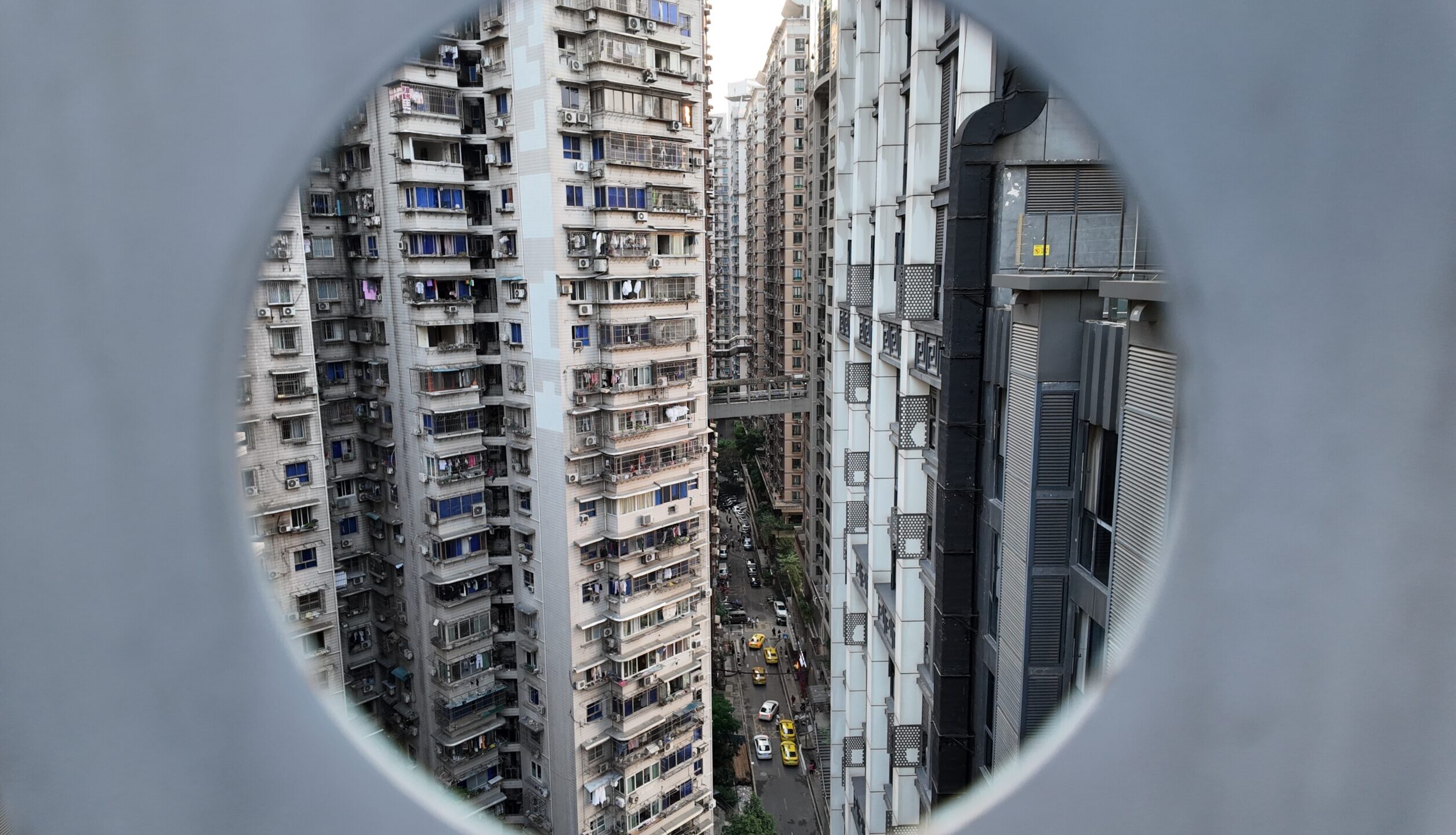
At Ink Voyages, we believe that Chongqing has a very special kind of beauty — certainly not a classical one, and probably even a little strange. Perhaps it is not a city for everyone, because its oddities and rough edges may put off visitors who prefer more classical, rational urban planning.
And yet, Chongqing can also make you feel like a child looking inside a kaleidoscope for the first time, with its “8D” architecture, its twists and turns, and its unexpected, astonishing changes in elevation.
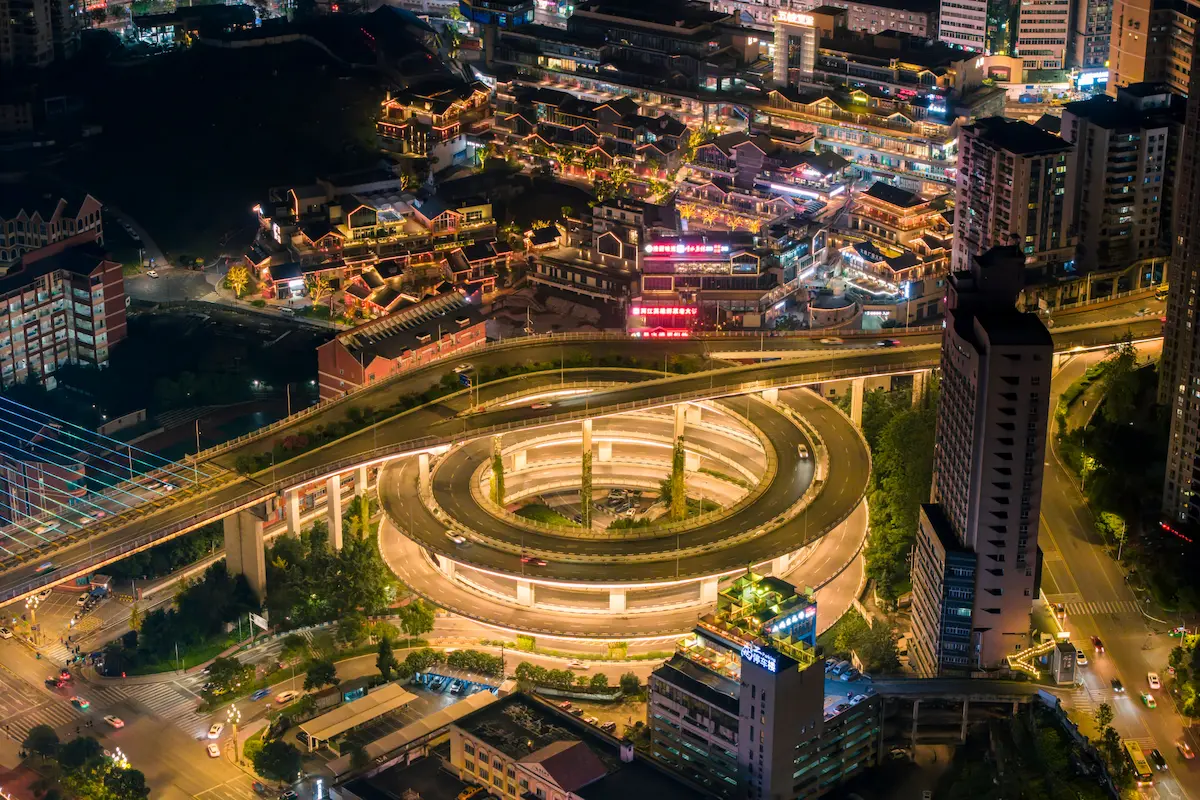
What may seem irrational at first sight — a train passing through a residential building, a square built on the roof of a hospital, buildings that teleport you from the ground floor to the sixteenth floor without your ever climbing a single flight of stairs — actually follows a very precise logic. It is the result of this megacity’s effort to settle on an extremely complicated territory. It is a daring challenge against rivers and mountains that has been going on for decades, and that has shaped Chongqing into one of the most fascinating and surprising cities in China — and perhaps in the entire world.
If you want to see with your own eyes what we are going to talk about in this article, you can find here our vlog & travel guide episode dedicated to exploring Chongqing.
This is the first part of our travel guide to Chongqing. On our blog, you can also find the other three parts, to explore this city with us in greater depth.
To help you find your way through the guide, here is a brief summary of the themes covered in each part:
Part 1: the strange beauty of Chongqing, between rivers, mountains and bunkers
Part 2: local life and the flavors of Chongqing
Part 3: Chongqing, the city of eight dimensions
Part 4: the old, the new and the wild side of Chongqing
And for more ideas for exploring China, you can browse our regional catalog of customizable private journeys.
The territory and the city
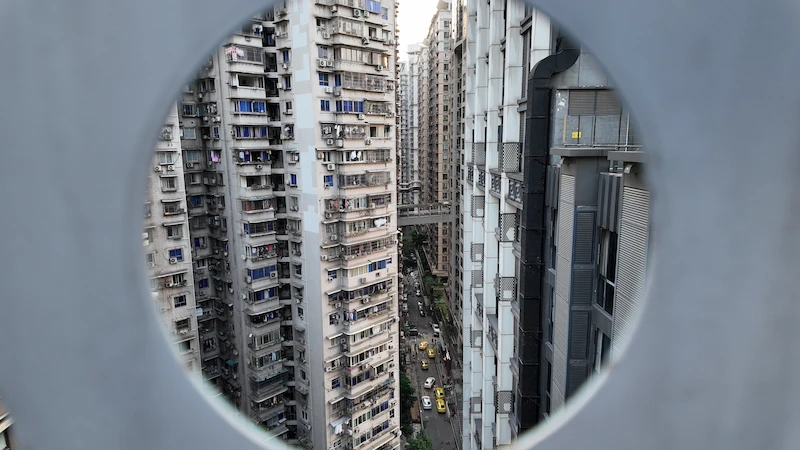
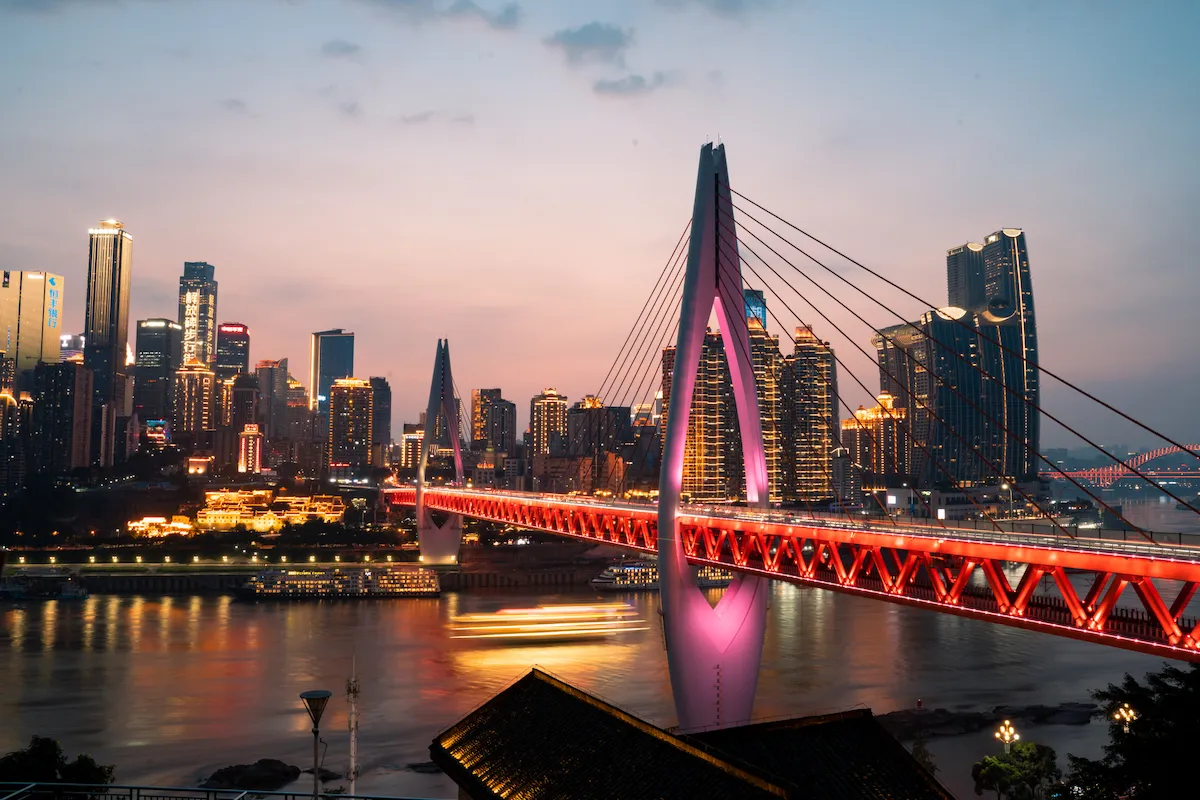
Chongqing is one of China’s four direct-administered municipalities: an immense territory covering 82,000 square kilometers — roughly the size of Austria — with a total population of over 32 million people. Its beating heart rises on a rocky promontory, caught in the spectacular confluence of the majestic Yangtze River and the Jialing River. It is precisely this winding topography that has earned Chongqing its reputation as an “8D city” — eight-dimensional city — a label that, despite a certain exaggeration fueled by clever marketing and social media, still reflects the peculiar character of this one-of-a-kind megacity.
In the past, because it was protected by mountains and located far from the coast, Chongqing was chosen as the seat of the Chinese Nationalist government after the fall of Nanjing, during the Second Sino-Japanese War. In response, the Japanese subjected Chongqing to massive bombing campaigns that lasted from 1938 to 1943, putting the city and its people through an extremely harsh ordeal.
The bunkers and tunnels in the mountains
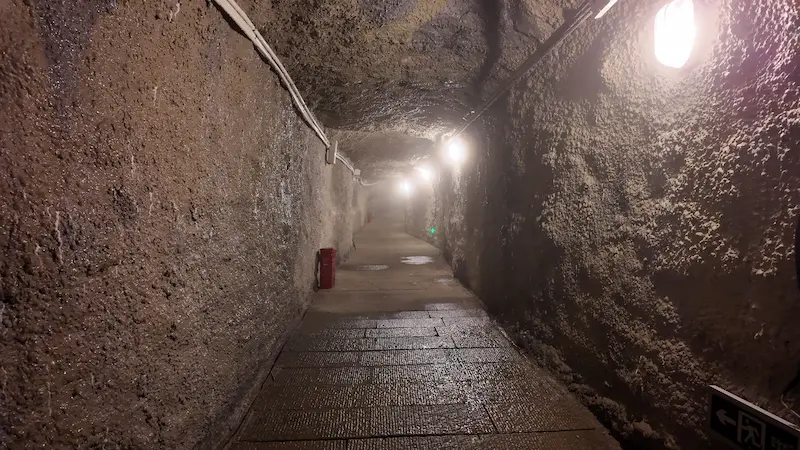
As a testimony to this painful chapter of history, Chongqing still preserves between one thousand and one thousand six hundred tunnels and bunkers, dug directly into the mountains and often interconnected, which were used by the local population to survive the bombings.
During our last visit to Chongqing, we visited the historic bunker hidden in the central district of Yuzhong, not far from Shibati. For only 15 RMB — about 2 EUR — you can have a truly special experience: as soon as you enter the bunker, the temperature drops and you find yourself wrapped in a thick humidity. The walls are literally dripping, as if they were sweating, and the yellow light of the lamps is blurred by the mist and vapors created by the moisture. In a second, it becomes easy to imagine the past coming powerfully back to life in the gray heart of the mountain.
But not all bunkers have been preserved untouched with a purely museum-like purpose. In fact, one of the things we like most about Chongqing — and one that reflects the city’s adaptive spirit — is that many of these bunkers have now been reintegrated into everyday life, transformed into teahouses, hot pot restaurants and even lively markets.
And if you are passionate about history, we also recommend adding to your visit to Chongqing’s bunkers one of the city’s most symbolic monuments: Jiefangbei, the Liberation Monument, located at the center of the pedestrian square of the same name. This tower, originally built in wood in 1941 and later rebuilt in stone, celebrates China’s victory in the Second World War and liberation from colonial oppression. When you stand in front of it, surrounded by skyscrapers, take a moment to think that, until a few decades ago, this monument — now the lowest structure around — used to tower over all the surrounding buildings.
The Cave Market
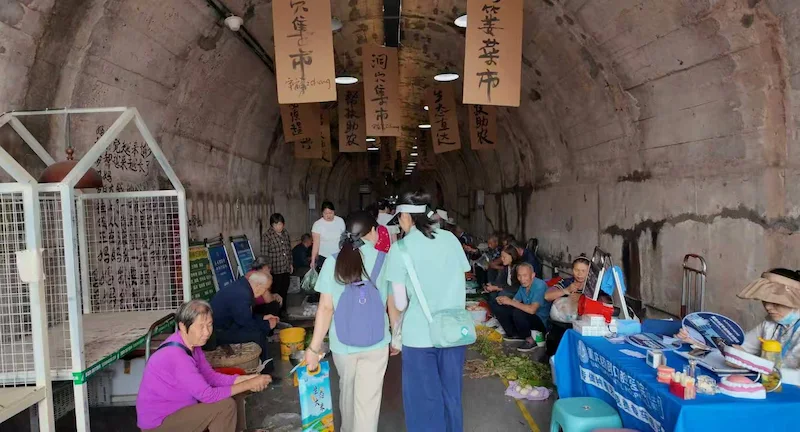
One place we highly recommend visiting is the “cave market”, accessible directly via Metro Line 4 at Hongtudi Station. It is located inside a very deep bunker, where you can observe the lively dynamics of local life, with people buying and selling without pause. Make sure to arrive before 11:00, because around that time the market starts to be dismantled, and the farmers who form its beating heart begin to return to their homes — which may be very far from Chongqing. A practical note: the market is not held every day. At the time of writing this guide, it can be visited on calendar days ending in the numbers 0, 3 and 6.
Let us tell you a little about its story, because it is truly moving. Since many of the farmers who animate the market come from far away, are elderly and carry very heavy loads, the metro has even adapted its schedule by introducing especially early rides. In addition, the metro staff is constantly involved in supporting these tireless workers, who have become a true symbol of the city of Chongqing. Sometimes, the market organizers even offer them hot pot to help them recover from their efforts.
In honor of the traditional baskets that farmers carry on their shoulders to transport their products, this market is also known locally as the “basket market” — Beilou Zhuanxian. When visiting, you will notice, right opposite the entrance to the bunker, a tower made of hundreds of woven bamboo baskets, standing like a spontaneous and proud monument to rural culture and to the work of this community.
Continue exploring Chongqing with Ink Voyages in the next part, where we leave the bunkers behind and enter the city’s local soul, through mountain neighborhoods, hot pot and traditional teahouses. Read Part 2: local life, hot pot and teahouses in Chongqing.


Leave a Reply